 Bilatzailea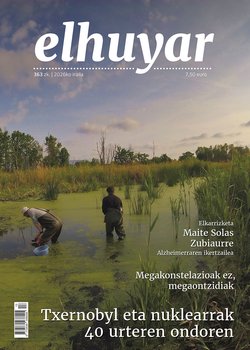


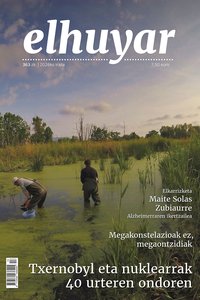
Chernobyl and nuclear, after 40 years
april 26, 2026 marks the 40th anniversary of the largest nuclear accident in history at the Chernobyl plant. To protect them from radioactivity, an exclusion zone was created around them. Over time, this area has become a symbol of the revitalization of nature. In the meantime, the approach to nuclear energy in Europe has also been changing.
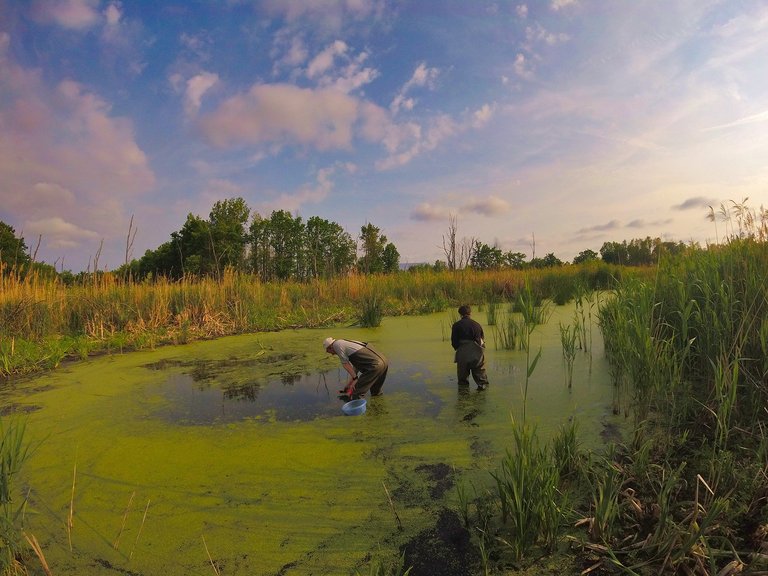
Forty and a half years ago, a series of failures caused the core of the fourth reactor at the Chernobyl nuclear power plant to overheat and explode. The explosion released a large amount of radioactive material and the toxic cloud spread over 162,000 km2.
Following the accident, the government of the Union of Soviet Socialist Republics removed 130,000 people from their homes, established a 30-km radius exclusion zone around the plant, and ordered clean-up operations. These lands are still in the exclusion zone, but before the beginning of the Ukrainian war, the city of Chernobyl, 14 kilometers from the central, was inhabited by 2,000 people, living a fairly ordinary life. In fact, in many places, 90-95% of the radiation has disappeared.
This is confirmed by the zoologist of the University of Oviedo, Germán Orizaola Pereda. It was the first time he went to investigate in this area 10 years ago and since then he has been on several occasions to observe its evolution. But since the beginning of the war, the investigations have been interrupted and the news continues with bitterness.
Orizaola is well aware of the possibility of going to the Chernobyl area to investigate: “It was by chance; while working at the University of Uppsala, I met him at a congress thanks to a researcher. His research team was studying radiation, and I was studying amphibians. I joined a European project and then I continued with my projects.”
He confesses that he did not fear: “It’s a unique place, very interesting from a scientific point of view, and I also knew there was no danger. You can't stay and live there, but for as long as you're working and taking some reasonable precautions, you know nothing's going to happen to you. Some documentaries and tourist agencies sell as if it were dangerous and the matxes who want to show how brave they are also looking for it. But it’s actually more interested in nature tourism than that, because it has an incredible natural value.”
“When you look at it, you realize how powerful nature is.”
However, Orizaola went there attracted by the scientific aspect: “As soon as you see it you realize how much nature has the power to recover.” In fact, he believes that this area offers many lessons and highlights two: “One is technical: how radioactive compounds evolve and how to manage a nuclear accident. And the other is what interests me: what if you give up an area of 4,500 km2?”
This area is greater than that of Bizkaia and Gipuzkoa together. According to the researcher, if Bizkaia is left uninhabited, with time, forests would be created and an enormous natural wealth would be created. “This is Chernobyl’s greatest lesson. We say that we want to conserve nature, we also organize mountain races, we promote tourism In this way, we will have an attractive place for some activities. But that's not nature conservation. If we want to do it right, we’ll have to do it differently.”
The researcher is interested, for example, in the way forests grow: “On the edges of the forests, you see young trees, a few meters high, taking up the surrounding land. Here, on the other hand, the forests are delimited, we put infrastructures or other limitations on them.” He recognizes that there has been a decrease in some birds, such as swallows that lived in the fields, but that these easily migrate to other places. Overall, diversity has increased.
Amphibians, good indicators
Amphibians, a specialty of Orizaola, are an ideal animal to study the recovery of ecosystems, since they are good indicators of environmental quality. “On the one hand, they live on land and in water. They enter the hibernate subsoil and also circulate at the bottom of the wells. Therefore, if there were radiation in these places, they would be affected. On the other hand, they don’t move much. This allows us to compare amphibians in places with different levels of radiation.” For control purposes, amphibians from other parts of Ukraine are used.
Orizaola recalls that upon arrival he saw that the situation had nothing to do with what he expected: “It was to be expected that the damage from the contamination would be evident. But I got to the well next to the reactor and saw that it was full of amphibians! And the wild boars and the moose went from one side to the other.” At first glance, they didn't seem to have much damage.
Subsequent studies have confirmed that those in the exclusion zone are the same as those outside the exclusion zone: physiological, immune, cellular The only difference is that the radiant frogs have a darker color.
Specifically, between 2017 and 2019, 189 Oriental Tree Frogs (Hyla orientalis) were studied at 12 points with different levels of radiation. In addition to the colour of the skin, the radiation dose received by each frog and the oxidative stress were measured.
Almost all frogs outside the exclusion zone had the typical color of this species, that is, bright green. The interiors, on the other hand, were noticeably darker, some even black. The darkest frogs also belonged to the areas that received the most radiation at the time of the accident. However, no relationship was found between the level of radiation they received at that time and their color.
This is how Orizola explained it: “We know that melanin protects us from ultraviolet radiation from the Sun, but laboratory studies with fungi and other organisms have shown that it also protects us from other types of radiation. Well, we've seen that in Chernobyl's frogs, too. At the time of the accident, frogs with more melanin were more successful and passed on their genes to future generations. It’s a beautiful example of evolution and a very rapid evolution.”
In addition to amphibians, bacteria have also been studied. They evolve much faster, and in them they have seen significant differences from the places with the highest radiation to those outside. The communities that make up the former are similar to those of uranium mines and naturally high radiation sites.
Large mammals also proliferate
Orizaola has also mentioned wild boars and elk, and in 2015, just before he went to Chernobyl for the first time, a study by the University of Portsmouth was published that confirmed the proliferation of large mammals in the area contaminated by radioactivity. What’s more, some of the species were more abundant 30 years later than before the disaster.
In particular, large mammals living in the contaminated area of Belarus were studied. Two methods were used to calculate the number of animals: direct helicopter counts during the winter from 1987 to 1996, and measurements from 2008 to 2010 on the footprints left by animals in the snow. The figures were then compared with results obtained with similar methods in other uncontaminated areas of Belarus.
“The color change of frogs is a beautiful example of evolution and also of very rapid evolution.”
In this way, it was found that in the contaminated area the populations of algae, common deer and wild boars increased significantly since 1987. For example, the number of deer trees was ten times higher than in 1996 and the density of wolves was seven times higher than in 1996.
In addition, as Orizaola has shown in amphibians, it was found that the density of the animals was not related to the level of radioactivity of the soil. Thus, researchers at the University of Portsmouth concluded that human activities
that agriculture, hunting, forestry... caused more damage to large mammals than chronic radioactivity.
Conditioned by the war
Orizaola was now planning to investigate other large mammals: Przewalski horse. He explains that before the COVID-19 pandemic they had everything ready and that permits were to be requested just when the war began.
“For us it was a very special project, not only because it is an emblematic species – considered by many as the only undomesticated horse species – but also because it is the best example to study the evolution of a species that did not exist before the accident. Because neither at the time of the accident nor before, there was this horse in those areas. In addition, we know how many individuals were included: 31. At first they died a lot, because they didn’t have the protocols we have now, but anyway, now there are about 200.”
"The European Commission has decided to boost nuclear energy."
they were introduced in the late 1990s and have been spreading throughout the area, increasingly further north and further east. “They’re big vertebrates like us, so they’re good indicators of what happens to big vertebrates coming in from the outside. They also feed on the ground.”
So they were going to look at their health. “But then the invasion began. It's amazing to watch tanks pass through the places you know on TV. And even more heartbreaking to learn about the experiences of those who have been our colleagues,” he admits.
There is also a concern that the plant will be attacked or that the roof will be damaged. Orizola warns that otherwise there will be consequences: “Before, we didn’t have any special barriers to go to research sites across the border. Now these areas are mined and riddled with military personnel. Large animals will be affected by pains, but above all they will suffer the consequences of the human presence. What used to be a vast area without humans is being divided into two areas and will not return to its previous state.”
In an article recently published by Science, the ecological impact of war has been reported. Through cameras, they have been able to observe the attacked area and confirm that the animals have changed their behavior patterns. However, Orizaola hopes to return to investigate.
On the other hand, he asked for his opinion on nuclear energy, pointing out that they were much more concerned about fossil fuels than nuclear energy. He believes that the priority now is to stop using fossil fuels to reduce carbon emissions and that, together with renewables, nuclear can help to do so.
New nuclear power plants in Europe
To some extent, this approach is in line with that of the European Commission. After the catastrophes of Chernobyl and, above all, of the Fukushima power plant, the European position in favour of nuclear energy lost momentum. Now, however, the European Commission has decided to give a boost to nuclear energy in response to the consequences of dependence on oil.
Already in 2022 it took a significant step by including nuclear energy in the list of green energy sources. France, Sweden, Slovakia, Hungary, Bulgaria and Poland applauded. On the contrary, Italy, Germany, Spain, Belgium and Austria approved other sources such as solar and wind energy.
In fact, most of the electrical energy installed in Europe in recent years has been of these two types, especially solar energy. However, electrification has not yet been sufficiently developed to significantly reduce the need for oil. Therefore, in March 2026, the European Commission announced that it would allocate 330 million euros to the development of nuclear energy. Part will be for nuclear fusion research, but the rest will be for the promotion of nuclear power plants.
Today, France is by far the largest producer of nuclear energy in Europe: between 65 and 70% of the electricity produced in this country comes from nuclear reactors. in 2022, Emmanuel Macron announced his intention to build at least 6 reactors in the next decade. Work should start next year, 2027.
However, not everything is in their favor. Paradoxically, climate change itself has made it difficult for power plants, which need a lot of water to cool their systems and, in recent summers, warming and drought are converging. In these cases, some power plants have had to stop the reactors.
In addition, other phenomena have occurred that are more difficult to predict: in the summer of 2025, jellyfish proliferated in the North Sea, where the Gravelines nuclear power plant receives water to cool the reactors. Well, the jellyfish clogged the pipes, and they had to stop the station. Another example of the surprises of wildlife.
Buletina
Bidali zure helbide elektronikoa eta jaso asteroko buletina zure sarrera-ontzian