 Bilatzailea


Photo of the week: The narwhale’s fangs are made up of two helical structures
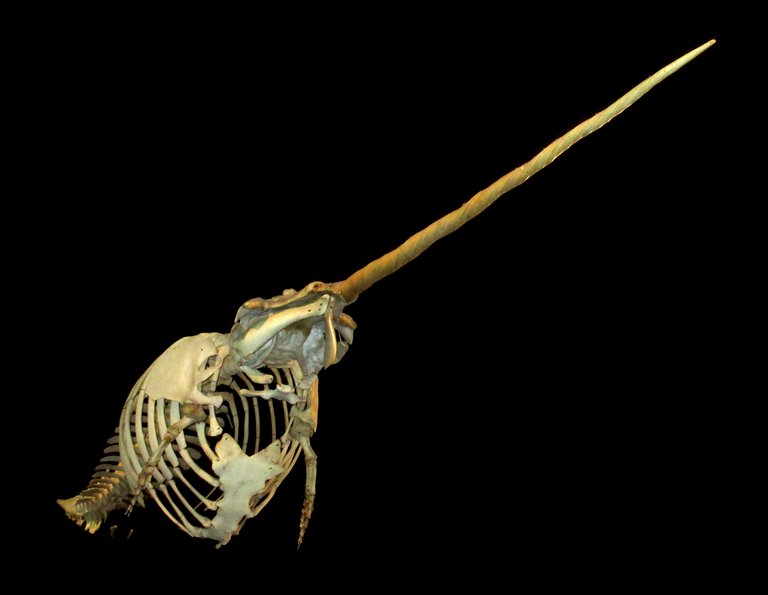
The canine of the narwhale (Monodon monoceros) is a curiosity of nature: it has a helical shape that turns to the left, can reach two meters in length, grows straight, not curved, and unlike other animals, in most of them only one stands out (the one on the left). Therefore, the narwhal is also called the unicorn of the sea. Now, in an international study led by the University of Aarhus (Denmark), the structure of the fangs has been clarified, finding, among other things, that it is made up of two helical structures that twist in the opposite direction.
Three large synchrotrons have been used to study the structure. Thanks to them, the 3D structure of the fangs has been clarified on atomic, nanometric and micrometric scales. The narwhale’s canine lacks enamel, has cement on the outside and dentin on the inside. Well, as you have seen, both grow spirally, but the cement twists to the left and the dentin in the opposite direction. The fact that the two helical structures rotate in opposite directions explains why the canine grows straight, without bending, and why it is so resistant.
The details were published in open Nature Communication. In addition, it has been suggested that research may be useful for the design of new materials. Of course, even if the structure of the canine is clarified, scientists still do not know its function. Because Narbal is more common in males than females, it is often thought to be a sexual element, but at the moment there is not enough evidence to support it.
Buletina
Bidali zure helbide elektronikoa eta jaso asteroko buletina zure sarrera-ontzian
Bizitza





Aldizkaria
Kolaboratu
Zure lana argitaratzea nahi duzu?
Gai zientifiko bati buruzko artikulu bat baduzu, bidali eta sarean zein aldizkari inprimatuan argitaratu dezakegu.