 Bilatzailea

It's wonderful to be able to predict the eclipse
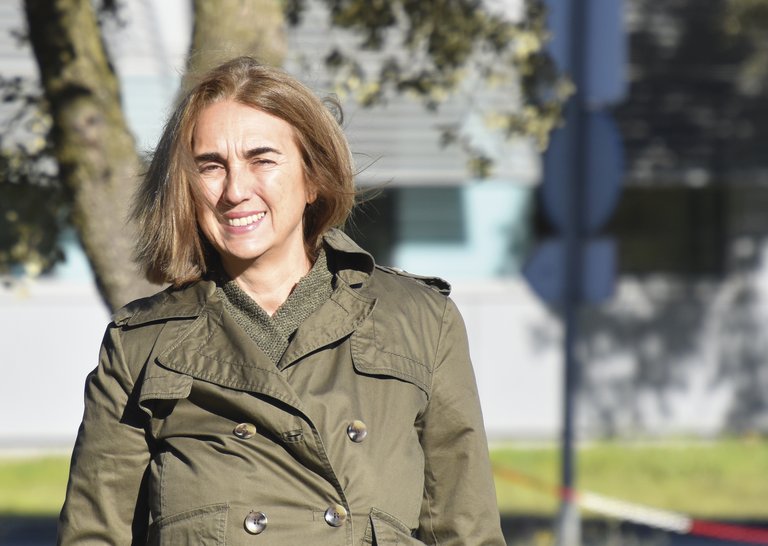
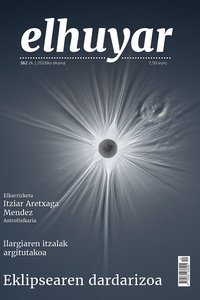
The eclipse of the Sun has been the excuse to interview the astrophysicist Itziar Aretxaga Mendez (Bilbao, 1965). But even if the eclipse is ignored, it has a lot to tell. In fact, he has been researching for several months at the Center for Astrobiology of the CSIC-INTA (Madrid), after almost three decades in Mexico. His research focuses on the giant births of stars that occur in distant galaxies, and he has focused on this, but he has not hidden the illusion that he sees the eclipse of our closest star.
Do you plan to observe a total eclipse of the Sun? Do you have a chosen location?
Yeah, I'm excited! In fact, I'm organizing my calendar so I can see the total solar eclipse. Right before that, I'll come back from one conference, and then I have to go to another. But in the meantime, that week, I'm gonna stay around here to see the eclipse.
Two years ago I saw for the first time a total eclipse of the Sun. I went through Mexico and went all the way to Texas to see the total eclipse. Previously, I had seen the partials and that was the first time I traveled to see the whole.
I think it's wonderful to be able to predict that this is going to happen. It is truly amazing to think that thousands of years ago they also had this wisdom, and how we can now accurately predict through physical models how the eclipse will occur, and plan when and where to travel to see it. For me this is really wonderful, an indicator of the progress of science.
The Sun is our closest star and the one we know best. But you investigate the most remote ones, the ones that are being born.
Yes, that is my research topic, the birth of galaxies: how stars are born inside galaxies and what conditions must exist for this to happen.
You’ve spent many years in Mexico. Can you tell us how you got there and what you've been doing?
Well, look, I've been in Mexico 27 years! I started studying Physics at the UPV, then I went to Madrid, first to the Complutense University, to finish my degree, and then to the Autonomous University, where I did my PhD. From Madrid to Cambridge, to the Royal Observatory of Greenwich, and from there to Germany, to the Max Planck Institute. And finally to Mexico, where I have lived for 27 years, almost until now.
What I'm investigating now is what I've always investigated in some way: the evolution of galaxies. In this evolution, many processes occur. One of them is the birth of stars, and my research has always been related to the birth of stars.
At first, when I did my thesis, I was mainly concerned with the stars that are born in the active nuclei of the nearby galaxies. Now, instead, I'm researching how giant stellar births occur in very distant galaxies.
During this time, some telescopes have disappeared and you currently have new ones. How do these changes affect research?
Yes, yes, we have new ones, and some of the old ones still walk. Now, above all, I observe these gigantic births in millimeter waves. But we put together all the information that exists, going from ultraviolet waves to radio waves. In fact, different processes are observed at each wavelength.
Some of these telescopes are very new, such as the large millimeter telescope in Mexico and the JWST [James Webb Space Telescope] in space. But there are telescopes that are not so new, such as the VLA [Very Large Array]. Located in Socorro, in the United States, it is a battery of radio telescopes, that is, it is not a single antenna, but a set of antennas with a certain configuration to be able to perform interferometry. Thanks to this, we get a very accurate picture.
So we don’t have to imagine you working with a single telescope, but with many.
That's it. We put several telescopes to work for a scientific purpose, and all this information is necessary.
At first I used other telescopes; some of them are no longer operational, they are retired. My first telescope was the Canarian JKT [Jacobus Kapteyn optical telescope]. With this I made my first observations. They weren't for my thesis, but for a colleague's thesis. We were both doing the doctorate, but he was ahead of me and I went with him to do the first observations to study.
I thought it was Christ's telescope. It was not the largest in the Canary Islands, it was only one meter long, and the William Herschel [optical and infrared] telescope, four meters long, was also in the Canary Islands. But at that time, JKT made a big impression on me. Now, when I go to 10m optical telescopes, I remember that. Everything is small now.
As with telescopes, as technology has changed, so has the way work is done.
Now we take data much more easily from one telescope and the other. Everything is connected on the Internet. They are huge data banks where we have a lot of information and we can connect immediately to access the data.
The world itself is much more connected. Every day, we spend several hours in teleconferences, working with colleagues. For example, I do teleconferences with the United States, Mexico, etc. It's different times, but that's how we do it. On the Internet it is easier to make progress, that is so.
So, yes, it has changed a lot. Now we're going to the telescopes less and less. They are more robotic and observations are made remotely.
The information collected by the telescopes is open, is all the data available to everyone?
Not at all. In large telescopes, usually, the team that has proposed the study has a year to exploit this data and see what can be extracted from it. But then they go to the databases and everyone can analyze that data. But that's how the big telescopes work.
Then there are other telescopes that are private, in which you have to be part of the mission or experiment in order to see this data.
Therefore, in general, there are two modalities: to have information for a year and then go to the databases, or the modality of experiments, in which the data are not public, but of the person who performs the experiment. And if you want the data there, you have to make a collaboration to be part of it, you have to put money to carry out that telescope experiment.
For example, in the higher energies, the gamma rays, they work like this. It's not the telescopes we imagine, which are pointing in one direction. They're panoramic telescopes, they see the whole sky at once. It is another way of analyzing space.
How do you act?
My approach to astrophysics is based on observations. For me, the ability to use telescopes is very important. There are some telescopes in Mexico that can be used for this type of observation, such as the Large Millimeter Telescope [GMT], which is the largest. Additionally, Mexico has a portion of the Gran Telescopio de Canarias [GTC, optical and near infrared]. I used it for my research as well.
And then there's another gamma-ray telescope, called HAWC. But it is used as an experiment and you have to be part of the collaboration to use this data. I've had colleagues working there, which is also very interesting. However, we specialize, we can not do everything at once.
I have these telescopes to work with. Now, I’ve been here [in Madrid] since 2025, and while I continue with them, I also have the potential to use others.
How did you take the step?
The Ministry of Science, Innovation and Universities of Spain has a program, ATRAE, to attract foreign scientists who already have a trajectory. I think they made their third call this year. Mine was the second. I asked to come to the CSIC, and I came in September.
I'm doing the follow-up work. There I was working with the Great Millimeter Telescope and now, taking advantage of the work there to make censuses of galaxies over long distances, I am studying how giant stellar births influence the formation of galaxies.
Even if it’s follow-up, it changes who you’re working for and with whom. Here I am forming my own team, and I have, for example, a PhD student who has already become an expert, and I will also have another postdoctoral student.
You can see that you like working with students; in Mexico you have also done a lot of work with young people.
After all, they are collaborators. At first you have to drive a lot, because they don’t have the route you have to know where things can go. But they take any research with a lot of enthusiasm and I love working with young people. They take something from you, but you also take it from them. Above all, illusion and seeing things differently. Working with the new generations is wonderful.
And from the scientific point of view, what has been the discovery that has given you the greatest illusion?
Always the last. The research I have done has always been my greatest illusion. Some things come out easier than others, but nothing is easy. You always have to work to get results, you always suffer a little. And you always take the final result you have achieved with the new illusion.
To arrive at these results, we have mentioned the evolution of telescopes, but it would also have changed the way the data were analyzed. You guys have been using artificial intelligence for a long time, haven't you?
Yes, for a long time. When I started with the thesis, the first neural networks were being used in astrophysics. Of course, there is a big difference between those first neural networks and the one that exists now. However, you need to know how to use it. Otherwise, if you leave the accounts in the hands of AI without knowing too much, a lot of nonsense can happen.
An expert should check that he has correctly interpreted the question asked and that the result is correct. In fact, he still does a lot of things wrong. It is another tool that I would say we all use to exploit data or, if not, to search for information. Also as a complement to complement what we are finding and to make graphics. I also use it a lot for programming. So, yes, we used it for a long time and in recent years there have been many advances and we use it for more things.
One last question about your other passion: photography. Are you going to take pictures of the solar eclipse?
No, no. No. I do underwater photography and now, from Madrid, I will have to travel a few kilometers to go to the sea. But I also traveled the kilometers in Mexico, the difference is that it is warmer there.
To photograph the sun you need special filters and mine is a completely normal camera. Because I'm an amateur photographer, and I want it to be that way. If I had a sense of need, I wouldn't enjoy it. And I take pictures to enjoy, with my ordinary camera, without any pressure or intention; for pleasure.
Buletina
Bidali zure helbide elektronikoa eta jaso asteroko buletina zure sarrera-ontzian