 Bilatzailea


From tradition to innovation: The revolution of the Remonte basket
A fronton and a laboratory don’t have much connection at first glance. However, one of the great leaps in the future of remonte can come from the collaboration between the two. Researchers from the Public University of Navarra have a clear objective: to make the ski lifts more resistant, accessible and durable through new technologies and materials engineering. Proposing changes in a sport with a long tradition is never easy, but innovation can open new horizons for this modality.
The ski lift occupies a special place among the modalities of the Basque ball, both for its technical characteristics and for its heritage value. Although in the game mechanics it has similarities with the ball of the hand (in which the ball is hit directly with the hand), in the remontage a basket or basket is used that influences the physical behavior of the ball.
In the lift mode, in which the glove box is inherited, a curved basket is used, and the ball enters the hand of the pelotari basket, slides uninterruptedly through the interior of the basket and, after increasing the speed, is thrown from the tip. This process involves a series of physical principles associated with energy transfer, progressive acceleration and launch channel geometry. For this reason, the chistera design is a key element for both sports performance and game safety.
Currently, the practice of remonte is limited, especially in Navarre and Guipúzcoa, experiencing an unstable situation. The problems of availability of material are one of the main barriers to attracting new players. Unlike other modalities, access to a ski lift is neither immediate nor cheap, which hinders both leisure practice and basic training.
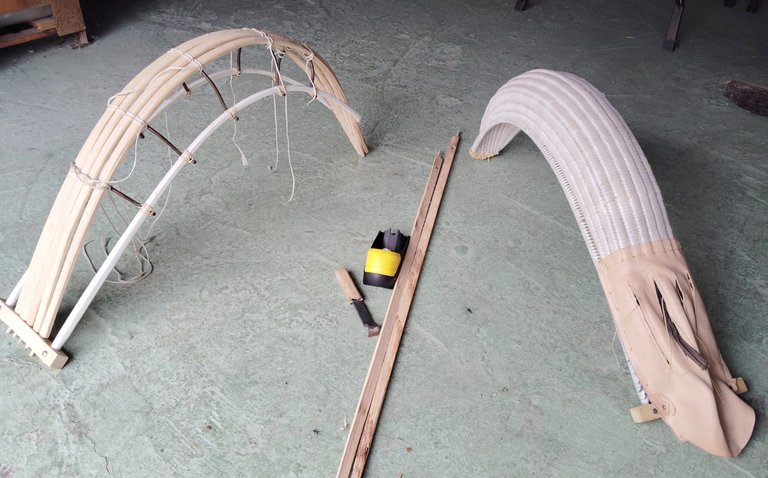
The Remonte Chisteras are manufactured through an artisanal process that has remained practically unchanged in the last century. The main structure is made of wood in rats; it is a fibrous and porous material, similar to bamboo, with a high capacity of molding under the influence of humidity, heat and suitable mechanical processes. This wood replaced the chestnut wood due to its greater tensile strength and flexibility.
This structure is reinforced by packing. Historically it was made of wicker or lime, but today it is replaced by polymers such as polypropylene. The outer ring of the chistera, traditionally made of chestnut wood, was replaced by a synthetic material: fiberglass. This component is manufactured using a mold in which the fibers are arranged in the longitudinal direction, and then the polymer matrix is poured until the composite material is formed. In this way, the tensile and impact strength with respect to the ring is significantly increased. Finally, a leather glove is added to the chistera; a wax coated thread is used to form a hand sewn joint, thus forming a highly specialized tool.
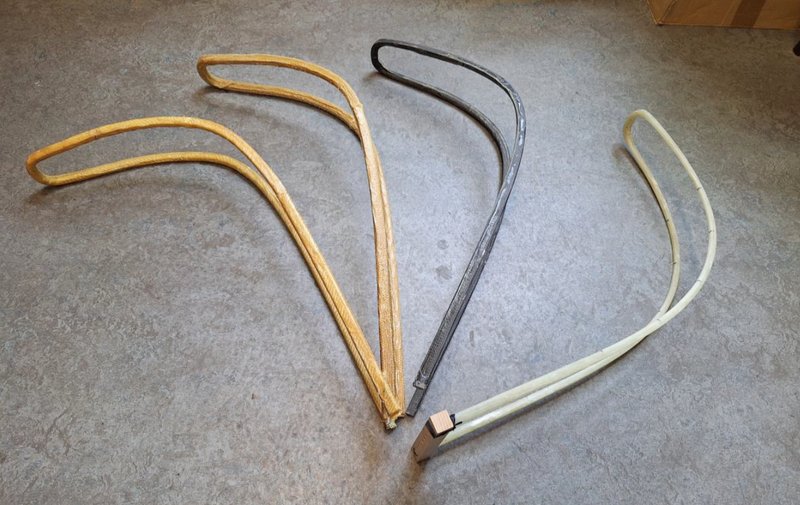
Rings of remonte baskets made of synthetic fibers. ED: Xabier Sandua Fernández
Although the artisanal value of Xistera cannot be questioned, its technical limitations are evident. The manufacturing process requires a high investment of time and specialized knowledge of the artisan, which makes the product more expensive and limits its availability. In addition, from a mechanical point of view, wood shows a great vulnerability to unwanted impacts. An improper hit of the ball can break the structure in a few milliseconds, which would invalidate the joke that has taken weeks of work.
This context highlights the need to look for alternatives that maintain the essence of the ski lift but do not give up technological advances. Materials engineering today offers solutions capable of overcoming the limitations of traditional materials by developing lighter, stronger and more durable structures. Advanced composites and polymers optimize the mechanical behavior of the chistera against dynamic loads in the game, reducing the risk of breakage and extending its useful life. This is precisely the challenge that the UPNA has turned into a research project.
In this research, innovation should not be limited to the selection of the material. Modern manufacturing methods, such as additive manufacturing (3D printing), offer new possibilities in the design of the ski lift basket. These techniques allow to significantly reduce production times, reduce costs and reproduce complex geometries with high precision. In addition, they allow the structure to be adapted to the functional needs of the basket, which is difficult to achieve with purely artisanal processes.
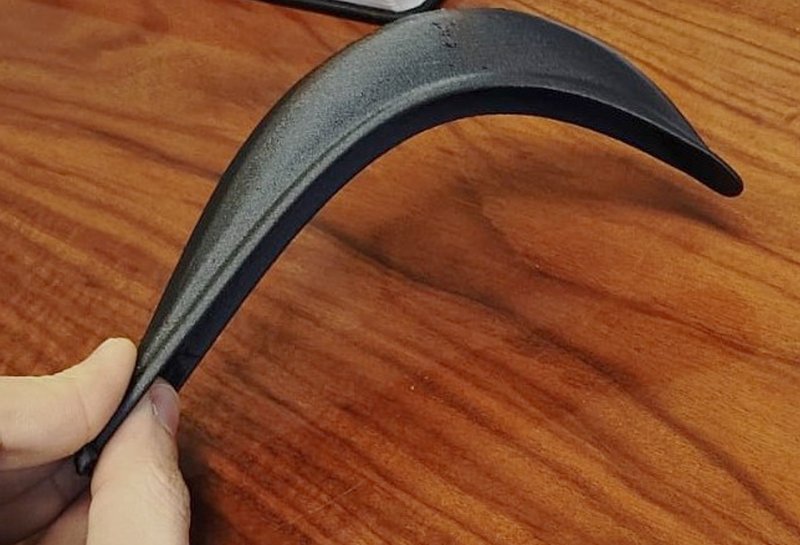
Climbed basket of remontage obtained by additive manufacturing. ED: Xabier Sandua Fernández
However, the development of a new xistera requires a rigorous methodology. As in any research process, the first step is to carry out a technical background analysis, collecting information from artisans, professional pelotaris and sources of documentation. This empirical knowledge is essential to understand the real demands of the game and avoid solutions far from sports practice.
Since the geometry of the shale chistera is not standardized and is based on traditional molds, it is necessary to perform a three-dimensional scanner of existing models for their subsequent digitization in a design software. From this geometry, computational simulations can be carried out to evaluate the behavior of different materials against the usual situations in the game: repeated impacts, folds and dynamic loads, among others. Once the most suitable materials and configurations have been identified, their compatibility with the selected manufacturing process will be analyzed and then the first functional prototype will be developed.
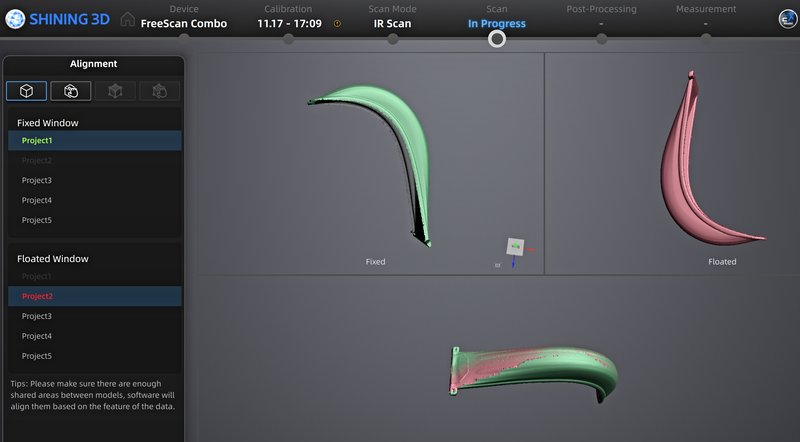
3D scanning of the ski lift basket. ED: Xabier Sandua Fernández
In this research, one of the most complex objectives is not technical, but social and cultural. The remonte has been played with a tool that has remained practically unchanged for more than a hundred years, which gives a great value of identity to the chistera. Therefore, any change must be approached with caution. The proposed strategy does not seek an aesthetic break, but proposes a structural evolution, maintaining the traditional outer packaging but improving the resistant core of the instrument.
The recognition of professional pelotaris is also a key issue. Therefore, based on experiences in similar modalities such as the basket point, it is proposed to use the first prototypes in the initial categories. This would facilitate a progressive and natural transition to new technologies. This approach will make it possible to evaluate the behaviour of the basket in real conditions and to familiarize the new generations with the new tools.
The future of remonte depends largely on its ability to adapt to current technologies. The combination of tradition and technology offers a unique opportunity to revitalize the modality, reduce barriers to availability and attract new practitioners. Having more accessible, resistant and durable baskets can have a decisive influence on the expansion of the ski lift, which would guarantee the continuity of this sport that is part of the cultural heritage of the Basque ball. In this way, once again, we would achieve the necessary and indispensable symbiosis between culture, tradition and science.
Buletina
Bidali zure helbide elektronikoa eta jaso asteroko buletina zure sarrera-ontzian