
 Bilatzailea


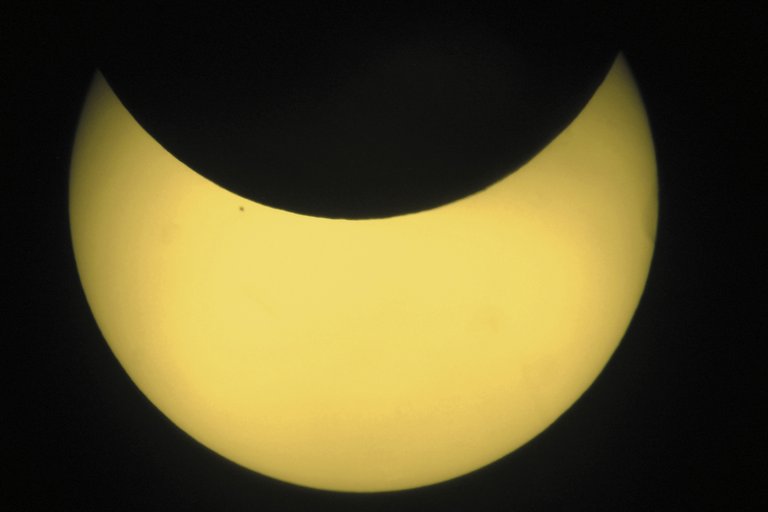
Illuminated by the shadow of the moon
It is legitimate to ask why. The case of an eclipse is no exception: what can we use a solar eclipse for? For man it is not a mere natural spectacle, the eclipse has its own characteristics and if it can be used, it will use them.
When did the Trojan War happen? When did those who built Stonehenge disappear? When was the first Emperor of China born? From our current point of view, ancient history lacks a reliable calendar. The exact date of the oldest events is unknown; c. Dating events up to the 6th century is very difficult, and most subsequent events are too. However, there is an exception, the conflict of the eclipse. That's what it's called.
In the conflict of the eclipse, the Medes are the protagonists. In the pre-Persian period, they controlled the southern coast of the Caspian Sea and opened war on the territory, taking current references from northern Iran to central Turkey. There they found the Lydians and began to fight. And one day, suddenly, the fight was interrupted. Yeah, but when was it? Well, exactly, a. 585 May 28 of the year. Just that day.
What is the purpose of an eclipse? Well, in that case, to use it as a calendar. According to the chronicle of the Greek historian Herodotus, during a battle between the Medes and the Lydians, the night took place. And the warriors took it as a sign of the end of the war. The border between the two lands was established on the Halys River and the six-year war ended. For the first time, an eclipse became a calendar. In addition, curiously, the eclipse was predicted by Thales de Mileto, but these two peoples were not aware of this prediction.
The leap to fiction
The idea that an unexpected eclipse is a sign of the gods is interesting for writing a script. It has often been used. Mark Twain’s book Yankee in King Arthur’s Court. And, for example, Hergé also used this idea in his comic book Tintin and the Temple of the Sun.
However, there have been attempts in history to predict eclipses. It is believed that this was the purpose of the Antizine mechanism. The mechanism for the Antiquity was found in a sunken Greek ship. The case is striking because it is a mechanical machine with many gears, sometimes called an analog computer, and the technology of making precise gears was supposedly not available at that time of the ship. For this reason, some experts propose that the machine is later, but that it fell into the sea and sank, coincidentally, where the submerged boat was.
In the latest film by Indiana Jones (Indiana Jones and the Dial of Destiny, 2023), the Antizine mechanism plays an important role. However, in this film it is a kind of time machine, while historians concluded that it was actually a machine for predicting the positions of the stars, such as eclipses.
The real device is on display at the National Archaeological Museum of Athens. in 2006, the journal Nature published an analysis of it and the result of a study on its functioning. And there's the key. It is often mentioned what it is and it is surprising to have such a device at that time, but it is rarely explained that it did not work properly on its own. The problem is that, through gears, it is based on the circular orbits of the stars, which are not circular. They're elliptical.
Eclipses to do science
Another possible answer to this question is what an eclipse is for: the answer of science. Eclipses are scarce, so they do not seem to be very useful.
The Moon orbits the Earth once a month, but eclipses do not occur once a month. The reason for this is that the Moon's orbit is complex. On the one hand, it has an elliptical orbit (sometimes closer than others) and makes a precession movement (the orientation of the ellipse changes constantly); and on the other hand, and above all, it must be taken into account that the orbit of the Moon and the orbit of the Earth are not in the same plane, so that, in most cases, the Moon makes its way above or below the Sun, as seen from Earth.
Sometimes there are eclipses. If we have a correct prediction of them, we can also get scientific benefit.
The movements of the stars serve to mark time, that is, they can be used in the form of watches; and they are also precise watches. Galileo proposed the use of eclipses from Jupiter's satellites in navigation, as they could not carry a specific clock on board ships. Having a specific clock, for example, meant that the length of the ship's position could be calculated accurately.
Well, Galileo thought that an eclipse of a Jupiter satellite is not seen at the same time in two places of different lengths. It wasn't a good idea. On the one hand, because Galileo was wrong, and on the other, because observing Jupiter is impractical and often not possible. In any case, the concept of using eclipses as clocks was interesting.
in 1676, astronomer Ole Romer was measuring the motion of Jupiter's satellites. In reality they were moons, moving around the planet; there would be no great mystery. It was just taking data. However, the times between the eclipses of Io varied throughout the year. The closer Earth and Jupiter were, the shorter the time interval from one eclipse to another and vice versa. But the speed of Io did not change. The period was always 42.5 hours. So the only conclusion was that light has speed, it’s not simultaneous, and when the Earth was far away, it took longer to get through Jupiter.
Romer received the data for years. Thanks to them, he calculated the speed of light. It was not a perfect calculation, but on the one hand, the fact that it was done has a great value, and on the other hand, the approximation is not very bad. It was the 17th century and its result is 212,000 kilometers per second (the real value is about 300,000 kilometers). Eclipses served to confirm a revolutionary concept that the speed of light was not infinite. He also calculated it.
A revolutionary theory
In addition to Jupiter’s, science has taken advantage of the eclipses of the Sun to advance. In this sense, one of the most famous eclipses in history was on May 29, 1919. Einstein had proposed a crazy theory, the Theory of General Relativity. He was crazy, among other things, because he made a crazy proposal that a very large mass deflects the path of light. And during the eclipse of 1919 this proved to be correct. The large mass is the Sun itself, while the diverted light is that of the stars behind the Sun.
You can’t see the stars during the day. The large mass of the Sun tilts its rays of light, but during the day this effect cannot be seen. Not even at night, because the Sun is not there. Therefore, a total eclipse of the Sun is the only possibility to observe it; it is like turning off the light of the Sun, but without taking the Sun away from it. And that's why physicists started looking for an eclipse. They tried several times and finally managed to photograph the effect with an eclipse of 1919.
These were difficult times; just after the end of World War I, there was tension between the British and the Germans, and the idea of relativity came from Germany. However, the British Frank Watson Dyson and Arthur Stanley Eddington were able to send two expeditions to photograph the eclipse. The eclipse lasted a long time, which allowed the shadow of the Moon to go a long way. One British expedition went to Sobral, Brazil, and the other to the island of Principe, Africa. The weather was scarce and the equipment was poor. But thanks to photographs taken in two places, it was shown that Einstein was right: The sun deflects the light of the stars. As a result, an eclipse was used to confirm for the first time in practice a theoretical prediction of general relativity.
Artificial eclipse
For modern science, eclipses are not particularly useful. The conditions created by an eclipse are rarely essential for an investigation. It should be noted that the eclipses are scarce. To give you an idea, in the 20th century there were 228 solar eclipses, of which only 71 were complete eclipses. Therefore, a researcher who needs them will have to wait a long time to take advantage of a correct solar eclipse. Also, where an eclipse is seen and for how long, this can greatly condition the investigation.
In any case, in some cases artificial eclipses can be caused and exploited. The most spectacular example is the SOHO (Solar and Heliospheric Observatory). It is an observatory of the ESA agency in space, located in orbit around the point called L1. There are several stable points associated with the orbit of any planet, even in the case of the Earth; if a spacecraft is located at one of these points, the spacecraft will not fall anywhere. They are called Lagrange points and the SOHO observatory revolves around one of these points, in orbit around the so-called L1.
But even more interesting than the location is what trick it uses to investigate the Sun's corona. The idea is to cover the Sun itself to obstruct its light and thus be able to observe the crown. That is, it uses an artificial eclipse to see the crown. It is the same work that the Moon will do on August 12: It will cover the Sun and we will see with the naked eye the crown of the Sun. It is not surprising that this type of observation makes it possible for the instrument to be called a coronograph. The SOHO Observatory uses one of them for the continuous observation of the crown.
This has allowed SOHO to discover thousands of comets and, of course, provides data for a long record of the Sun’s activity. Eclipses are useful, so if you don't have an eclipse, create one.
Buletina
Bidali zure helbide elektronikoa eta jaso asteroko buletina zure sarrera-ontzian