
 Bilatzailea



The difference between the brains of humans and chimpanzees is partly due to the infection of a virus
Between 5 and 7 million years ago, a virus infected ancient chimpanzees, but not ancient humans. The genetic material of this virus was integrated into the chimpanzee genome, causing the inactivation of a gene that was present in both humans and chimpanzees at that time. In today’s humans, this gene regulates brain development, but not in chimpanzees.
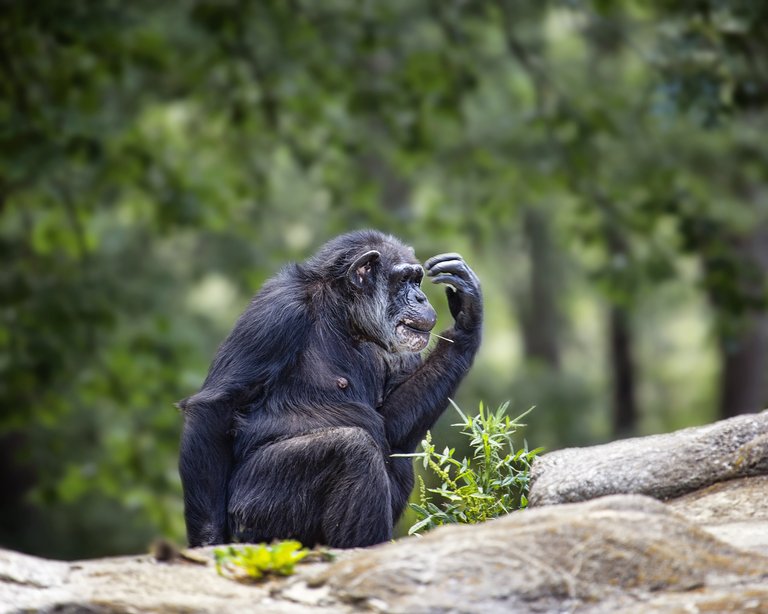
A study reveals one of the mechanisms that caused the brain difference between humans and chimpanzees. An ancient virus infected the ancestor of chimpanzees and transformed their DNA.
“In cultured human brain organoids, the LINC00662 gene was inactivated, which atrophied human neurons.”
The evolutionary line of chimpanzees and humans separated them between 5 and 7 million years ago, and only 1.2% of the DNA of these two species is different. Knowing this, the researchers wanted to clarify how the brains of humans and chimpanzees have become so different, that the genes that produce proteins are so similar in both species.
Humans and chimpanzees have a gene called LINC00662. In humans, this gene is expressed during brain development and produces a long non-coding RNA of the same name. This molecule is involved in the maturation of neurons. The researchers conclude that between 5 and 7 million years ago, chimpanzees were infected with a virus called PTERV1, whose genetic fingerprint prevented them from producing the molecule LINC00662.
To reach this conclusion, the researchers removed the genetic material of the PTERV1 virus from chimpanzee stem cells, which led to the formation of LINC00662. On the other hand, the LINC00662 gene was inactivated in cultured human brain organoids, which atrophied human neurons.
These results leave a number of unknowns to be resolved. On the one hand, it is unclear why human ancestors were never infected with PTERV1. On the other hand, not all the functions of LINC00662 in humans are yet known and the effect of its absence on chimpanzees remains to be elucidated.
Buletina
Bidali zure helbide elektronikoa eta jaso asteroko buletina zure sarrera-ontzian
Bizitza





Aldizkaria
Kolaboratu
Zure lana argitaratzea nahi duzu?
Gai zientifiko bati buruzko artikulu bat baduzu, bidali eta sarean zein aldizkari inprimatuan argitaratu dezakegu.