
 Bilatzailea


Eclipse tremor II: Animal agitation
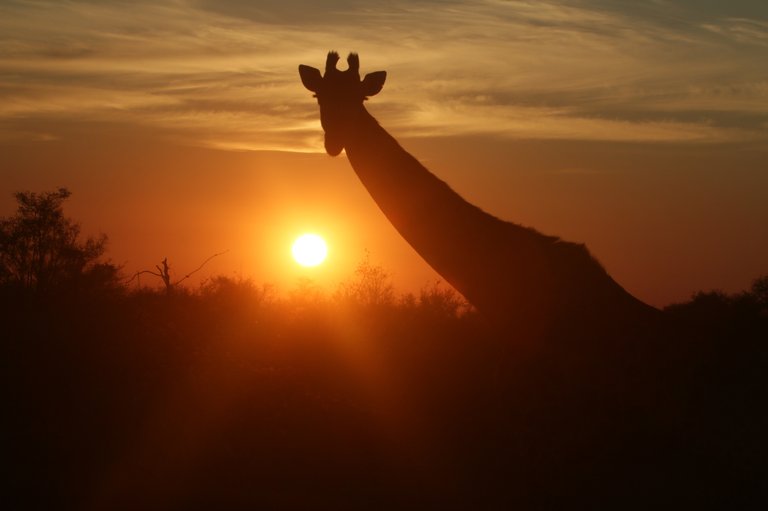
Those who experience an eclipse know it, and those who experience it for the first time will see it: people are not the only ones who notice it, it also affects other animals that suddenly turn the day into night and turn it back into light. Focusing on animals to document their behavior, citizen science projects have been organized for the August eclipse.
This curiosity for animals is not new. Maider Pérez de Villarreal Zufiaurre is a veterinarian, expert in ethology, who has studied the documents that collect the reactions of animals during eclipses. Find significant examples: “One of the first stories is that of the Italian Ristoro d’Arezzo. he described what had happened during the total eclipse of June 3, 1239: all animals and birds were terrified; and wild beasts were easily apprehensible.” on August 21, 1560, during an eclipse in Portugal, astronomer Christoph Clavius wrote: “As a whole, the stars appeared in the sky and an amazing spectacle occurred, as the birds fell from the sky to the ground because of such terrible darkness.”
“The crickets start singing, the birds return to the nest or become more active, the whales start jumping and the dairy cows enter the stable.”
Perez de Villarreal confirms that changes in both wild and domesticated animals have still been documented today. The crickets begin to sing, the birds return to the nest or become more active, the whales begin to jump, and the dairy cows enter the stable. Eclipse observer Tora Greve traveled on an expedition to Zambia in 2001 and, with the disappearance of the Sun, discovered that frogs began to sing and that birds of prey stopped flying. He was standing around a well and saw that the giraffes began to run in the fullness of the eclipse. When the sun appeared again, they calmed down and began to eat the leaves of the trees again.
Chronobiology and uncertainty
Behind these strange behaviors, as Pérez de Villarreal explains, there are two dimensions: chronobiological and related to environmental uncertainty. “From a behavioral biology perspective, these events can be understood as natural experiments that allow us to study how animals respond to rapid changes in the main environmental signals. In the case of mammals, although empirical research is still limited, the available studies allow the identification of relatively consistent response patterns that combine chronobiological and behavioral mechanisms.”
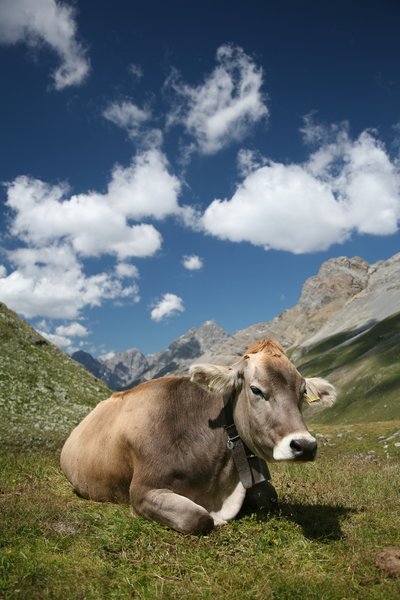
A cow among the mountains of Switzerland. Ed: Daniel Schwen/CC BY SA 3.0 via Wikimedia Commons
The ethologist recalls one of the most complete studies carried out during a solar eclipse. it was done in 2017 at Columbia’s Riverbanks Zoo during a total solar eclipse. 17 studied the behavior of vertebrate species, including mammals such as primates, elephants, bears and ungulates. “The results showed that approximately 75% of the studied species experienced changes in behavior during the integrity phase of the eclipse, which shows that the eclipse is a significant environmental stimulus,” he emphasizes.
“One of the most common responses observed in mammals is the activation of behaviors associated with sunset.”
In general, one of the most common responses observed in mammals is the activation of behaviors associated with sunset. As Pérez de Villarreal explains: “This phenomenon can be explained in the field of chronobiology, that is, in the study of biological rhythms regulated by environmental cycles. The sudden decrease in luminosity during an eclipse may suggest to the circadian system that night is coming. As a result, nocturnal behaviors such as slowing down activity, tendency to group or preparation for rest are activated. This pattern has been documented in domesticated mammals (cattle and sheep) as well as in wild species. And also in captivity, for example, in bears.”
Both wild and domesticated
However, it warns that this response is not uniform in all mammals. “In species of greater social and cognitive complexity (such as primates and elephants), behaviors that are not explained by mere obscuration have also been observed. In these cases, individuals show signs of nervousness, increased social activity, or changes in group organization. For example, in gorillas and baboons, social interaction and mobility have been observed to increase. Elephants also tend to group and change their movement patterns. These behaviors suggest that, in addition to the chronobiological component, there is a dimension of evaluation of the environment, that is, the reaction to extraordinary and unexpected events,” he concludes.
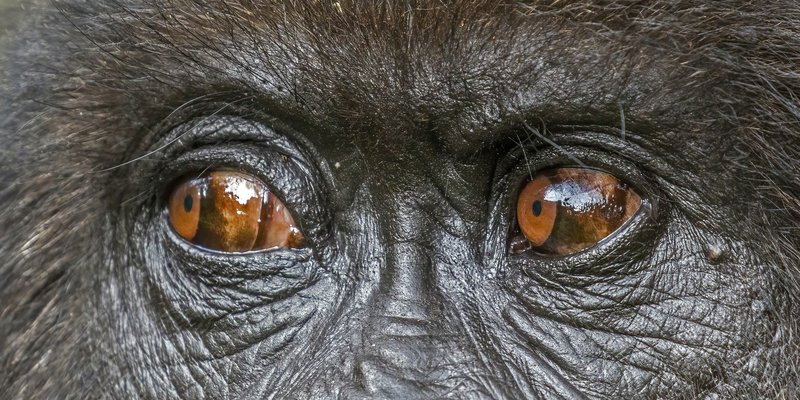
A mountain gorilla in Rwanda. Ed: Charles J. Sharp/CC BY SA 4.0 via Wikimedia Commons
In domesticated animals (dogs and cats) the evidence is more heterogeneous and often anecdotal in nature. Some dogs show nervousness or tend to approach caregivers, but many others do not notice any significant changes. In these cases, the human presence and daily routines have a great impact, which tarnishes the direct impact of the eclipse, according to Pérez de Villarreal.
“The strange and ephemeral nature of eclipses makes it difficult to repeat investigations and obtain large samples.”
“Therefore, the available evidence suggests that the response of mammals to total solar eclipses lies at the intersection of two dimensions: on the one hand, the automatic response of circadian rhythms regulated by light and, on the other, the ability to process and assess the environment in the face of unexpected events. Domesticated mammals generally show more predictable responses associated with the first dimension, while wild mammals, especially those with complex social structures, have greater behavioral diversity, indicative of a more active environmental assessment,” he summarizes.
He also mentioned boundaries. First, the strange and transient nature of eclipses makes it difficult to repeat investigations and obtain large samples. In addition, many studies are carried out in controlled environments, such as zoos, which raises doubts about the generalization of the results to wild populations. That is why, looking ahead, he believes that systematic observation and automated tracking technologies will help to better understand the response of animals.
Buletina
Bidali zure helbide elektronikoa eta jaso asteroko buletina zure sarrera-ontzian