 Bilatzailea


No megaconstelations, megaships
The sky is full of satellites. They are thousands, and they want to put hundreds of thousands more. Through them, they promise the Internet for the whole world, spatial data centers and the possibility of sunlight at night. But at the same time, these satellites illuminate the night sky, obstructing astronomy, increasing space debris and polluting the atmosphere. A world heritage is being transformed by the decision of a few.
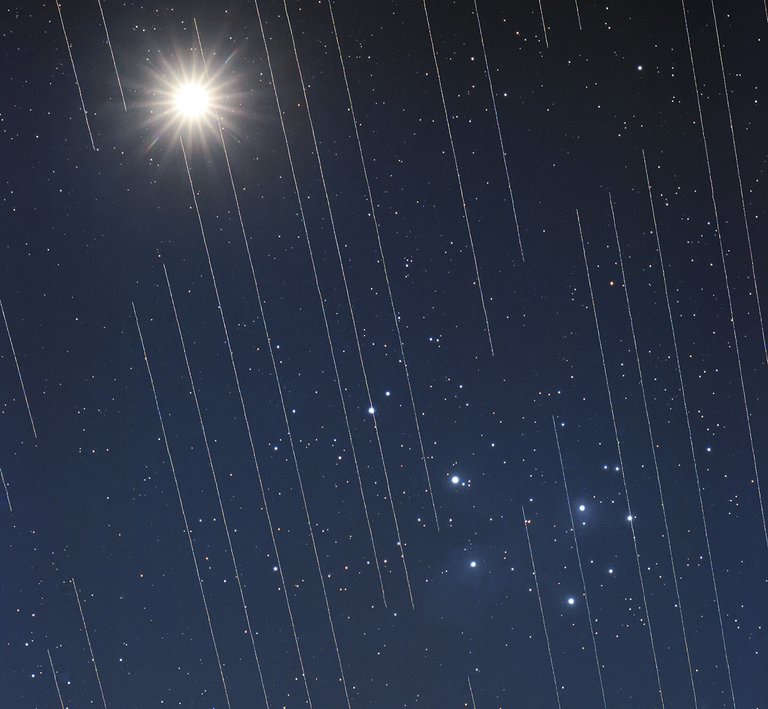
Not many years ago, the one who looked at the stars at night seemed like a star that he would see from time to time, but a bright spot that was moving slowly. “You saw one, and maybe in 20 minutes you could see another, or not at all,” recalls with nostalgia Juan Antonio Alduncin Garrido, member of the Department of Astronomy of Aranzadi. “Now they are constantly passing by. The sky has changed a lot.”
the change began in 2019. It was then that the first Starlink satellites, owned by SpaceX, began to be launched. Since then, hundreds have been thrown every year, and there are already more than 10,000. There are other similar projects, although they do not reach these figures: OneWeb (654 satellites), Amazon Leo (300), Xingwang (190), Yaogang (179), etc. (data from May 2026). “They’re called megaconstellations,” says Alduncin. “To me, however, it seems like a very nice name for something so ugly, because the constellations have always been groups of stars. I call it Megaflot.”
in 2025, 4,510 objects were sent to space (82% from the USA), mostly small communication satellites such as Starlink, which aim to improve global Internet coverage. In fact, the companies involved argue that they democratize the Internet connection.
Alduncin makes an illustrative comparison: “Imagine that to guarantee electricity all over the planet, all corners would have to be filled with high voltage cables that can be seen in all directions. We would go, for example, to the Pyrenees and see all the mountains and valleys crossed by cables. We all have a right to electricity, but we wouldn’t allow such an attack on the landscape.” Well, something similar is happening with the night sky. “When you look at the sky, you have to discern whether what you are seeing is a star or a satellite. For those of us who love the beauty of the night sky, it’s amazing how this landscape is polluting.”
An obstacle to astronomy
Satellite megaships are not just a nuisance for astronomers or lovers of the night sky landscape. They also influence research and are having problems in several observatories. “Much of the research in astronomy is done through images,” says Alduncin. “When they’re taking images of stars or galaxies, a bunch of lines appear that completely distort the information they’re collecting and interfere with data collection.”
It mainly affects telescopes on Earth, but also those in space. For example, the SPHERE X space telescope, although in orbit 700 km (farther away than the Starlinks), is not sufficient to escape light pollution. According to reports by astronomers working with him, 73.3% of the images captured between May and September 2025 were contaminated with artificial satellite remains.
And they also affect radio telescopes. "For radio telescopes trying to detect weak radio waves coming from very distant galaxies and objects, satellite interference makes their work difficult," explains Alduncin. “In short, they hinder professional astronomy.”
Accumulation of garbage
From another point of view, Beatriz Jilete Calleja also looks at the situation with concern. He is a space debris monitoring systems engineer and a member of the Space Ethics group “The lower Earth orbit, between 150 and 2,000 km, is beginning to fill; the risk of collisions has increased exponentially.”
“When you look at the sky, you have to discern whether what you are seeing is a star or a satellite.”
According to the European Space Agency's latest Environmental Space Report, there are about 17,500 satellites in Earth orbit, of which 15,200 are active. In addition, objects larger than 10 cm are about 45,000. “We have the ability to see objects up to ten centimeters from Earth that we can track,” explains Jilet. But models indicate that there may be 1.2 million objects between 1 and 10 centimeters, and about 140 million objects less than one centimeter. “These objects are moving at a tremendous speed: about 24,000 km/h. With that kinetic energy, they're bullets, bullets we can't see. They can dig a satellite, which in turn creates more parts that can collide with other parts, and so on.”
The chain of reactions that can occur in collisions due to the accumulation of garbage is called Kessler syndrome. “This is a theoretical hypothesis, but this threat is beginning to be probable, especially in the 500km orbit (where the Starlinks are located),” warns Jilet. “It’s not science fiction anymore. The situation is alarming, and we should start regulating space traffic. As in land, sea and air traffic, there should be international rules.”
Several countries are developing their laws. Meanwhile, there is the Convention for Outer Space, adopted by the UN in 1967, which states that space and celestial bodies are the heritage of all humanity, that nations cannot take possession of them, that nuclear weapons cannot be placed and that exploration can only be carried out for peaceful purposes. “These principles are very good, but they are short for the exploitation of the space that we are currently doing,” says Jilet.
For example, who decides how many satellites can be put into orbit? “No one,” Jillet replies. “Each country decides which satellites can be launched. There is no international regulation. Right now, space is the wild west.”
“Each country decides which satellites can be launched; right now, space is the wild west.”
And the predictions are terrifying. Orders have been placed in several countries for the deployment of many more mega-ships, each with more than a thousand satellites, and SpaceX made the request earlier this year for the launch of another million satellites, which would be space data centres. Some astronomers have calculated that if this happens, more satellites than stars will be seen in the sky.
The Orbital Reflect project could be even more damaging in terms of light pollution. “A la carte sunlight” is the motto of the project. they want to put 50,000 mirrors in orbit to sell sunlight at night. Each mirror would be four times brighter than the full moon, and of course it would also contaminate the surrounding areas. If the project were to take place, the night sky could become three or four times brighter. “It’s brutal,” Alduncin says. “This would take light pollution to another scale. It would not only be bright spots; it would brighten the night, which would have an impact on nature and also on human health.”
Polluting the atmosphere
However, light is not the only source of pollution caused by satellites. It is even possible that a new form of pollution is occurring in the atmosphere that we do not yet know. More and more satellites are re-entering and disintegrating into the atmosphere. In this process, aluminum oxides are mainly formed. a typical 250 kg satellite leaves 30 kg of aluminum oxide in nanoparticles that can remain in the atmosphere for decades. They have calculated that megaflot can release up to 360 tons of aluminum oxide per year.
The potential impact of this is not yet clear, but some studies are suggesting that it could have a significant impact on ozone and the climate. Global warming could increase, and the opposite, by reflecting the sun. “We’re injecting new materials into the atmosphere and we don’t know what the consequences are,” says Jilet. “We know very little about it, but it’s a very active line of research right now.”
For example, ESA has a “Zero Waste” plan to stop generating space waste by 2030. Jilete himself is involved in the Draco mission. “We are preparing a satellite to investigate what happens when it re-enters and disintegrates into the atmosphere.” Among other things, an experiment will be carried out to understand how these aluminum oxides are formed and to be able to design new materials that do not leave traces when they are burned. “A lot of research is being done to make the satellite’s atmospheric footprint neutral.”
On the other hand, it should be noted that, in recent years, the launch of all these satellites to orbit has increased enormously. Almost a rocket a day is fired. It pollutes the atmosphere. In any case, “it is true that we are launching more than ever, but the footprint of this, if we compare it with civil aviation, is still very small,” says Jilet, without denying that it is something to take into account.
“I am passionate about space, but I also believe that we must make sustainable use of resources,” Jilet proclaims. It underlines the work that Europe is doing in this regard. “The aim is to monitor the consumption of resources and the amount of pollution of each satellite that is generated in Europe, taking into account until the last screw of the satellite. That’s the way we should go.”
“Heaven is the heritage of humanity and should be recognized as such.”
In June 2025, the EU introduced theEU Space Act, a legislative proposal designed to create a single space market across Europe, with special emphasis on security against space debris, cybersecurity, sustainability and business competitiveness. “Laws are being gradually articulated in Europe and in several countries, but of course it has to be at the international level, otherwise we would not achieve anything,” says Jilet. “Heaven is a world heritage site and should be recognized as such,” he adds.
The sky of all
In fact, the night sky has scientific, cultural and symbolic value. And both experts believe that this heritage should be protected against commercial interests. “I think it is everyone’s right, just as it is the right to enjoy the clean coasts and the right beaches, to enjoy the sky that allows us to see planets, the Milky Way and constellations without the interference of many artificial things,” says Alduncin. “That’s what worries me the most at the moment. And I also find it worrying and sad that communications are given so much importance, above everything and without taking into account anything else.”
“For many indigenous communities around the world, the night sky is still of great cultural importance,” warns Jilet. “This cultural and scientific value of the sky is blending very well into international CPS cooperation.” The CPS is the International Astronomical Union’s (IAU) Centre for the Protection of the Dark and Quiet Sky. Well, from this institution they ask that the magnitude of the satellites should not be equal to 7. The smaller the magnitude, the brighter the satellites are, and those above 7 are not visible from Earth. “This would ensure that future generations can continue to see the Milky Way,” says Jilet.
Because there are private companies that are transforming the common sky. “Half of the satellites that are active—or belong to Elon Musk,” says Jilet, “everything is between the three lords.” Basically, a corporation in one country is ruining the night sky, orbit and atmosphere for everyone. “It really affects everyone, because satellites are circling the entire planet,” says Alduncin.
Alduncin sees the future of the night sky as dark — or too clear, as it looks — not only because of satellites, but also because of light pollution on Earth. “For more than twenty years we have been raising awareness among authorities about the moderate use of light. And although in many cases there has been a significant improvement in public lighting, at the same time there has been a spectacular increase in private lighting, such as gas stations, hotels, shop windows, luminous panels, etc., which provide as much or more light than public lighting and in a very uncontrolled way.”
“As a result of all this excess light, the night sky is not dark enough and you can see fewer and fewer stars,” says Alduncin. “But as long as most people don’t realize that excessive clarity is bad, I don’t think the problem will be solved. The new generations will lose a lot. The cultural and scientific loss is truly disastrous. And the forecasts with satellites are terrifying.”
But Jilete is more optimistic: “In view of all the efforts that are being made in many working groups, I look forward to the future. I have been working in this field for 11 years and since I started there has been an explosion: new lines of research, changes in satellite design, awareness, legislation I think we're on the right track. In addition, in the end, even as a business, everyone is interested in getting it right. Now, the question will be whether we will move fast enough to avoid a catastrophe.”
Buletina
Bidali zure helbide elektronikoa eta jaso asteroko buletina zure sarrera-ontzian
Bizitza




Aldizkaria
Kolaboratu
Zure lana argitaratzea nahi duzu?
Gai zientifiko bati buruzko artikulu bat baduzu, bidali eta sarean zein aldizkari inprimatuan argitaratu dezakegu.