 Bilatzailea

Marine litter in the Gulf of Bizkaia: what do we know and why is it essential for citizens to know the litter?
Plastic pollution is one of the biggest environmental challenges today. Every year millions of tons of plastic waste arrive in the ocean, and although we often imagine the Pacific islands covered with garbage, this problem also affects the Gulf of Bizkaia, a corner of the North Atlantic where, unfortunately, part of this waste is also trapped.
In recent years, two lines of work have begun to converge, which until now were developed separately: scientific campaigns and citizen science. This allows us to better understand the reality of our Cantabrian Sea. In fact, we have significantly more data available, so it is possible to analyze areas and moments that academic science cannot analyze.
The dynamic and vulnerable Gulf of Bizkaia
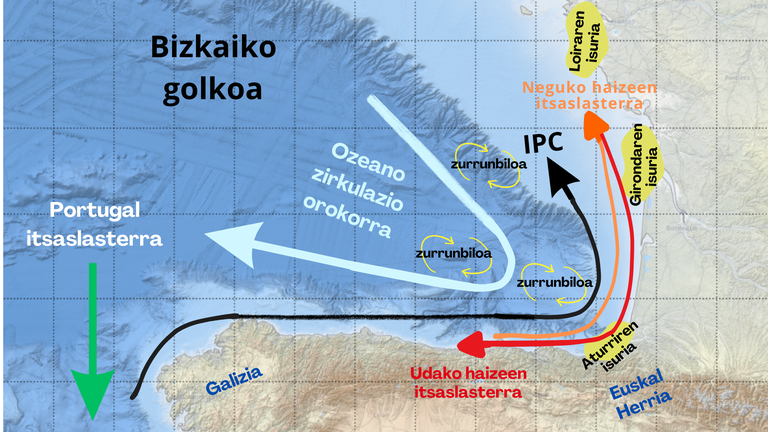
The Gulf of Bizkaia presents a rather complex situation in terms of marine litter, since due to its physical and oceanographic characteristics it is easy to accumulate waste. The continental shelf is not the same from east to west and is crossed by numerous underwater canyons that act as “sinks” of garbage. In addition, many currents, such as the IPC, the Portuguese current or the currents generated by the wind, have a great influence, moving and reorganizing the waste according to the seasons. On the other hand, we must not forget the influence of the large freshwater feathers from the rivers of France and the numerous vortices that occur in the sea, two factors that make it very prone to the arrival and accumulation of waste in the Gulf of Bizkaia.
To all this we must add human pressure: we have a very busy coastline, with important fishing and commercial ports such as Pasaia and Bilbao, and cities with a great tourist activity such as San Sebastian, Bilbao, Bayonne and Biarritz. All these factors significantly increase the pressure exerted on the marine environment.
All these natural and anthropogenic factors together make the Gulf of Bizkaia a particularly sensitive area for the accumulation of marine litter.
Academic science vs. citizen science: when society forms the map
Scientific campaigns to monitor marine litter in the Gulf of Bizkaia are not known to the general public. Every year, Bioman, Pelacus, Demersales and the BM 1 program, the latter for beach monitoring, are launched, working tirelessly to understand what is happening on our coasts. Basic information about these campaigns is easy to find, but the results are not so easy to obtain: often the data is not published or presented briefly.
This lack of transparency is compounded by the use of different monitoring methodologies (BAKA type networks, GOB type networks, scientific diving, image analysis, etc.), as well as the incompatibility of the waste classification systems used. In fact, the results are expressed in very different formats (elements/km², kg/km², elements/100 m, mass or number of objects), so the scarce information available is not enough to compare campaigns, regions or years.
Faced with this situation, it is clear that an alternative is needed to fill this information gap and, in this context, the Gulf of Bizkaia has a valuable resource: a wide network of citizen science projects. These projects involve volunteers who are generally unskilled; they monitor marine litter and often publish the results. Considering only the northern part of the Iberian Peninsula, there are dozens of organizations that have been doing this work for years. Mater Eco-Active Naval Museum, Surfing Federation, Oxygen Foundation, A. Institutions such as the Foundation, Surfrider or the Red Cross–LIBERA have carried out thousands of tastings and generated a large amount of information on platforms such as MARNOBA. This information would have been impossible to obtain by using only traditional scientific campaigns.
Although the data collected through citizen science also have limitations, such as the lack of precise information on the sampling area and the limited and varied training of volunteers, the large amount of data generated by campaigns based on citizen science contributes to a more real image of the situation. For example, official campaigns monitor only 10 beaches in the north of the peninsula, but citizen science has collected data on 209 beaches from 2018 to the present.
What do we see when we combine the data from both sources?
The main conclusion is that the south-east of the Bay of Biscay is a point of accumulation of marine litter, and that 97% of the accumulated litter is plastic. Thus, the concentration of waste found on the beaches of the north is equal to or even higher than that measured in the Mediterranean. This is a striking fact, considering that our coast is open to the vast Atlantic Ocean, while the Mediterranean is practically closed.
As for the beaches, it is confirmed that the French coast accumulates much more garbage than in the north of the peninsula (494 units/100 m versus 281.73 units/100 m). This difference could be due to factors such as the transfer of waste from the Spanish coast to France by winter currents or the increase in the amount of garbage that the large French rivers take to sea. A clear example of this is the Aturri River, whose mouth is the beach with the highest density of waste in the entire Gulf of Bizkaia: 1.101 Units/100 m.
The Gulf of Bizkaia is one of the main areas of floating garbage collection, especially in the eastern sector. Thanks to the work of the Mater Eco-active Naval Museum, 168,086 floating objects have been registered and collected on the Basque coast since 2018, a figure that clearly shows the true dimension of the problem.
As for the seabed, the concentrations of waste around cities and ports are high and decrease as they move away from the coast (although in the latter points measurements are difficult or even impossible). However, the highest garbage densities do not appear on the continental shelf, but on the underwater canyons, where an average of 4,813 items/km² are recorded, much higher than the maximum values of the platform. One of the highest concentrations of garbage is found in the Arcachon Canyon, in the south-east of the Gulf, which confirms that these canyons are areas of marine litter accumulation, and that priority attention should be paid to these points.
[Future challenges in the fight against marine litter]
Despite the abundance of plastic pollution data from many geographical locations, the combination of these data remains a challenge due to a wide variety of methods, classifications, databases and formats. Therefore, it is essential to move towards methodological harmonization in order to obtain consistent conclusions and comparable results that allow us to understand how much waste we really have on our coasts and how it is distributed, in order to find the most appropriate solutions.
The Gulf of Bizkaia is a valuable but fragile ecosystem and, to protect it, the first step is to know how it is and how it is. In this task, citizens are not mere observers, they are protagonists.
Bibliography
Alfaro-Ortega, C., Iturrondobeitia, M., Lizarza, S., Peña-Rodriguez, C Zaldua, N., & Ibarretxe, J. 2026. Citizen science initiatives and outcomes in plastic pollution monitoring and control in the southern Bay of Biscay. Marine Pollution Bulletin, 227, 119467
Alfaro-Ortega, C., Ibarretxe, J Iturrondobeitia, M., 2025. Marine litter in the south-east of the Bay of Biscay: a review of current methods, standards, databases and challenges. Mar Pollut Bull. 213, 117632. https://doi.org/10.1016/j. Marpolbul.2025.117632.
Buletina
Bidali zure helbide elektronikoa eta jaso asteroko buletina zure sarrera-ontzian