
 Bilatzailea

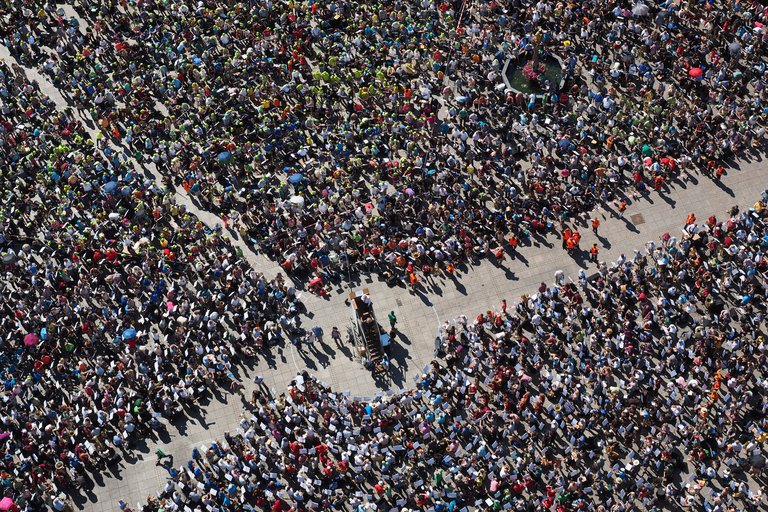
Researcher Heinz von Foerster and colleagues The end of the world: the famous article was published on 13 November 2026 in 1960. The paper concluded that, given the rate of human population growth over the last 2,000 years, the population would become mathematically infinite today. The failure of prediction shows that it can be dangerous to consider as universal law situations that appear to be permanent at a given time.
“Von Foerster’s model was fairly accurate for much of the 20th century, but predictive power was lost as demographic conditions changed.”
The authors of the study correctly observed that population growth was growing faster than exponential models. The human population of the world needed the entire history of humanity to reach a billion inhabitants in the year 1800. However, from that year onwards, it took only 125 years for the population to double, and 50 years later it doubled again to 4 billion people.
Von Foerster and colleagues studied the growth of the human population in B.C. 1. from 1958 to 1958, a hyperbolic model was defined, in which population growth is not constant, but increases with the increase in population size. Thus, according to this hyperbolic model, the human population tends to infinity in a finite period of time. However, the researchers worsened by considering a historically unusual growth rate as a permanent feature.
In an essay published in the Science journal, Javier A. Birchenall explains that population growth began to decelerate in the 1960s. Von Foerster’s model was fairly accurate for much of the 20th century, but predictive power was lost as demographic conditions changed.
According to Birchenall, even the current decline in the fertility rate should not be used to make predictions for a distant future, just as the growth rate of the 1960s could not be prolonged indefinitely.
on November 13, 2026, the world’s human population is about 8.3 billion people and will continue to grow, but growth will slow down. Currently, the population of Japan is down 0.77% per year; if we accepted this data as a universal and permanent trend, we would announce that on May 5, 3108, no human life will occur on Earth. This prediction is not erroneous from a mathematical point of view, but it is based on the hypothesis that fertility will not change.
Irati Diez Virto
Elhuyar Zientzia