 Bilatzailea


It’s a big challenge, but it has given me back the desire to do science
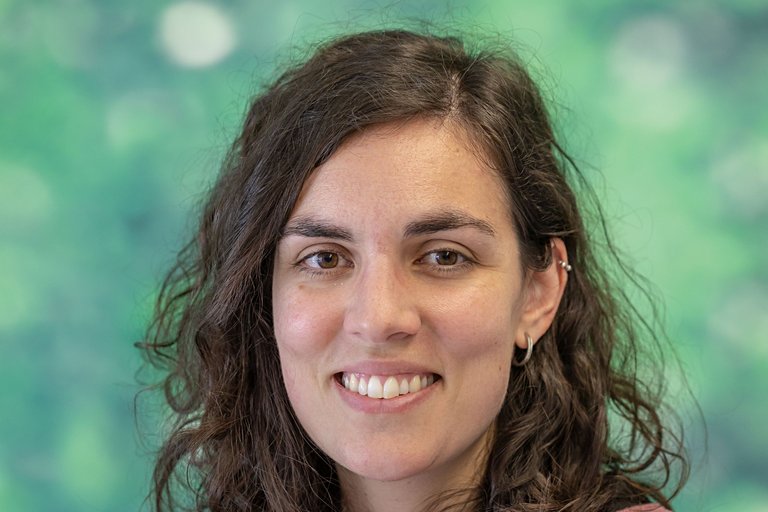
From Leitza to Pamplona there are 50 kilometers by car. But in the life of Nerea Zabaleta Lasarte there are thousands of kilometers between these two places and an ocean. Zabaleta was born in Leitza and currently works at CIMA, a research center at the University of Navarra. But on his way from one place to another he has passed through Paris, New York and Boston.
The journey has been guided by research, but he confesses that at the beginning of the tour he did not know that he was going to take this direction: “I really wanted to study Medicine, but in high school Physics and Biology were at the same time and I was advised to do Physics because it was more difficult. The fact is that when I went to enroll, at the public university I was not allowed to choose Medicine because I had to have Biology done.”
“I wrote to the CIMA Department of Gene Therapy saying that I wanted to do internships. That’s how I did my internship in Gloria González’s lab.”
Thus, he chose Biochemistry, with the intention of making the leap to Medicine. “And look where, I liked it so much, I kept doing it. It was focused on medical research, and one day the CIMA gave us two classes on gene therapy. I found it very attractive, so I wrote to the Gene Therapy department at CIMA saying that I wanted to do internships. That’s how I did my internship in Gloria González’s lab.”
Once he took this path, he did the master’s and doctorate directly. And he did two PhD stays abroad: one in Paris 10 years ago and another in New York a little later.
“I think I was very lucky,” he admits. “In fact, the laboratory in Paris was similar to that in CIMA and we had a very good atmosphere in the group. I still have contact with some of my friends! Instead, everyone in New York did their job, and I had to follow the lab staff to do what I wanted to learn there.”
Although the experience is very different, it is clear that both were very enriching. And when he finished his doctorate in 2018, he returned to the United States to do his postdoctoral work in Boston. “A start, for a couple of years, but I stopped six years.”
“The laboratory in Paris was similar to that in CIMA. Everyone in New York did their job
His partner, also a scientist, also moved to Boston. And then the pandemic broke out. He explains that there the measures were not so strict and that people acted responsibly, so in that sense he did not have such a bad time. It was very professional though.
Work and personal life
“In my lab we were doing gene therapy and we were using a vector. And the head of the lab thought it could be used to make a vaccine by adding the spike protein of the SARS-CoV-2 virus. So that’s what we focused our research on. We knew we wouldn’t get it before the Modern, but it was a huge academic effort and we got some really good things. For example, in our experiments we saw that the antibodies lasted two years; this is not seen in mRNA vaccines,” he explains.
Although they did not reach the clinical phase with the vaccine, it was very beneficial from the point of view of the curruculum for Zabaleta, who took over the laboratory and published many articles. But the pressure, the responsibility and the stress took over and, in addition, the couple also wanted to take the next step in their career. So they decided to return. 2024. he set the date for his return at the end of the year, as he wanted to close the stage well.
“I joined the CIMA and, in my first year, I got a European grant. “I have a team of five to six.”
And just then, she got pregnant: “Our daughter was born there and we came back when she was four months old. I got a Ramon and Cajal grant, and although it's good, it doesn't give you a lot of money to investigate. But, with the help of Gloria González, I joined the CIMA and, in the first year, I obtained a European grant. Thanks to this, I now have a team of five to six people and my line of research: gene therapy in the kidneys.”
It is clear that it is not easy to succeed. In fact, very little research has been done on this, precisely because it is difficult. Therefore, everything remains to be done: “It’s a big challenge, but that has given me back the desire and the illusion of doing science. And also the fact that they are personally in another situation, of course, close to their friends and family.”
“His research project is called RENALGENE and the European Starting Grant gives him the guarantee to move forward.”
However, he does not forget his friends in the United States, as well as his travels and some of his traditions. But she is happy with her return, and with the important awards and subsidies she has received, she looks to the future with hope, both professionally, since she directs cutting-edge research in her laboratory and personally, since she is pregnant again.
In fact, its research project is called RENALGENE and the Starting Grant grant granted by the European Research Council to carry it out, endowed with 1.5 million euros, guarantees the research of innovative treatments for hereditary kidney diseases. We will know the results!
He holds a Degree in Biochemistry and a Master’s Degree in Biomedical Research from the University of Navarra. He has made a research stay in Genethon (France) and at the Albert Einstein School of Medicine (USA). Later, he achieved elegance at the University of Navarra and the CIMA. He has been a postdoctoral researcher and professor at the Grousbeck Center for Gene Therapy at Mass Eye and Ear and at the Harvard Medical School in Boston, USA. He is currently the principal researcher in the Development of Gene Transfer Technologies group at CIMA.
Buletina
Bidali zure helbide elektronikoa eta jaso asteroko buletina zure sarrera-ontzian
Bizitza

Aldizkaria
Kolaboratu
Zure lana argitaratzea nahi duzu?
Gai zientifiko bati buruzko artikulu bat baduzu, bidali eta sarean zein aldizkari inprimatuan argitaratu dezakegu.