 Bilatzailea


Nanosensors for skin regeneration
The human skin is a complex three-layer organ that performs a series of essential functions, such as the barrier of protection against microorganisms and temperature regulation. When wounded, these layers initiate a coordinated healing process, but in patients with diabetes or persistent infections this process can be impaired and the wounds become chronic. Although standard treatments (dressings and gauze cloths) provide physical protection, they are passive and do not resolve underlying biological dysfunction. For this reason, nanoparticles are being studied as an innovative option, since they can be molecular "engineers" capable of guiding and improving the healing process by interacting directly with the cells.
Designing nanoparticles for tissue repair
An international team of researchers formed by the University of the Basque Country (UPV/EHU) and POLYMAT, in collaboration with the Charité University in Berlin, has taken an important step forward in this field: they have developed a new class of nanoparticles specially designed to support the process of complex skin repair.
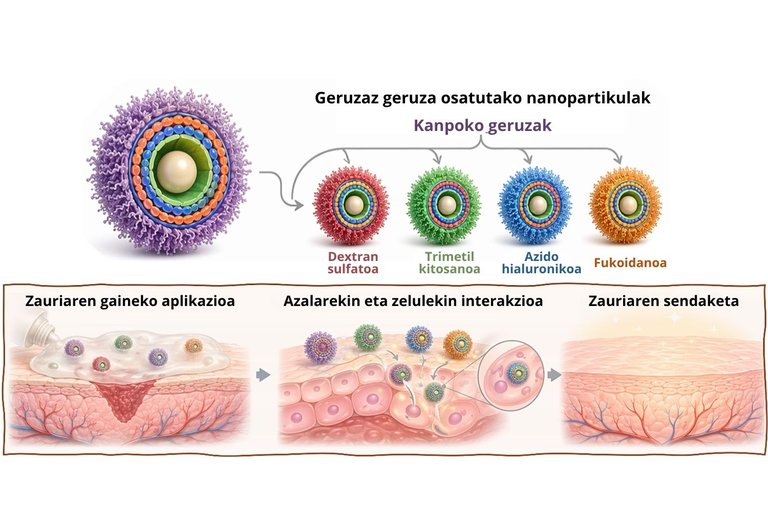
These nanoparticles have been produced by a process called layer-by-layer, which consists of layering the desired chemical compounds on the surface of the particles. This process is comparable to the construction of a small sphere, where each layer has a specific biological or chemical purpose. The end result is a structure similar to the onion, since it is formed by a plurality of specialized layers that are staggered and wrapped around a central core. These nanoparticles are composed of biodegradable and biocompatible polymers: materials that naturally disintegrate in the body over time without causing harmful biological effects. This makes them especially promising for medical applications.
This precise engineering allows scientists to decide how the particle will behave after it enters the body. For example, certain inner layers may be used to protect medicaments while other layers control the timing of the release of such substances. The outer layer, on the other hand, is adapted for the cells of the body to converse with each other, acting as a small engineer who works precisely on a microscopic scale.
The team of researchers analyzed the influence of the outer layer or "coating" of the nanoparticle. This is the part that comes into direct contact with the main repair cells of the skin, keratinocytes. These cells are the most abundant in the epidermis and are the agents primarily responsible for closing the wound and restoring the integrity of the skin. In order to optimize the interaction between particles and keratinocytes, the researchers studied various polysaccharides, long chains of sugar molecules found in nature. These sugars are ideal for medical use due to their high degree of biocompatibility. Specifically, four polysaccharides were studied: hyaluronic acid, trimethyl chitosan, dextran sulfate and fucoidan.
The results of this study were striking. When the nanoparticles were coated with these polysaccharides, especially hyaluronic acid, the keratinocyte cells absorbed the nanoparticles in large amounts, sometimes reaching an absorption rate of 80% in 4 hours. This high efficiency suggests that skin cells are naturally "tuned" to detect these polysaccharides. This detection is due to the fact that the surface of a cell is covered with specialized proteins that function as small sensors. When they encounter a known sugar structure, they are more easily attached to them.
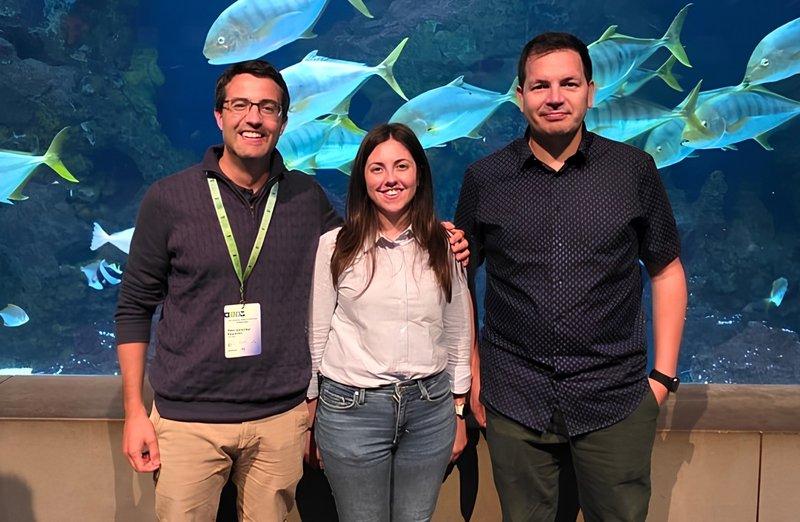
Responsible for the research project (from left to right): Aitor Larrañaga, Maria Angela Motta and Marcelo Calderón.
These “small engineer” nanoparticles do much more than just enter the cell. They actively promote the skin renewal process. By improving cell-particle interactions and creating a more favorable biological environment, these nanoparticles help keratinocytes move through the wound área. This migration is the basic step necessary for the skin to close a physical void and recover our protective organ.
To ensure that these results are applicable to real medicine, researchers passed basic laboratory tests and performed experiments using human skin samples taken from healthy donors. The findings were particularly positive for hyaluronic acid-coated nanoparticles. These precise particles significantly improved tissue repair as they not only helped form the layer of a new skin cell, but also stimulated the growth of new blood vessels. This last point is essential, since the blood vessels supply the nutrients and oxygen necessary for the survival and growth of any tissue. One of the most interesting findings was that the application of hyaluronic acid in its crude form did not bring the same benefits. This underlines the importance of nanoparticle design. By bringing the polysaccharide together in a structured system, it can stay longer at the wound site, prevent rapid degradation, and interact more with the cells.
[A new chapter in regenerative medicine]
These findings lead us to a future where wound treatments will not only be passive treatments such as current patches and dressings, but will also be used as active guides in the healing process. As small engineers, these nanoparticles can coordinate a broad set of biological events necessary for successful repair. Scientists now imagine being able to incorporate these nanoparticles into creams or gels for direct application to the patient’s wound. Such a treatment would be easy to use and would at the same time provide a highly targeted and effective therapy.
Looking ahead, the research team is exploring ways to make nanoparticles even more effective. One strategy is to add antimicrobial molecules that help prevent infections, one of the main causes of chronic wound healing, while rebuilding the skin. Another strategy is to incorporate anti-inflammatory proteins. Beyond wound care, these nanoparticles are attracting increasing interest for their potential role in the treatment of a wide range of diseases.
In the future, these microscopic engineers can transform clinical dermatology by allowing for faster, more efficient and less complicated wound healing, while reducing health costs by shortening healing times. The next challenge will be to transfer these technologies from the laboratory to clinical practice and finally to pharmacies. In this context, POLYMAT participates in the project "Intelligent Hydrogels for Personalized Nanomedicine", led by i+Med, to generate innovative therapeutic solutions through the potential of these advanced biomaterials.
Buletina
Bidali zure helbide elektronikoa eta jaso asteroko buletina zure sarrera-ontzian