 Bilatzailea


There has always been a strong connection between art and astronomy
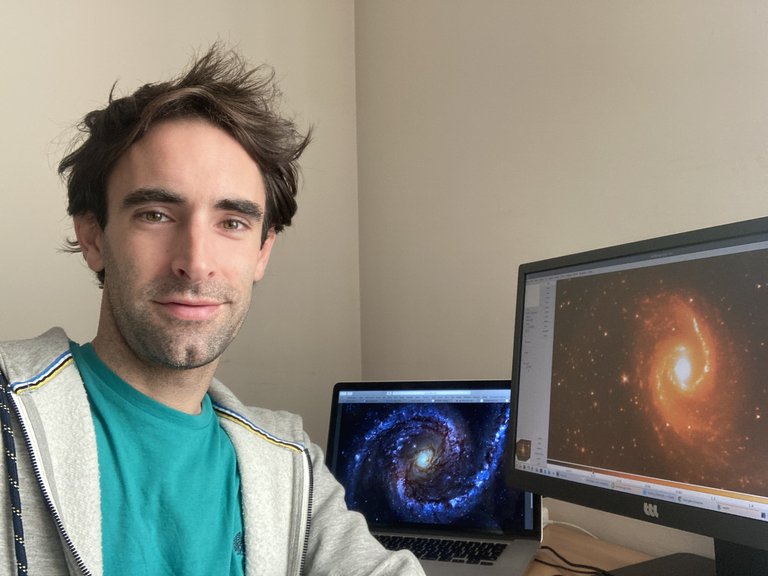
The astrophysicist Miguel Querejeta Pérez recalls that he began to fall in love with astronomy at a very young age: “I remember that in summer we went to Ezkarai, because an aunt has a house there with two very nice terraces from which you can see the sky very well. And he had a small telescope. when I was about 12 years old, I started observing the sky with that telescope and I became interested.”
So, when it was time to start college, he decided to move to Madrid, where, unlike Bilbao, they had an astrophysical specialty. He admits that, despite his clear vocation, he did not like some subjects very much. “It happens sometimes, doesn’t it? Some teachers were quite mediocre and some of the subjects were very theoretical, very deep mathematical questions. I was not interested in that at all. But my passion for astronomy helped me move forward.”
Therefore, he continued on the path he had begun and had the opportunity to move to other countries: “I spent a year doing Erasmus in England, in Nottingham. And after finishing my degree, I went to Germany to do my PhD in Heidelberg at the Max Planck Institute of Astronomy. It was about galaxies, very nice. I was lucky because I had previously done a summer project in the Canary Islands with this theme and I was very interested. After finishing my doctorate, I went to Munich with a fellowship, to the ESO Observatory. Similar to a postdoctoral but with greater freedom, since each one chooses the object of study. In addition, I did part of the work in Atacama, Chile, with radio telescopes. It was horrible,” she says.
Between the cosmos
And just when he finished that, he took the official position at the Royal Astronomical Observatory in Madrid. Now he's doing research there, but he's also working on other projects. In fact, he also has a degree in Hispanic Philology and has just published a book that combines astronomy and art, together with the art historian Inés Pérez Teresa. Entitled The Cosmos in the Art (The Cosmos in the Art), both authors tell how the cosmos has been represented in the art and how art serves to interpret the cosmos.
“Art has often been a tool of astrophysics,” explains Querejeta. “We are used to seeing the images that telescopes give us today, but until the 19th century we had no way to photograph them, and then drawing was very important for astronomers. Galileo, for example, was an artist with a cartoonist training that helped him, among other things, to reflect the observations of the Moon on paper and make accurate measurements. There has always been a strong connection between art and astronomy.
He concluded by saying that he would see the solar eclipse of 12 August from Ezcaray, "of course!" and confessed that he was anxious because it would be the first time he would see a total solar eclipse. Finally, he has announced that this year he will also publish another book aimed at children. As he has always had a passion for the study of the sky, since he was very young he has also liked dissemination, as evidenced by the fact that he has won two CAF-Elhuyar awards, the conferences he offers and now also literary works.
The astrophysicist Miguel Querejeta Pérez graduated in Physics from the Complutense University of Madrid and received the Extraordinary Prize. He did his thesis at the Max Planck Institute of Astronomy in Germany and was awarded by the Spanish Astronomical Society. He worked at the European Southern Observatory (ESO) in Munich with a prestigious ESO Fellowship and later joined the Royal Astronomical Observatory in Madrid. Currently, it combines research and dissemination. He has a Degree in Spanish Language and Literature and has just published the book El cosmos en el arte.
Buletina
Bidali zure helbide elektronikoa eta jaso asteroko buletina zure sarrera-ontzian