 Bilatzailea


Nobel Prize in Chemistry for the discovery of nonlinear effects and autocatalysis in asymmetric organic synthesis
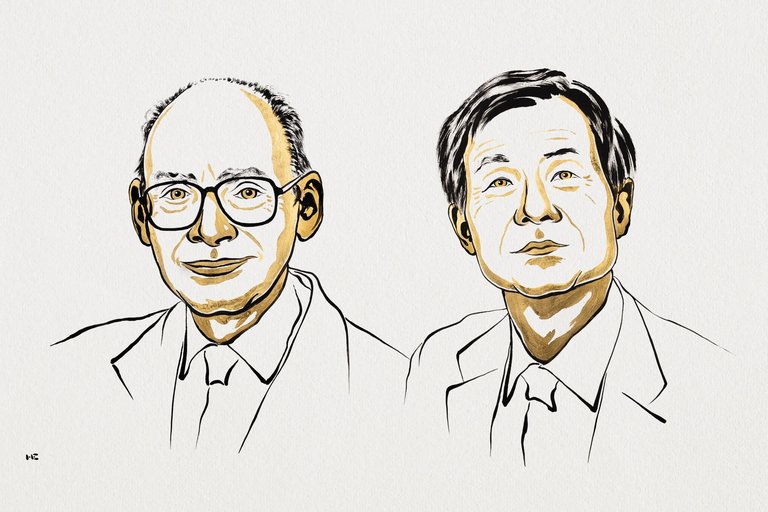
Henri B. Kagan and Kenso Soai are awarded the Nobel Prize in Chemistry in 2026.
Some molecules have two variants and one is a mirror image of the other. Molecules with two variants are called chiral and those that are mirror images of each other are called enantiomers. Living things usually contain a single enantiomer of a chiral molecule.
“They have managed to create a single variant of molecules, just as living beings do by themselves.”
In contrast, in laboratory reactions, chemists always obtained the two variants of the molecule of interest in the same proportion. However, the two variants do not have the same results in some reactions. For example, during drug synthesis, they found that one variant could be therapeutic, while the other could cause unnecessary and sometimes harmful side effects.
The chemists Henri B. Kagan and Kenso Soai have succeeded in creating a single variant of the molecules. Just like the living do.
“Henri Kagan and Kenso Soai have given a solution to a chemical mystery that has been going on for more than a century: how homocirality can emerge naturally. The chemical reactions they have developed are spectacular,” says Heiner Linke, President of the Nobel Committee for Chemistry.
Henri B. Kagan: The nonlinear effect of asymmetric syntheses
Henri B. Kagan wanted to produce as pure enantiomers as possible, among other things because of their importance in drug synthesis. In fact, in 1960 the drug thalidomide caused enormous problems, since both enantiomers of this molecule were used as drugs. At that time, thalidomide was used to treat pain and discomfort during pregnancy, and it was found that one enantiomer of this molecule had a sedative effect, but the other enantiomer caused malformations in fetuses.
The synthesis of the molecules is carried out using catalysts, i.e. molecules that contribute to the chemical reaction but do not subsequently stop in the product. Chemists believed that the chirality of the catalysts determined the chirality of the product and that there was also a linear relationship between the two.
Henri B. Kagan disputed this belief by testing with various catalysts and enantiomers. In practice, he designed a method to enhance the generation of one of the enantiomers, and this type of reaction was called asymmetric synthesis with non-linear effect.
It was a historic breakthrough, and many chemists began to explore this new phenomenon. One of them was Kenso Soai.
Kenso Soai: autocatalysis
This chemist set himself a goal: he wanted to design a reaction in which the catalyst synthesized more catalysts. I mean, he wanted to create an autocatalytic process.
After experimenting with various molecules, in 2003 Kenso Soai achieved his goal: he obtained a chemical reaction that produced one enantiomer more than the other, and this product was then converted into a reaction catalyst that produced exponentially more product.
This type of reaction was called the Soai reaction and is considered one of the most elegant chemical experiments ever carried out.
Henri Kagan and Kenso Soai have elucidated how homo-chirality can be produced, allowing the formation of single enantiomeric products. This knowledge is essential in any company that manufactures substances for use in living beings, such as the pharmaceutical industry and agricultural chemicals. It is also believed to be important in the production of new materials.
Buletina
Bidali zure helbide elektronikoa eta jaso asteroko buletina zure sarrera-ontzian
Bizitza





Aldizkaria
Kolaboratu
Zure lana argitaratzea nahi duzu?
Gai zientifiko bati buruzko artikulu bat baduzu, bidali eta sarean zein aldizkari inprimatuan argitaratu dezakegu.