 Bilatzailea


Animals in prehistoric paintings are organized according to a pattern
Iñaki Intxaurbe, researcher at the UPV/EHU, has analyzed the arrangement of the murals of 9 caves in the Basque Country through network analysis and statistics.
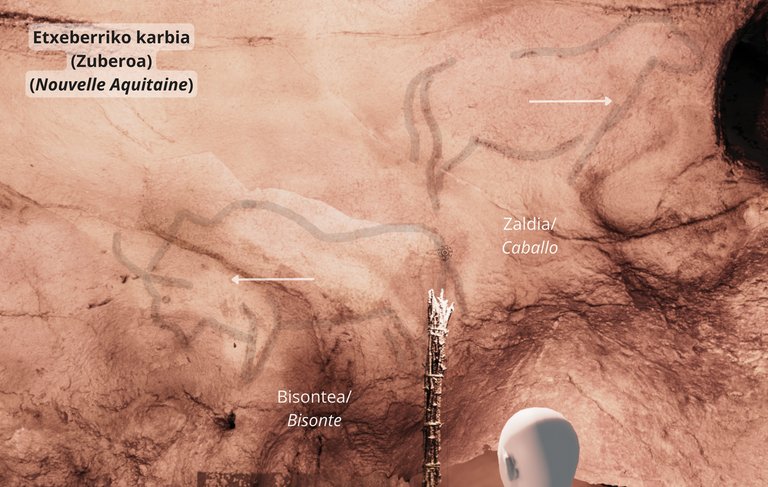
According to the associations that are repeated in the cave images, bison, horses and goats appear in the center of the compositions and other animals in the environment. They used to represent the horses looking to the right, and the other animals usually looking to the left. The results were published in the Journal of Archaeological Method and Theory.
Iñaki Intxaurbe, researcher in the Department of Graphic Expression and Engineering Projects at the UPV, explains that, to carry out this study, he analyzed 500 graphic motifs from nine caves in the Basque Country, drawn between 16,000 and 14,000 years ago. After making digital copies of these drawings, he used them to perform simulations and statistical analysis. He wanted to see if these images were drawn randomly or if they followed a certain pattern.
The results show that the art inside the cave was made in an orderly and not random way. Some animals were placed in the center, while others were placed around them. Bison, horses and goats were the main animals, with which the authors of the drawings followed a structural pattern. The statistics suggest that all images of the entire cave were organized according to the appearance and orientation of these three animals.
Now we know that the rock art of the end of the Paleolithic had a syntactic structure, and that behind it there is a graphic idea or a graphic code that we do not understand but that would have been important for them.
Buletina
Bidali zure helbide elektronikoa eta jaso asteroko buletina zure sarrera-ontzian
Bizitza



Aldizkaria
Kolaboratu
Zure lana argitaratzea nahi duzu?
Gai zientifiko bati buruzko artikulu bat baduzu, bidali eta sarean zein aldizkari inprimatuan argitaratu dezakegu.