 Bilatzailea


[Discovery of a functional nanoporous graphene]
This study presents a revolutionary and functional two-dimensional carbon allotrope, a new form of carbon that overcomes a major obstacle to the use of graphene in electronics. This new material is very stable in the presence of oxygen and air and, due to the chemically active nature of its nanopores, has a high affinity for molecules such as carbon monoxide (CO). Thanks to this dual functionality, the discovery opens the way to both faster and more efficient semiconductor technologies and highly sensitive chemical sensors for monitoring environmental pollutants.
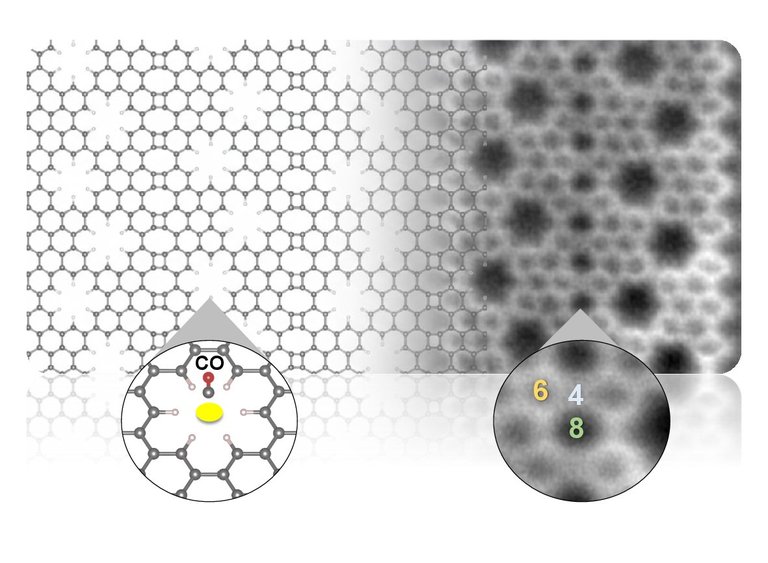
Carbon is one of the easiest to adapt elements of the periodic table, and it usually appears in very different forms, such as graphite and diamond. Among the two-dimensional (2D) forms of carbon, graphene has captivated the scientific community for its exceptional strength and conductivity. However, immaculate graphene does not have banned bands, which means that it acts as a metal and not as a semiconductor. This significantly limits the use of graphene in digital electronics, as transistors require materials that can be switched on and off in a controlled manner. To overcome this obstacle, a study led by Dr. Martina Corso (CFM-MPC), Professor Aran García-Lekue (DIPC) and Dr. Ignacio Piquero-Zulaica (CFM-MPC), published in the journal Advanced Materials, describes a previously unknown 2D carbon allotrope. This new material combines the basic structure of graphene with [18]-annulene-type nanopores and biphenylene segments. The eight-membered rings in these biphenylene segments are shown alternating with four-membered rings (see Figure 1).
The key to this breakthrough lies in the atomic precision achieved through surface synthesis (OSS) and the application of a “bottom-up” design. The working groups of Professor Sinitskii (University of Nebraska) designed some specific molecular precursors. When these precursors are placed on a gold surface and heated in a controlled manner under ultra-high vacuum (UHV), they are assembled into a pGNR 12 and then fused together laterally (see Figure 2). This process eliminates structural defects common in conventional synthesis and allows for the creation of a continuous nanoporous graphene (NPG) structure with a periodic pattern of four, six and eight membered rings, as evidenced by measurements by low-temperature tunneling microscopy (LT-STM) and non-contact atomic force microscopy (nc-AFM), in which tips functionalized with a CO molecule are used. By controlling the exact geometry of these rings and pores, scientists are able to determine how electrons will move through the material and, therefore, program its electrical and mechanical behavior.
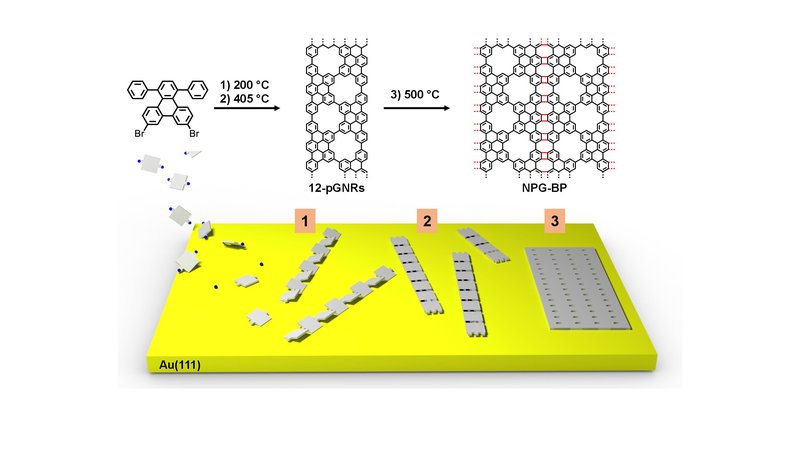
figure 2: Schematic of surface synthesis (OSS) of a nanoporous graphene (NPG) structure with periodically separated nanopores and biphenylene (BP) segments. The OSS model was created by Dr. Bernhard Kretz.
The design is based on graphene nano-arrays (GNR) of the “armchair” type, with a width of 12 carbon atoms. Anulene pores (12-pGNR) are strategically introduced into them. These nanopores act as interruptions in the hexagonal network and dramatically alter the structure of the material's electronic bands, as seen by angle resolved photoemission spectroscopy (ARPES). Standard graphene allows for unrestricted electron flow, but the use of these nano-sized pores creates the banned band required for semiconductor. The way in which these tapes are connected, either by graphene-type (NPG-G) or biphenylene-type (NPG-BP) bonds, the resulting material will have a direct or indirect banned band, offering unprecedented versatility for electronic design.
From an engineering point of view, the mechanical properties of this new allotrope provide significant advantages. Although the presence of pores reduces the enormous inherent stiffness characteristic of pure graphene, biphenylene units help to reduce mechanical anisotropy. This means that the sheet responds more evenly to stresses coming from different directions, making it easier to integrate into practical devices that have to withstand stretching or varying pressures. Significant environmental resistance is added to this structural stability, as the synthesized NPGs were found to be stable when exposed to oxygen and air under ambient conditions.
The chemical functionality of the material is another pillar of this discovery. Nanopores are not only structural deficiencies, but act as active sites that interact more easily with neighboring molecules. Through gas adsorption experiments, the research team demonstrated that the pores have a selective affinity for carbon monoxide (CO), which is preferred over oxygen (see Figure 1). This ability to capture these gas molecules with high precision opens the way to the development of highly sensitive chemical sensors for medical diagnostics, environmental monitoring and industrial process control.
Density Functional Theory (DFT) and Tunneling Effect Spectroscopy (STS) confirmed that electronic states near the banned band are mainly concentrated in the inter-pore segments. This suggests a practical design rule: by choosing which type of segment (graphene or biphenylene) to place between the pores, designers can “adjust” the size and type of banned band for specific applications. This ability to customize electronic behavior on an atomic scale distinguishes this material from other carbon allotropes, such as graphidine, and consolidates it as a solid platform for the next generation of nanoelectronics.
In short, this research is a milestone in the science of materials, as it is a bridge between fundamental physics and practical utility. The combination of a graphene support with biphenylene strips and a regular pore pattern has resulted in a fully adjustable two-dimensional carbon type. The ability to simultaneously control electrical conduction, mechanical rigidity and chemical reactivity through molecular design reveals that atomic level architecture can open completely new doors in the field of future semiconductors, filtration membranes and sensors.
Reference: P Ango-Portugal, M. Irizar, L. Huang, et al. “A Functional 2D Carbon Allotrope Combining Nanoporous Graphene and Biphenylene Segments.” Adv. Mater. Mater. (2025) E11706. https://doi.org/10.1002/adma.202511706
Buletina
Bidali zure helbide elektronikoa eta jaso asteroko buletina zure sarrera-ontzian