 Bilatzailea

Epigenetics will allow us to predict the risk of diseases.
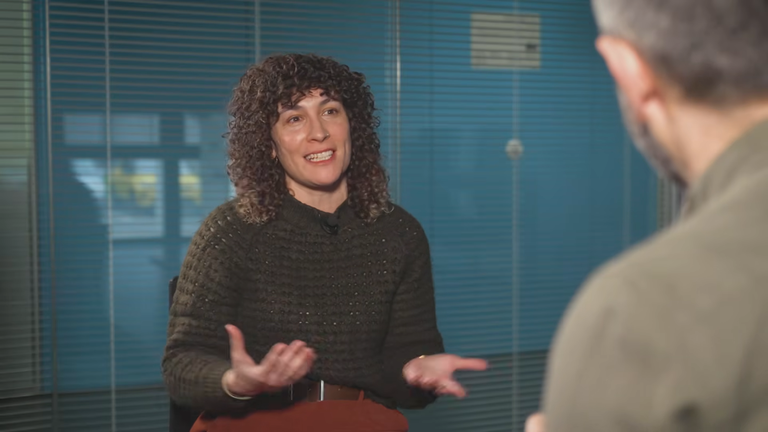
Dr. Nora Fernández Jiménez is part of the Immunogenetics Research Laboratory (IRLab) of the UPV/EHU, dedicated to research in the field of epigenetics. Recently, it has launched a pioneering research project focused on the search for epigenetic markers in the human placenta.
DNA is said to be our instruction book, but what does that book tell us about a person beyond his physical appearance?
It’s more than a book, it’s a complete library, a huge library, where we have all the instructions we need.
Four letters, a letter or a molecule, are used to write long sequences. It's amazing how much information can be stored in these long chains, isn't it?
These chains are longer than we can imagine. Imagine that our body is made of cells, which are very small. Well, inside each cell we have about two meters of perfectly rolled DNA.
However, in these long chains, a mistake is enough to have serious consequences, right?
There are mistakes, yes, and many, but most of them are not so serious. Sometimes, however, we can get sick with just one mistake and seriously.
How do these errors occur?
Sometimes we inherit these mistakes from our parents. Other times they can be generated throughout life, sometimes by the environment itself. Many of them are corrected immediately. But sometimes some of these mutations give the cell a certain advantage and it proliferates more. When this happens, sometimes cancer appears.
Currently, can these errors or some errors be corrected?
The most recent technique we have at the moment to write or correct our DNA is CRISPR. This technique is like using molecular scissors, we can enter the DNA, make a cut and introduce the change we want. However, sometimes it can have defects, so it is not yet used in many diseases, only in very specific cases. He was a revolutionary in medicine.
Will genetic diseases be a history in the future?
I don't know to what extent. There are some diseases, for example, that attack the eye. The eye is a very closed organ in which we can make changes without affecting the whole body. Errors can then also be tolerated, because they will only be given in it. But other times, in more systemic diseases, it is more difficult.
We have said that our instructions are in a kind of library, but we do not read them all. Is this the basis of epigenetics?
Yeah, that's it. Continuing with the analog, if all our DNA is a huge library, epigenetics would be the “post-it”, bookmarks, etc. that we put in books.
Epigenetics tells each cell which part of this instruction book it should read to perform its function properly, such as the part it should read to become a hair or retinal cell. And it also tells the body how to grow, for example, during pregnancy, and even later, during our development.
What to read and what not to read?
There are several types. We, for example, investigate DNA methylation in the laboratory; this is perhaps the most well-known epigenetic brand. But there are many others, such as histones. DNA is wrapped in these proteins, and the type of histone is also the epigenetic mark.
It’s important to know these brands well and know how they work, right? What can they tell us?
We look for patterns in these brands and try to relate these patterns to, for example, diseases. We believe that these brands can be used to predict and prevent the risk of suffering from certain diseases.
However, when we emphasize it, we don’t change the book or the library, do we?
No, we don't change anything, the letters are still the same. What we change is what to read and how to read, that is, the statement.
What diseases are you currently investigating?
We are following a lot of diseases. Now, we're investigating the placenta. It is a very interesting organ because it connects the mother and the fetus during pregnancy. The placenta may contain genetic and environmental marks of the child. The relationship between epigenetics and the risk of suffering from metabolic diseases, obesity, neurological and neuropsychiatric diseases, among others, is being studied.
Do we pass on these epigenetic marks to the offspring?
To be honest, there are still few tests of this epigenetic transmission in man, but it is known that there may be something. Very small molecules have been found in spermatozoa that can explain some inheritance at the epigenetic level. But from what we know so far, we do a certain reprogramming of epigenetics in our gametes, that is, in sperm and eggs. It is like a second chance, a future without burdens for our descendants. In most cases, the vast majority of brands are eliminated in humans, but not in plants.
But are the epigenetic marks that each of us has eternal or can they be changed?
Epigenetic marks are very interesting, precisely because of this. They're changing. They're flexible. We have to think that our cells differ, so as the cells divide, these marks have to change. Otherwise, we could not develop different cell types from the same cell type. They change during development and will probably continue to do so once we have reached adulthood, often due to environmental factors.
Are environmental factors influencing?
Yes, of course. Smoking, diets, sports, pollution... We are investigating all of this as well. Environmental factors can cause changes in both the epigenetic markers and the text of the book.
The latter are, for example, mutations that cause cancer.
So if the markers are modifiable, does that mean we can put them on and off?
Yes, they are reversible. This is demonstrated, for example, in the case of celiac disease. We have seen how methylation levels in patients on a gluten-free diet can return to normal in some cases.
It can also be said that our epigenetic code, linked to markers, can be reprogrammed, therefore?
Yes, it can be reprogrammed, but at the moment there is no technique at the epigenetic level that is as effective as CRISPR.
The next scientific goal, therefore, looking to the future, would be to develop a kind of epigenetic edition?
I think that would be very interesting in medicine. The most important thing in this area is the specificity to generate as few side effects as possible in the patients for the assignment of the treatment.
Can diseases be predicted?
We can predict risk rather than disease. It can be very useful to include individuals in screening programs because we will be able to use resources to better track people who are actually at risk. But society must have full confidence that this information will only be used for the benefit of the patient, and for this it is necessary to have a very powerful public system.
In the meantime, let us take care of our epigenetics because our destiny is not written. Or yes?
It's not written. Sometimes, yes, but rarely. There are inheritable mutations mentioned above.
But in the rest of the cases, genetic and epigenetic patterns are very complex and it is very difficult to predict whether a person will suffer from a disease or not. So the best thing we can do is take care of each person in the right way.
Buletina
Bidali zure helbide elektronikoa eta jaso asteroko buletina zure sarrera-ontzian