 Bilatzailea


El Niño: Mechanics of the climatic giant
El Niño is the main cause of extreme weather events on Earth.
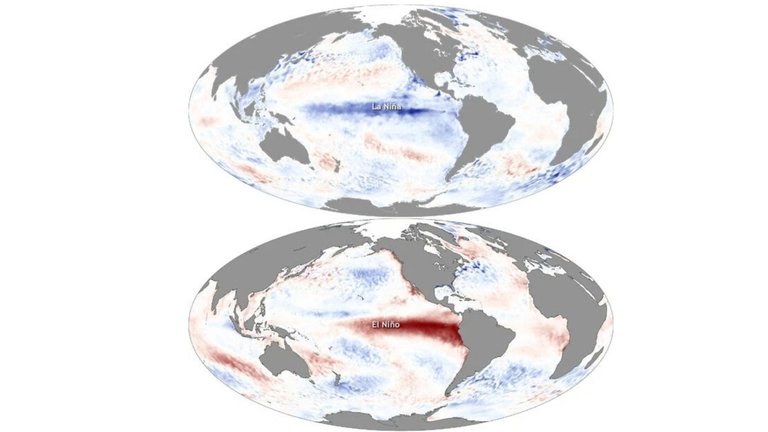
El Niño is a phenomenon that usually occurs every 2-7 years. In May, the World Meteorological Organization indicated that a new El Niño phenomenon will occur with a 90% probability in the August-November interval. If the predictions were fulfilled, the record for the hottest year would be broken again in 2027, causing extreme weather in different parts of the world.
“Although it can cause great damage, it is a completely natural phenomenon.”
The El Niño Southern Oscillation (ENSO) is a climatic pattern that includes the phenomena of El Niño and La Niña. El Niño and La Niña are two opposing phases: El Niño heats the waters of the Pacific Ocean at the equator, while La Niña cools them.
This oscillation is the main cause of extreme weather events and is associated with droughts, floods, forest fires and coral bleaching. It also affects agriculture, ecosystems and human health. Although it can cause considerable damage, it is a completely natural phenomenon caused by a strange interaction between the Pacific Ocean and the atmosphere above it.
“The sea level around Ecuador is half a meter higher in eastern Oceania than in western South America.”
Due to the inclination of the Earth's axis of rotation, the Sun does not heat the Earth uniformly, and the equator heats more than any other area on Earth. In equatorial areas, hot and humid air tends to rise, causing a drop in atmospheric pressure. To compensate for this imbalance, the wind blows towards the equator from higher latitudes. In the equatorial zone of the Pacific Ocean there are permanent allision winds throughout the year that blow from east to west, that is, from South America to Indonesia.
“Sometimes the Alisio winds weaken, they can also change direction.”
In normal conditions, this wind pushes the warm surface water of the Pacific Ocean along the northern coast of Ecuador, Peru and Chile towards Indonesia and Australia. In part due to this constant flow, the sea level around the equator is half a meter higher in eastern Oceania than in western South America, and the water is warmer. This difference in sea level also tends to be constantly balanced, and on the northern coasts of Ecuador, Peru and Chile, deep cold water rich in nutrients rises to the surface.
Scientists still haven’t figured out why, but sometimes alisio winds weaken and can even change direction. In the absence of wind, warm surface water is not sent to the Oceania area and accumulates on the equatorial coast of South America. When it begins to evaporate, the huge amount of heat accumulated by the ocean passes into the atmosphere. This is the El Niño situation, which has a profound impact on the Earth’s climate.
Buletina
Bidali zure helbide elektronikoa eta jaso asteroko buletina zure sarrera-ontzian