 Bilatzailea


[Use of glass fiber composites in safety components in elevators]
This work explores the possibility of using composite materials as a light substitute for metallic components in telescopic elevator skirts. Glass fiber reinforced laminates have been characterized and optimized by finite elements. The prototype developed has met safety requirements, allowed a weight reduction of more than 30%, maintained mechanical performance and improved energy efficiency.
Agility has become a key objective in the development of structural and safety components in lifting equipment, driven by the need to improve energy efficiency, mobility and operational performance1,2. Reducing the weight of the structures reduces inertial loads, reduces mechanical fatigue, facilitates transport and increases safety, in addition to shortening installation and transfer times, which improves the overall efficiency of the equipment3.
Steel is currently the most widely used material in lifting systems due to its high mechanical strength, durability and reliable fatigue behavior. However, its high density significantly increases the weight of the components, which increases energy consumption, transport costs and dimensioning requirements of the support structures. In addition, steel has corrosion sensitivity and is electrically conductive, which imposes important limitations on certain working environments4.
Aluminum alloys offer lower density and higher corrosion resistance, but in demanding structural applications they do not always have the required mechanical behavior
In this context, hybrid structures combining the properties of metallic materials and composites are attracting increasing interest. These solutions combine the ductility and hardness of metals with the lightness and adaptive mechanical properties of composites, making them an attractive option for the structural and safety components of future lifting equipment.
At present, all structural components of telescopic elevator skirts are made of metallic materials. Although some attempts have been made to use thermoplastic materials, their use has been limited to secondary functions such as coatings, shields or decorative elements. No structural components made of composite material have been identified. Therefore, the objective of this work is to study the feasibility of replacing these metallic components with hybrid structures of composite materials and metal-composites, especially in hybrid joints and areas of high wear.
Materials and methodology
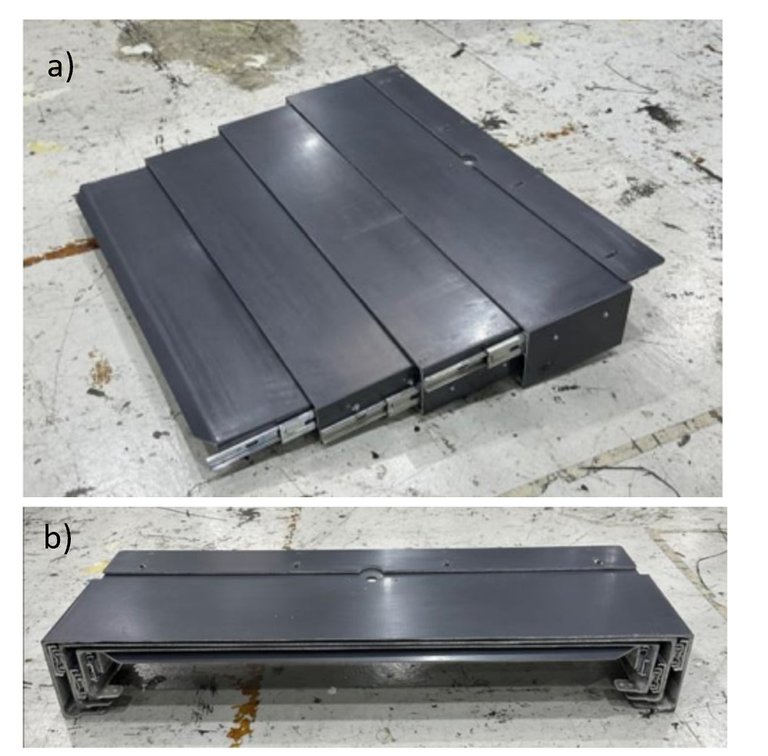
In the first phase of the research, a mechanical characterization of a composite laminate reinforced with biaxial glass fibers was carried out. For this purpose, using the same manufacturing process as the skirt, a series of plates were produced and subsequently the test pieces were machined according to the corresponding regulations. Tensile, flexural and density tests were performed. The main mechanical properties obtained are summarized in the following table.

Once the properties of the material were defined, finite element models (FEM) were developed to analyze the structural behavior of the skirt. The studied configuration has a telescopic skirt with four bodies, where each body is made of composite material and joined by metal guides. The main design requirement was that the displacement under a load of 300 N applied at any point of the skirt was less than 30 mm.
In the first iteration, a simplified model was developed by means of a four-layer laminate. The layers were set in a 0°/90° orientation, resulting in a total thickness of 4.8 mm. In this model, the metal guides were considered as elements of infinite rigidity. After the application of the boundary conditions, it was observed that the deformation was mainly concentrated around the longitudinal axis of each skirt, which allowed a more detailed study of each subassembly. In the critical case, a maximum displacement of 14 mm and a Tsai-Wu index of 0.64 were obtained. The Tsai-Wu criterion is an indicator used to predict failure in composite laminates, assuming that when the value is less than 1, the material will not fail. Therefore, it was concluded that the design meets the safety requirements. As a result of this analysis, a four-layer laminate of glass fiber biaxial fabric positioned in 0°/90° orientation was selected for the skirt forming parts.
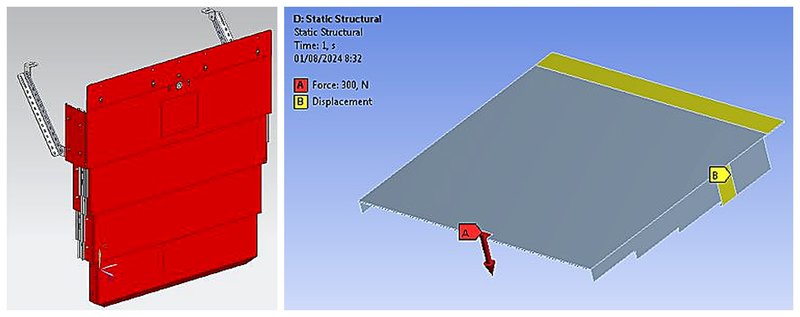
Finite element model (FEM) of the telescopic skirt
Design and manufacture of the skirt
Based on the results obtained from the finite element analysis, the geometry of the skirt was redesigned. Considering the increase in thickness, the joints and lengths between the pieces were adjusted to ensure proper assembly. Likewise, all geometries that could hinder the demolding were eliminated. This design again resulted in a significant reduction in the weight of the structure. In fact, the original metal skirt had a mass of about 12 kg and the composite version developed is expected to weigh less than 8 kg.
This represents a weight reduction of more than 30% while maintaining structural behavior. Modular metal molds were designed for the manufacture of the skirt. The molds were manufactured by laser cutting and sheet metal folding, integrating all the geometries and holes required by the pieces. Removable molds were used to facilitate demolding in the counter-parts.
The manufacturing process began with the preparation of the surface by applying various layers of mold release. The gelcoat coating was then applied to achieve the final aesthetic finish of the part while providing additional protection against corrosion and aging. With the gelcoat still fresh, manual lamination was performed. Biaxial fabrics and glass fiber resin were systematically deposited. To reduce the risk of delamination, glass fiber MAT layers were inserted between the structural layers to improve cohesion.
After demolding, the parts were machined, creating the necessary holes and functional voids. Finally, the five components were joined using the same guide and joining elements used in the original metal skirt.
Conclusions
The results show that glass-fiber reinforced composite materials are a viable alternative to replace the metal components of telescopic elevator skirts. The design developed has met all the established mechanical limits, reaching a maximum displacement of 14 mm and a Tsai-Wu value of 0.64. In addition, a weight reduction of more than 30% has been achieved, which results in significant improvements in transport, energy consumption and handling. These results demonstrate the great potential of composite materials and hybrid metal-composite materials in new generations of structural and safety components in lifting equipment.
Bibliography
[1] Wang, Hua; Zhang, Shuai; Yu, Junyang. 2018. “Computer Aided Tolerance of Composite Elevator Assembly Involving Clamping Forces Coordination”. Procedia CIRP, 75, 256–260.
[2] Yu, Bolin. 2014. A Surface Composite Coating Elevator Safety Gear Wedge. Advanced Materials Research, 838–841, 148–151.
[3] Callister Jr., William D.; Rethwisch, David G. 2018. Materials Science and Engineering: An Introduction. Wiley, Hoboken.
[4] Kheswa, Banele Siyabonga; Whitefield, David; Potgieter, Herman; Bodunrin, Michael. 2026. “Corrosion of S32205 Duplex Stainless Steel”. CORROSION, 82(1), 4–16.
[5] Wang, Renhong; Wang, Xiuli; Su, Peiyu; Chen, Zhihua; Liu, XiaoWei. 2026. “Study on Mechanical Properties of Reinforced Aluminum Alloy Bolted Joints.” Structures, 84, 111066
[6] Akkaş, Y.; Alsancas, S. 2026. “Lightweight Design of Running Prosthetic Feet Using Honeycomb Sandwich Composites: A Comparative FEA Study”. Frontiers in Bioengineering and Biotechnology, 14, 1785315.
Buletina
Bidali zure helbide elektronikoa eta jaso asteroko buletina zure sarrera-ontzian