 Bilatzailea


Energy self-sufficiency in the Basque Country
In the Basque Country there are opportunities to achieve net energy self-sufficiency through the implementation of renewable and predominantly public facilities.
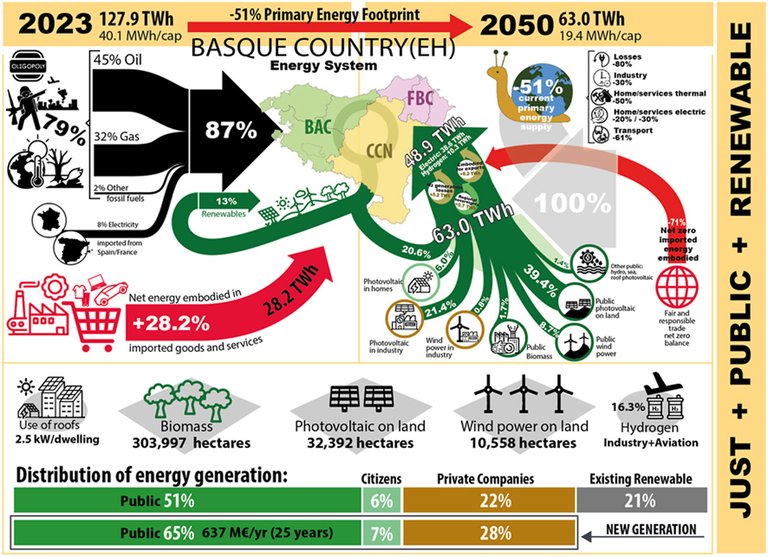
Researchers from the UPV/EHU, LAB and BC3 have proposed an energy model for 2050 that promotes social, political and economic debate on the subject. According to the study published in the journal Utilities Policy, in order for the Basque Country to achieve a just, public and sovereign energy transition by 2050, it would be necessary to reduce energy consumption by 51% and increase local renewable energy generation by 386%.
The Basque Country is one of the regions with the highest dependence on fossil fuels in Europe. 79% of the energy consumed today comes from fossil fuels, of which the US is the main supplier with 33% of the gas consumed and 12% of the oil. In addition, it consumes 13% more energy than in the Spanish State. According to the authors, energy consumption in the Basque Country is high, bad and expensive.
Therefore, in addition to reducing energy consumption, it has been estimated that to meet the needs of the territory, the current renewable generation in the Regional Community of Navarra should increase 2.6 times, 5.6 times in the Northern Basque Country and 7.1 times in the Autonomous Community of the Basque Country.
The authors argue that the energy transition will not be fair if it is not public and renewable, and that the study aims to stimulate debate to find a solution to the current serious energy situation.
Buletina
Bidali zure helbide elektronikoa eta jaso asteroko buletina zure sarrera-ontzian