
 Bilatzailea


The air conditioning doesn’t cool as much as you think
This summer we are experiencing unprecedented heat waves in Europe and Asia and we are looking for solutions to withstand them in our buildings, including the installation of air conditioning. However, experts say that there are better solutions.
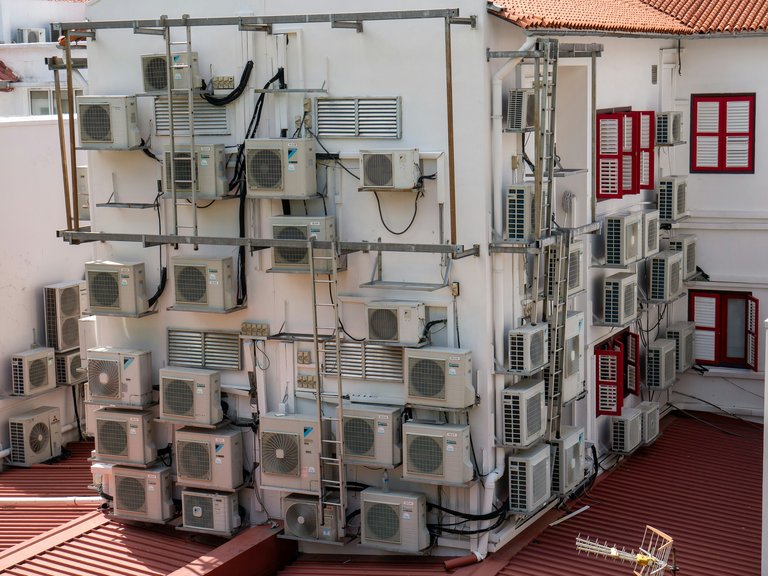
According to an article published in Nature Reviews Clean Technology, we currently use 10% of the world’s electricity to power building cooling systems. This percentage is expected to increase in the coming years, as heat waves are expected to be more frequent, intense and prolonged. by 2050, it is estimated that the electricity we will need to cool buildings will increase by 210% compared to 2024, and greenhouse gas emissions will triple.
Air conditioning is widespread in countries such as the United States, Japan and Australia, but is less common in European households and/or low-income countries. Cooling systems are expensive and consume a lot of energy. But, in addition to that, they have many other disadvantages.
“Air conditioning lowers the temperature in buildings, yes, but at the expense of more heat build-up in the city.”
At times of high temperatures, the use of air conditioning also increases and there are blackouts due to excessive electricity demand. The authors consider this conclusion to be extremely dangerous, as it leaves vulnerable people unprotected from high temperatures.
On the other hand, air conditioning reduces the temperature of buildings, yes, but at the cost of accumulating more heat in the city. The “split” cooling system, the most common system in homes and offices, takes the heat from the interiors and expels it to the outside. This operation creates a wheel nut, since the increase in the outside temperature in turn creates the need to use more air conditioning.
“With passive cooling, 97% of solar energy can be reflected.”
Fortunately, in recent years new materials have emerged that passively cool buildings, requiring little or no energy. One of the most important advances is the materials that reflect the light of the Sun and, in addition, do not heat the environment, which can take on the form of paint, glass, gel or other forms.
During the day, heat from the Sun comes to us through infrared waves that are absorbed by the surfaces. If the surfaces heat up more than the environment, they release infrared waves back and heat the environment. However, there is a wavelength range of infrared waves that is not absorbed by the environment and that escapes directly into space. These new materials reflect the infrared waves emitted by the Sun, but at certain wavelengths that will not be absorbed by the environment.
Another example of passive cooling systems are paints containing microspheres or nanospheres of silicon or aluminum oxide. These spheres improve light scattering, and a previous test reduced the surface temperature by 5.26°C and reflected 97% of the solar energy.
The authors of the study point out the need to accommodate these innovative materials as soon as possible, knowing the forecasts of heat waves. They emphasize the need to transform current refrigeration systems and make them more efficient to ensure the health and well-being of all.
Buletina
Bidali zure helbide elektronikoa eta jaso asteroko buletina zure sarrera-ontzian