 Bilatzailea


Autism in the eyes
The origins of autism are surrounded by suspicion and gossip. But today it is known that its genetic basis is precisely influenced by the genes that direct the development of the nervous system during the first months of pregnancy. Genetics is the main cause, but the environment also influences it. For example, a drug used against pregnancy nausea, thalidomide, was one of the side effects of autism. In contrast, taking folic acid before pregnancy decreases the risk of autism by 40%. This disorder
directly affects the brain: the tonsil, the cerebellum, the mirror cells (cells that cause the child to reflect the behavior of those around him), the field of language and the imagination. It also affects the mind. However, there are many intelligent people with autism disorder. Autism
cannot be cured, but the quality of life can be significantly improved with proper treatment, i.e., proper education and care. No pharmacological treatment is currently available, although it is under investigation.
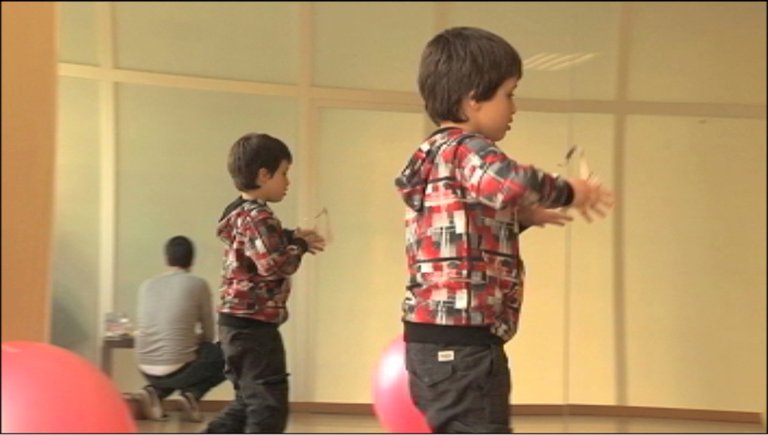
It’s Friday afternoon, the last hours of school at Toki Eder. As usual, children are eager to leave the classroom. Michelle and her friends are happy.
JOAQUÍN FUENTES; child psychiatrist, Gautena: Basically, I would say that there are two main stereotypes. One, we think they're very lonely people. They don't like relationships, being with others... But that's a lie.
FATIMA; Michael's mother: It’s always been very social with us. He looks us in the eye, asks us for things... Always trying to get our attention. I hadn’t read anything about autism.
JOAQUÍN FUENTES; child psychiatrist, Gautena: It is a mistake to say they are all the same. They're all different. And within this diversity, most are interested in contact and communication. Another thing is cost.
FATIMA; Michael's mother: “My son looks at me, he smiles at me... it can’t be.” Well, yeah, yeah. It could be. Starting to read, there are only myths about autism. Nowhere does it appear that every child has their own autism, with their own personality. And that autism affects the personality, the conception of the world.
JOAQUÍN FUENTES; child psychiatrist, Gautena: Another mistake is very common to think that they are all wise because a few were so. And that's not the case. We have people who are very intelligent and who are not, as in the rest of the population. Moreover, intellectual disability is more widespread in this case.
Autism spectrum disorder has several symptoms that affect three areas: relationships, communication, and imagination. It’s a wide fan, even those with a normal level of intelligence in between, and it’s precisely those who, first hand, help to understand how they see the world.
JOAQUÍN FUENTES; child psychiatrist, Gautena: There is one person who once told me one thing that I like very much: “It’s like I came to Earth from Mars: I don’t know how the people there work. At first I won't know how to act like them, but I can learn. If you show me, I'll learn. Give me the instruction book, and I will learn.” That’s what they do: learn. We use our instincts, but they have to learn.
The child with autism has a natural ability in his favor: vision. He calls attention to the images and understands them well. That is why parents, therapists and teachers use photographs and drawings, which are pictograms. Pictograms are images that help you understand the world; they somehow divide reality into smaller, more understandable parts. In addition, they are also used to communicate by children who do not speak.
FATIMA; Michael's mother: We need pictograms because he doesn't talk. He understands it because he is unable to use the language. They are visual systems because they understand their way of communicating. And for now, very schematic pictograms are not valid. The drawing must be clear, understandable, and must serve to communicate. For example, to request things.
Developments in the field of new technologies have opened a new door. For example, tablets allow you to manage pictograms much more easily and quickly: add new pictograms, order them, organize image sequences to indicate actions, make agendas...
The development of applications that can be useful for communication has become a priority for many associations, such as Gautena. The e-membrane application has been developed. In addition to facilitating the communication of the person with autism disorder, applications such as these also respond to the needs of those around them, who were forced to carry a lot of pictograms on their back to have access to the occurrence.
FATIMA; Michael's mother: I used to dream about this sometimes. Four hours of sleep and nothing more in mind: how to order, actions, things for the bathroom... What a nightmare! These were made in school; very schematic for him, but he had the help of photos. And the actions are infinite: search, clean, climb, no, yes... And now, I can do all this in a di-da with just one finger.
Mikel has a tablet called Piktoplus, developed by the company Limbika in San Sebastian.
JORGE GARCÍA; Limbika: Communication between the user and the world takes place through pictograms. A pictogram is, after all, a drawing; a drawing to communicate a feeling, a thought or an activity. When the pictogram plays on the tablet, it gives you a voice, and the communication is very personal in this way.
We already have it in Basque, and we are trying to develop it in Basque so that it can make a natural language that uses conjugated verbs. The goal will be to avoid the need for Piktoplus when the child acquires the language. In this process he adapts himself by increasing the complexity of the drawings he uses, making sentences more difficult... He is designed to adapt.
JOAQUÍN FUENTES; child psychiatrist, Gautena: When we started in Gipuzkoa, 30 years ago, 30 out of 10,000 children had the disorder. Now, in the United States, for example, one in 88 has it. And one in 38 in Korea. The main difference between the two data is that we only consider those who come to clinics in the United States and also here. In Korea, on the other hand, 50,000 children were taken and examined. The alteration was observed in 38 of them. Not all of them needed special help; some were just variants of normality. That’s why we say that this is a “fan”, a spectrum.
JOAQUÍN FUENTES; child psychiatrist, Gautena: We are privileged in many things. And our main challenge may be to advance in early diagnoses and multimodal treatments, to develop new drugs that go to the heart of the disorder. That’s what we’re doing, but that’s our challenge. In other countries this is not a challenge. And, we must not forget. It is known that most people with autism do not receive treatment; they are completely excluded.
JOAQUÍN FUENTES; child psychiatrist, Gautena: Some children start talking late; others struggle to learn to walk; or they find it difficult to learn to read. On the other hand, what is difficult for others is relationships, making friends, communicating with others, internalizing social norms... Therefore, the alterations that we unite under the umbrella of autism affect the development of social and communicative functions, that is, the very being of the person.
FATIMA; Michael's mother: He is the one who cannot communicate, and he is the one who lives full of stimuli; the one who lives in a struggle. But he's a champion.
Act, act and act... until you get it. Because whoever doesn't try never gets it. But with action, it will finally come out.
Buletina
Bidali zure helbide elektronikoa eta jaso asteroko buletina zure sarrera-ontzian