
 Bilatzailea

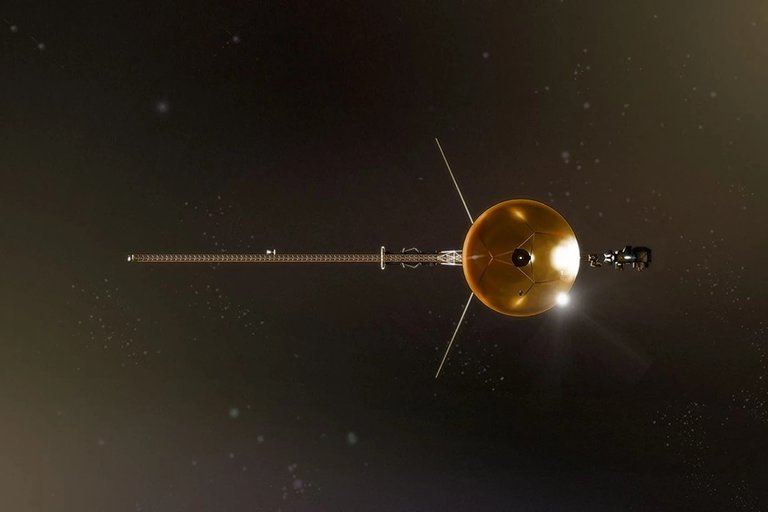
A man-made object has never been so far from Earth. The probe will be about 25.9 billion kilometers from Earth, and a beam of light sent from Earth would take a day to reach it, while the Voyager 1 probe has taken 49 years, 2 months and 11 days to travel that distance.
“They are the only probes that directly study the interstellar field.”
Although Voyager 1 will be the first to arrive, the twin Voyager 2 will reach the same milestone in 9 years if everything goes well. The two probes were launched in 1977 but are on a different route; both passed through the planets Jupiter and Saturn, but Voyager 2 was diverted to later visit Uranus and Neptune as well.
Both probes are the only ones that have worked outside the heliosphere, that is, outside the area exposed to the solar wind. Voyager 1 left this area in 2012 and the twin probe in 2018. Therefore, they are the only probes that directly study the interstellar field.
Both became very popular because they included within each of them a phonographic disc containing information from the Earth addressed to aliens: Sounds and images of life on Earth and human culture.
‘they travel at 61,000 km/h and 55,300 km/h respectively.’
In addition, when the Voyager 1 probe was beyond the planet Neptune, about 6 billion kilometers from Earth, mission officials turned the probe around and focused it on the Earth. This is how about 60 photographs of the Solar System were obtained, one of which became especially popular: A painted blue dot. In this photo you can see the Earth, a tiny point between the sun’s rays.
Both Voyager 1 and Voyager 2 probes continue to send information to Earth, but some instruments have been turned off to save energy. they travel at speeds of 61,000 km/h and 55,300 km/h, respectively, towards the interstellar zone.
Irati Diez Virto
Elhuyar Zientzia