
 Bilatzailea


A decagonal wave has been found at Saturn's south pole
in 1981, the Voyager space mission detected a hexagonal wave at Saturn's north pole. Now, a similar structure, decagonal, has been seen at the South Pole.
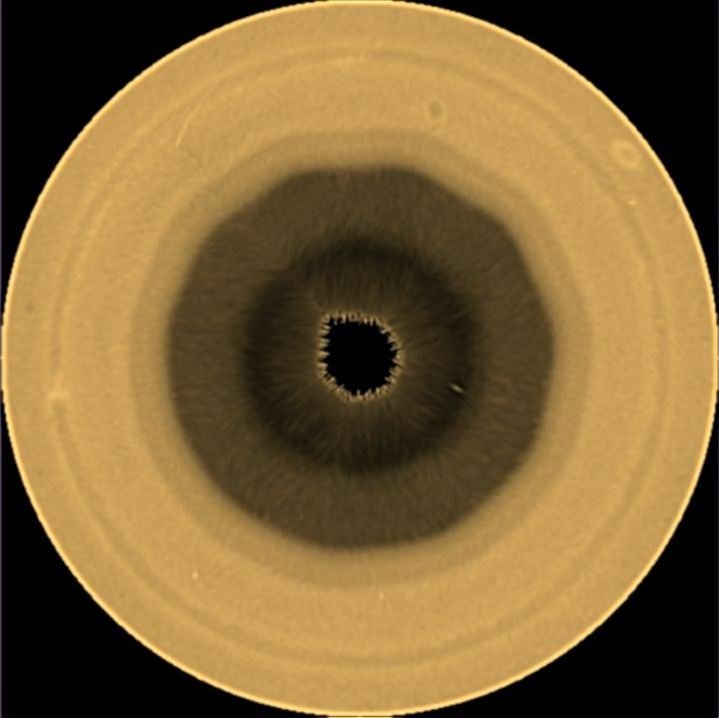
The hexagonal wave at Saturn's north pole has been known for 45 years, and its formation and dynamics are being studied. The distribution of its winds and atmospheric dynamics are symmetrical, so it was expected to find a similar structure at the south pole.
A new research led by the UPV/EHU's Planetary Sciences team has identified the formation, but instead of being hexagonal, it is decagonal. The structure has been characterized for the first time and its dynamics have been measured.
“The Decagon moves at a speed of about 10 km/h, as if it were a whole.”
For the study, images taken by the Hubble telescope and an extensive network of amateur astronomers have been used, estimating that the structure originated between 2023 and 2025. The decagon moves at a speed of about 10 km/h, as if it were a whole. Researchers believe that it may be a temporary variable formation and not a stable structure.
The hexagon of the North Pole, on the other hand, has remained stable since its discovery until today. it measures about 30,000 km and changes color according to the seasons.
The depth of both the hexagon and the decagon, which can be superficial meteorological formations or deep-rooted structures, remains to be clarified. The models used for the research are a first approach that will serve as a basis for many other studies. In any case, Saturn is closer to solving the mystery of the supposed asymmetry of the two poles of the planet.
Buletina
Bidali zure helbide elektronikoa eta jaso asteroko buletina zure sarrera-ontzian
Bizitza





Aldizkaria
Kolaboratu
Zure lana argitaratzea nahi duzu?
Gai zientifiko bati buruzko artikulu bat baduzu, bidali eta sarean zein aldizkari inprimatuan argitaratu dezakegu.