 Bilatzailea


Fossils of an ancestor close to Sapiens have been found in Morocco
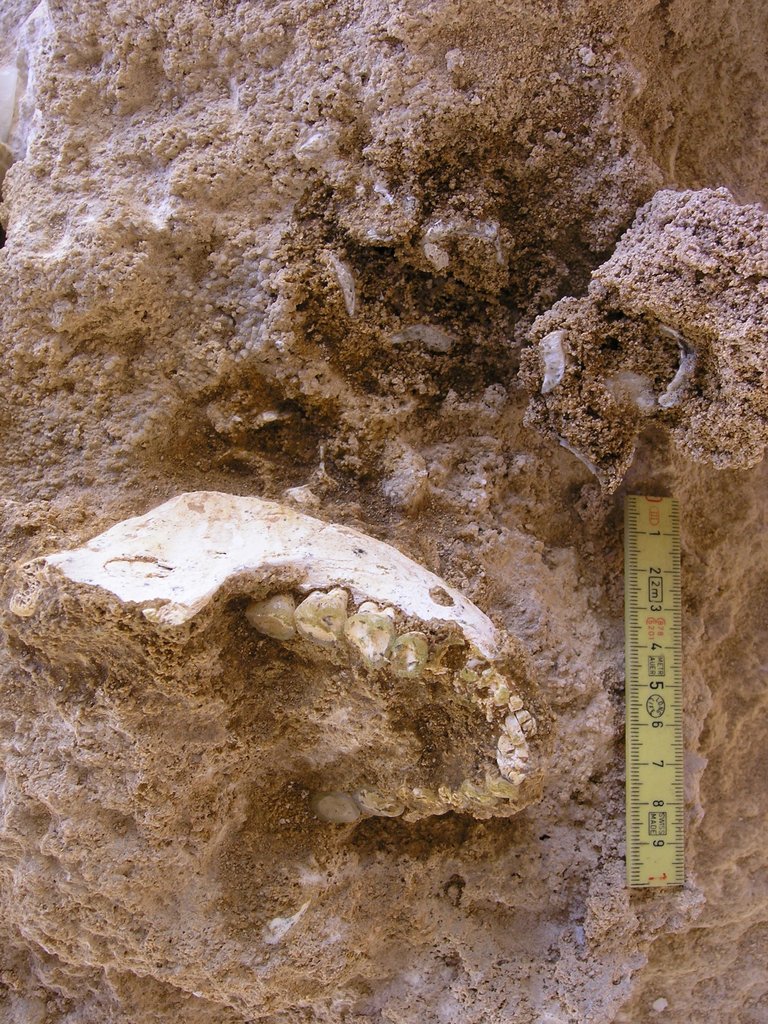
The study of the fossils of some hominins of the site of Thomas Quarry I (Casablanca, Morocco) has led to the conclusion that they belong to a lineage very close to the modern man. Although the Homo antecessor of Atapuerca dates from a similar period to the human being (773,000 +/- 4,000 years), they are morphologically different. Thus, the study provides important clues to elucidate the evolutionary history of the Sapiens, Neanderthals and Denisovans.
The study involved a large group of researchers, including Asier Gómez Olivencia from the UPV/EHU, who published the results in the journal Nature. The fossils were found in a cave called “Grotte à Hominidés” (Grotte à Hominidés), including two partial jaws, numerous teeth and vertebrae. In fact, Gómez Olivencia has been in charge of the study of some cervical and thoracic vertebrae and, he confesses, he is happy to have participated in the study, since it is a work of great importance.
Same time, but different
The dating has been very accurate because the high-resolution magnetostratigraphic recording of sediments shows that they date from the time of a significant change in the Earth's magnetic field (Brunhes/Matuyama boundary). As already mentioned, the fossils of Homo antecessor found in Atapuerca date back to that time, and although they were once considered ancestors of the nearest Sapiens, they have subsequently been found to have characteristics close to the Neanderthal lineage. It is therefore not yet clear who he is and where the last common ancestor of the Sapiens, the Neanderthals and the Denisovans lives.
“This ensures that the division between the Homo sapiens and Neanderthal lineages occurred in an ancient chronology.”
In Africa, there was a gap in fossils from that time, so the current discovery helps to fill that gap. According to the study, morphologically H. in Antecessor they are different, although they are from the same period. “This guarantees that the division between the Homo sapiens and Neanderthal lineages took place in an ancient chronology: more than 800 thousand years ago; perhaps 1 or 1.2 million years ago,” emphasizes Gómez Olivencia.
The fossils of Morocco combine the characteristics of the ancient Homo erectus and the later Sapiens and Neanderthals. Therefore, they are located near the origin of the lineage of the modern man. Finally, Gómez Olivencia recalls that human evolution is not linear, but "scrubland"; and that the current situation, in which there is only one human species, is the exception: “In evolutionary history to date, there has always been more than one human lineage living at a time with distinctive features.”
Buletina
Bidali zure helbide elektronikoa eta jaso asteroko buletina zure sarrera-ontzian