
 Bilatzailea

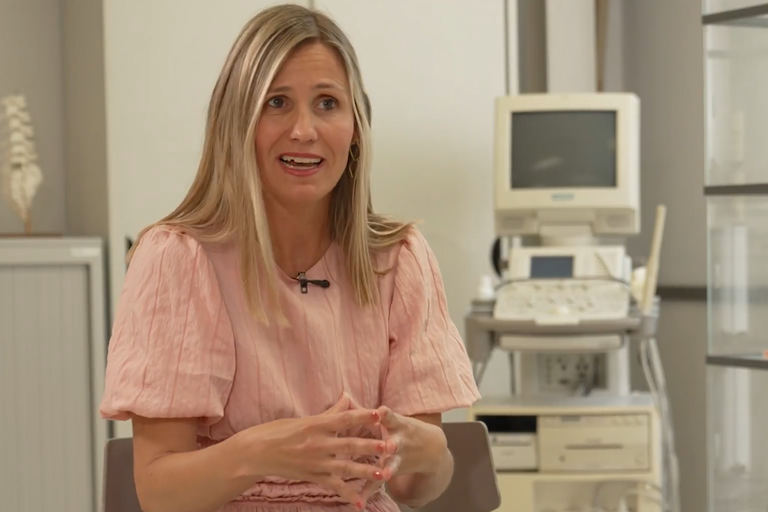
In biomedical engineering, the worlds of engineering and medicine come together to seek technological solutions to our health problems. Maialen Aginagalde Unanue holds a degree in Pharmacy and a vocational teacher. His field is health sciences and, since 2017, he is the coordinator of the degree in Biomedical Engineering at Mondragon University.
To begin with, I would ask you for a definition. What is biomedical engineering?
Biomedical engineering is a multidisciplinary engineering that uses the principles, foundations and techniques of engineering and applies them to the field of biology and health. But, beyond being multidisciplinary, it is also sectoral, since it focuses on a specific sector of the industry: health technologies.
On the other hand, biomedical engineering aims to improve people’s health and quality of life.
But, in fact, those who practice this discipline are engineers, right? They're not doctors.
They're engineers, obviously. We try to make this message very clear. They are engineers and, in addition, they must master many disciplines: mechanics, electronics, design And, of course, they also need specific knowledge from the world of health.
What products and technologies do they create?
An example of this is the design and development of devices to improve medical treatments and diagnostics. On the other hand, they are also dedicated to bioinformatics, that is, to the analysis of biological data. Another important area is the regulatory process of medical devices, since the regulations are very specific in this field. In addition, they are involved in the management of various health facilities and processes. Finally, there is also work in the world of prosthetics that may be more familiar to everyone.
Do you design prosthetics?
Prostheses always start from a need, from a problem. From there, one of the great advances is the personalized prosthesis, which adapts to the specific needs of the person.
When it comes to prosthetics, people will think of artificial arms or legs. But that world is much broader, isn't it?
Yes, the general definition of a prosthesis is a structure that replaces any part of our body, both external and internal. Another concept related to the prosthesis is the orthosis; for example, the device that is placed to immobilize the leg after an operation is an orthosis and a sling. The goal of orthoses is to improve the functionality of our locomotor apparatus.
In terms of technology, what are the advances or new avenues of research that are currently taking place in the world of prosthetics?
On the one hand, to mention manufacturing technology, 3D printing in the world of personalized prostheses is a great advance. This technology is easy to adapt and is widely used in the manufacture of prostheses. In relation to this, much progress has also been made in the science of materials. Plastics are generally used, but the range of materials is very wide. On the other hand, we have bionic prostheses, which are those that can be controlled by people through thought. And if we turn this around again, there are bionic prostheses that help us feel and allow us to perceive touch, texture and temperature.
Is it the present or the future?
We'd say he's in the process.
Prosthetics is a very close example, but you, biomedical engineers, also work with things that cannot be touched: data, artificial intelligence...
Yes, for biomedical engineers, biomedical data is very useful. Biomedical data are data obtained from a blood test, an electrocardiogram is biomedical data and the image obtained in a mammogram.
Artificial intelligence plays an important role in the analysis of these images. In fact, we are able to detect anomalies that cannot be seen with the naked eye through trained algorithms. Therefore, these tools are of great help to doctors, since they allow them to perform their work better, more easily and with greater precision.
In addition, the organs can now be seen not only in photographs or static images, but also in action. That’s a huge step forward, isn’t it?
Yes, of course. This type of image is called functional and represents a great advance, although it is not so unusual. For example, pregnant women are often subjected to an observation called Doppler. In this observation, the movement of the blood flow in the umbilical cord is observed directly to ensure its suitability. And this is a functional image. Another example is the resonances that are performed for direct observation of the brain. Also here, using the functional image, you can see the blood flow in different areas of the brain.
Can you also create new organs?
Yeah, and that's a nice challenge, too. The name of this discipline is tissue engineering, which aims to manufacture parts of the body in the laboratory. To achieve this, three components are necessary: stem cells (cells that can be transformed into any cell), supports, that is, a physical place where these cells grow, and finally, chemical signals, that is, chemical compounds that control the good development of the tissue.
How do you manage to combine these three components?
Through 3D bioprinting. It is similar to the 3D printing mentioned above, but in this case it is not printed with plastic, but with bioinks. Bioinks are composed of cells and extracellular matrices that, as they are printed, form layers of organs.
Is there work in this world today?
Many people ask this question, and the answer is yes. The Basque Country has opted for this industry in recent years at European level, and there are currently more than 300 companies. According to data from the SPRI Group, these companies provide approximately 5,400 direct jobs. There are many types of companies, but most of them are focused on the Basque Health Cluster network.
What kind of companies are they? I mean, what product do they create?
There are many types of companies: some have made defibrillators, others have made prostheses, others have made surgical robots... They are small businesses and there are also startups. On the other hand, universities and technology centres are also part of this ecosystem.
How are we today in the world? Can we compete with large companies?
We are small, yes, but our position is improving; I am very optimistic about it. I believe that our industry has very solid foundations and scientific excellence, we have developed research and we also have the knowledge and potential of industrial production. The Basque Government has long said that we are strategic in this area, and the path is very clear. In recent times, three strategic paths are mentioned: neurosciences, personalized therapies and precision medicine.
So we have the bases, we have the professionals, and I think this sector will have something to say in the future.
Oihana Jauregi Larretxea
Elhuyar Zientzia