
 Bilatzailea

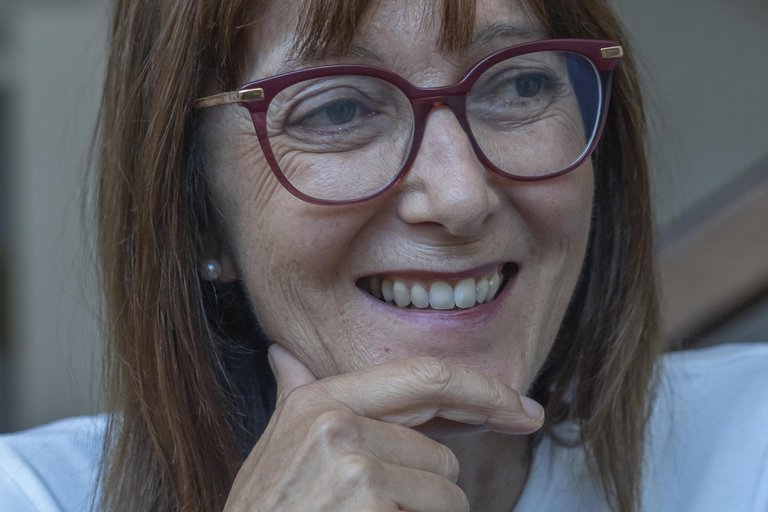
Alkorta is a Doctor of Civil Law. In his work, he shows a strong social commitment, especially in the debates generated by human reproduction techniques and new technologies (digital platforms, artificial intelligence systems). He talked about them in depth and honestly.
He was born in San Sebastian in 1967. Professor and researcher at the University of the Basque Country, president of the Iura Vasconiae Foundation and member of Jakiunde and Elhuyar, among others. In fact, the interview took place at the headquarters of Elhuyar and once again demonstrated his skill in analyzing and clearly exposing complex issues from different aspects.
In this dichotomous division of letters/sciences, you studied law, but you have applied your knowledge to science and technology.
“Yes, that has been, in my opinion, the main characteristic of my career: being a frontier.” I studied Law, but I saw that the main challenge of Law was precisely to respond to the challenges posed by the development of science and technology. So I went down the path of bioethics and got into data protection, now I’m working on artificial intelligence
It seems to me that science/literature must overcome this distinction and we need integration. Because in society we have some dependence on technology and science. On the one hand, they make our lives better, there is no doubt about that. But on the other hand, they also bring us risks. For example, we are destroying nature with climate change, we are losing control over human decision making and our data as a result of the application of technology To respond to these risks posed by technology, we need both.
“It seems to me that science/literature must overcome this distinction and we need integration.”
If I had to summarize it in one sentence, I would say that scientists and technologists cannot ignore the world of values or act as if values did not exist. They must integrate the world of values into their practice, and for this it is essential to strengthen the social sciences. And I think we're doing the opposite. We are widening the gap between them, and we really need to resort to mutual understanding and synthesis.
However, researchers may not have the decision-making capacity to limit their performance. The most obvious example is the nuclear bomb.
- That's it. And, in addition, the values at stake are not personal values of each researcher, but of society as a whole. Therefore, we cannot leave all responsibility to the scientist or the technologist.
In this regard, I am reminded of Joxe Azurmendi’s meditation on technique. it was in 1998 that he formulated the problem that we face today: our scientific and technical potential has increased enormously, but not to the same extent the public awareness and responsibility to guide that potential. Azurmendi calls this imbalance a “delay in consciousness.” We can do more and more things, but from there the question arises immediately: is everything possible human and legitimate? This is, in my opinion, one of the main problems of the governance of technology today.
“Is everything possible human and legitimate? This is, in my opinion, one of the main problems of the governance of technology today."
These decisions cannot be made by a scientist alone, but they cannot be left to the market either. Society must be involved in guiding science and technology.
You saw this need from the beginning and started with human reproduction technologies. Why? Why?
—I did my doctoral thesis on the first law on artificial human reproduction, where I realized how difficult it is to govern technology. When a technology allows us to do something, there is a strong tendency to put it into practice without properly measuring the social and legal consequences beforehand.
I have seen this very clearly in reproductive technologies: as new opportunities have opened up, new markets have also emerged that have not always given due consideration to the rights of women and children born through these techniques. That’s where my interest in technology governance largely comes from.
Reproductive technologies were then the subject of debate, and now the issue has become even more complicated.
- Yes, yes. I did my thesis in the 1990s, and the questions at the time were quite limited: in vitro fertilization, embryo freezing, gametes donation or filiation. Today we have questions of another level: surrogate pregnancy, egg freezing, embryo selection, gene editing or the use of artificial intelligence to select embryos.
Therefore, the technology itself is much more sophisticated, but above all, the nature of the questions it poses to us has changed. We are no longer just wondering whether or not to allow a certain technique, we are playing, for example, how we understand reproduction, what kind of children we want or how far we allow technology to enter into very intimate decisions of our lives.
You say that these new questions are not only due to technological advances, but also because society has changed.
- That's it. And one of the most important changes for me is that we are increasingly responding to collective problems through individual solutions. It is very clear with fertility.
“We are increasingly turning social problems into problems that individuals have to solve on their own.”
Our ways of life, the organization of work, the price of housing or the age of family formation have changed, which has consequences on fertility. But instead of responding to these problems through social policies, the solution is often offered to the individual: to use technology, to go abroad if he cannot here, or to look in the market for the option that suits his needs. Surrogacy is one of the clearest examples of this. We are increasingly turning social problems into problems that the individual must solve on his own.
Or because production is prioritized, as in the case of footballers.
“Yes, and there’s another imbalance there.” The best period of biological fertility of women occurs almost at the same time as the period that our society establishes for the construction of professional life. It is precisely at the biologically most suitable age for having children that we are finishing our studies, stabilizing our work, obtaining housing or consolidating our professional career. And public policies do not provide sufficient incentives to make both things compatible.
This is where technology and the market come in, with a promise: if you can’t or don’t want to be a mother now, keep your eggs and then you’ll have a chance. Technology offers us the possibility of delaying biological time, but this possibility becomes a market product. And there is the interesting question for me: why does the female body have to adapt to the times of the productive system and not the other way around?
Now, as Ellen Hester explains, there is another twist, as bronatalists aim to artificialize the entire process of creating children, from gametes to artificial uteruses.
- Yes, yes. Ellen Hester has critically analyzed this issue, and before that, Carmel Shalev and others have also done so. They proposed that, from a feminist perspective, technology would free women from the physiological link of having children and allow them to delay and control their fertility in order to have a more autonomous life. But over the years they have realized that the evolution of these technologies has been just the opposite.
In fact, what has been achieved is the privatization of fertility, which creates a number of problems. Among other things, there is economic discrimination, since the woman who can pay can access certain services and the others cannot.
You have mentioned feminist authors, and the feminist perspective is also very evident in your works. What has feminist thought given you?
—Feminism is often associated with activism, but it has also given me a theoretical framework: a way of asking questions. When a new technology or opportunity comes up, I ask: Who can benefit from it? Who is outside? For whose benefit, and at whose expense? Who takes the risks and who pays the costs?
Liberal thought has tended to represent the individual as autonomous and independent. Feminism, on the other hand, has taught us that people are interdependent: we are vulnerable, we need others and we always make our decisions within certain social conditions. This forces us to understand autonomy in a different way.
“Liberal thought has tended to portray the individual as autonomous and independent. “Feminism has taught us that people are interdependent
It is very clear in reproduction. Nowadays, we are increasingly told that everyone has to plan their own “reproductive project”: when they will have children, if they will freeze their eggs, how much they will invest... But in this way, we put the responsibility for a social problem on women. In the name of autonomy, we add another burden: that his fertility must also be managed and financed by him. And this can lead to economic inequalities and new discrimination.
That is, we do not realize the price of the promise that the market makes us.
“The market doesn’t just offer you an option; it makes it desirable and sometimes almost obligatory. It tells you: you can control your fertility, delay motherhood until you want, plan your life. But having more options is not always having more autonomy.
That’s why we have to ask who defines what is desirable. Do we really demand that our fertility is increasingly prolonged and technologized? Or does the market create needs that we didn’t have before and then sell their solution?
“Freedom is not only about accumulating opportunities; it is also about understanding why we want those opportunities and who guides them.”
For me, that’s the fundamental question: just because a technology allows us to do something doesn’t mean we have to do it, nor does having that option make us freer. Freedom is not just about accumulating opportunities; it is also about understanding why we want those opportunities and who guides them.
We can talk about data control and artificial intelligence from reproductive techniques.
- Yes, yes. In recent years we have begun to quantify our body more and more: monthly, fertility, sleep, physical activity This data is collected, cross-checked and conclusions are drawn about our behavior. But now we are taking another step: technologies are being developed that are also capable of acquiring and interpreting neurological data.
This gives a new dimension to the issue. So far, data protection has mainly focused on ensuring privacy and the control of personal information. But if technology is able to infer our attention, intentions, emotional states or other mental states, what is at stake is not only privacy.
Europe has developed strong data protection standards, but these technologies raise other questions. What can be inferred from our neurological data? Who can use them? Why? Why? And above all, to what extent do we want to allow technology to be incorporated into our decisions and our internal framework?
This is where the ambivalence of technology reappears. A device that interprets brain signals may, for example, help a person regain mobility or ability to communicate. But the same technology can also produce very intimate information about that person.
It reminds me that in a device that was developed for people with total paralysis, the password was a thought agreed with the patient.
—Yes, which shows how far the area to be protected can go. But there is another problem: how we give permission. We accept conditions, cookies or data uses every day, but to what extent is this consent really free if the design itself is meant to say “yes”?
“We learned something similar with tobacco: a company knows that its product can cause harm, it cannot leave all responsibility to the consumer.”
The platforms know very well how to retain our attention and guide our behavior. In the United States, for example, there have been major lawsuits against Meta, especially for design features that encourage compulsive use in adolescents. In Europe, we have also begun to impose fines on addictive design.
This represents a major change: we cannot leave all responsibility to the user, saying “you gave your consent”. The company that designed it is also responsible, especially when it knows that its product can cause dependency or damage. We learned something similar with tobacco: a company knows that its product can cause harm, it cannot leave all responsibility to the consumer.
What do you think is more effective: legally limit the design of the platforms, or prohibit their use by minors of a certain age? Or are the two compatible?
—In my opinion, both must be done, and Europe has gone along with it.
If these companies put mental health at risk, they have a responsibility. For this reason, in the macro case against Meta, which was opened in the United States, the company preferred to agree with the judges on the penalty, avoiding the sentence and paying it in advance. Otherwise, a very long rope could follow, because those affected would automatically claim compensation.
It is true that, compared to tobacco, the causal effect is not so easy to prove. Digital companies try to deny this relationship and defend that it is a mere correlation. But the fact that the punishment has been agreed with the judges suggests that they know that there is a risk of proving causality.
It's revealing, yes. And it has also been very significant that the largest American companies in the field of artificial intelligence demand that the regulations be tightened, thinking that the systems they have developed have become too risky.
“Yes, but I think that must also be understood in a certain economic and geopolitical context.” The most advanced AI models require huge investments and it is still not entirely clear how these business models will be profitable in the long term. At the same time, there is increasing technological competition, especially between the United States and China.
That is why, when large companies demand regulation, there may be a genuine concern for security, but there may be other interests at stake. Regulation, for example, can increase market access costs and benefit companies that already have a strong position. And companies, of course, want to have a voice in this governance model. That is why we must be careful to think that self-regulation is enough.
In the end, we return to the initial question. The direction of technology cannot be decided only by the market and companies. Economic interests, rights, security and social priorities must be balanced.
In this sense, in addition to the UPV/EHU, you do a lot of work for society, also through other institutions (Jakiunde, Elhuyar) and the general media.
“Yes, I think researchers have a responsibility to society. It is not enough to generate knowledge; this knowledge must be shared so that society can make its own decisions. Not in a paternalistic way, but with transparency: explaining what we know, what we don’t know, what opportunities are opened and what risks may exist.
We have a problem with technologies: we naturalize new devices very quickly. They are incorporated into our daily lives and, as soon as they realize it, they not only change the way we do it, but also the way we understand ourselves and the world. At that time, many times, the only option left to us is to adapt.
That is why I think it is important that the debate should be held earlier. Society needs rigorous and understandable information to be able to participate in decisions about the direction of technology. This bridge between researchers and society is essential for the recovery of decision-making.
And that's not going against science or technology. On the contrary: it builds trust and gives consistency to development. We need that wisdom that Joxe Azurmendi spoke of: not only do we have knowledge, but we also need to know what we want to use it for and where we want to put limits. In the end, what we lack is not more technology, but a compass.
Ana Galarraga Aiestaran
Elhuyar Zientzia