
 Bilatzailea
Riemann's hypothesis is considered one of the most complex problems in mathematics. in 2000, the Clay Institute of Mathematics compiled a list of the Millennium Problems, stating that it would devote $1 million to solving one of these problems. There are seven problems in total and in September 2026 OpenAI announced that it had solved one of them using artificial intelligence: Navier-Stokes equation. Now, Anthropic says it has solved another problem, as with the previous one, aided by artificial intelligence.
"The resolution, which covers 250,000 pages in natural language, has yet to be understood by Alpöge."
On November 20, Anthropic matemarist Levent Alpöge published a note on his website. He stated in it: “I think I found some evidence of Riemann’s hypothesis together with Claude.”
Claude Anthropic is a family of artificial intelligence models developed by the company and, as Alpöge explained in his note, after a process that has lasted six weeks, he has managed to solve the Riemann hypothesis using Claude. The truth is that the resolution in natural language occupies approximately 250,000 pages. Therefore, Alpöge admits that he has not yet been able to understand the resolution made by Claude.
To ensure that artificial intelligence has not made any logical mistakes, Lean FRO, the Mathlib initiative and MIT researchers have analyzed the code and concluded that it is correct. However, no one has been able to ensure that Claude’s resolution really freed up the problem, given the length of the code.
“Two mathematicians have solved Riemann’s hypothesis using only human reasoning.”
As if that were not enough, a few hours after Alpöge published the note, mathematicians Alessandro Masullo and Brian Conrad indicated that they had succeeded in solving Riemann's hypothesis, using only human reasoning. It took Masullo twelve years to explain the resolution in the 940-page document, but they planned to publish it within a year to correct the errors that the resolution might contain. However, when Claude’s resolution was published, they decided to advance the publication date.
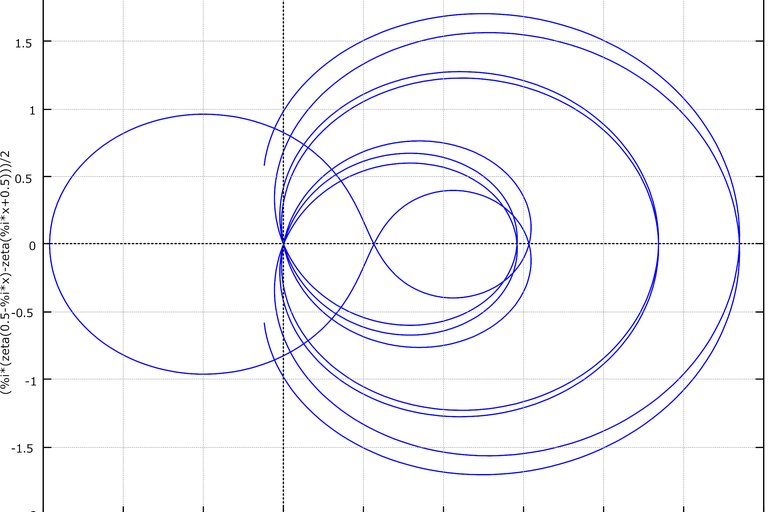
The hypothesis published by Bernhard Riemann in 1859 determines the distribution of zeros in Riemann's zeta function. This distribution is related to the distribution of prime numbers—numbers that can only be divided by themselves and by number 1. The determination of the distribution of these numbers would directly affect, among other things, cryptography and digital security, since many current encryption systems depend on the properties of the prime numbers.
Irati Diez Virto
Elhuyar Zientzia