
 Bilatzailea


An exoplanet orbiting in the opposite direction to its star
It is revealed that an exoplanet orbits in the opposite direction to its star. The mystery is even more complex because there is no massive body around the exoplanet that can influence the planet's orbit.
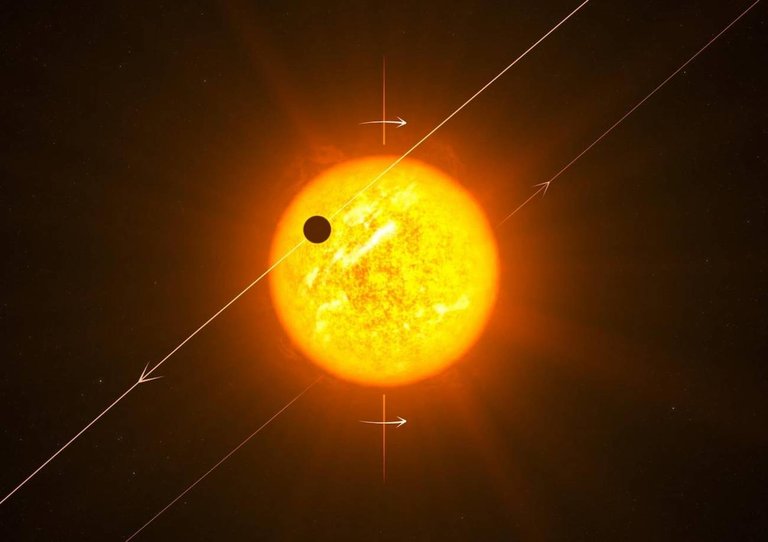
An international study has determined the orbit of exoplanet GJ 3090 b using a spectrograph built in Chile with the help of the Instituto Astrofísico de Canarias. This exoplanet is 4.5 times larger than Earth and orbits a red dwarf star called GJ 3090. Research has shown that the exoplanet orbits in the opposite direction to its star, which is a very curious feature.
“Perhaps in the creation of the star a second disc was created on a different plane.”
The authors do not yet understand the reason for this configuration. In general, during the formation of the stars, the star is surrounded by a cloud of gas and dust, inside which the planets are formed. Normally, the protoplanets that are formed and the disk around the star rotate in the same direction. But this is not the case with the exoplanet GJ 3090 b.
Researchers have explained that the presence of a massive body around the planet could explain the special nature of the orbit, but they have not found it. That is why other hypotheses are being proposed. According to one of these hypotheses, perhaps during the formation of the star a second disc was formed in a different plane, where the exoplanet GJ 3090 b was later formed.
Buletina
Bidali zure helbide elektronikoa eta jaso asteroko buletina zure sarrera-ontzian