
 Bilatzailea
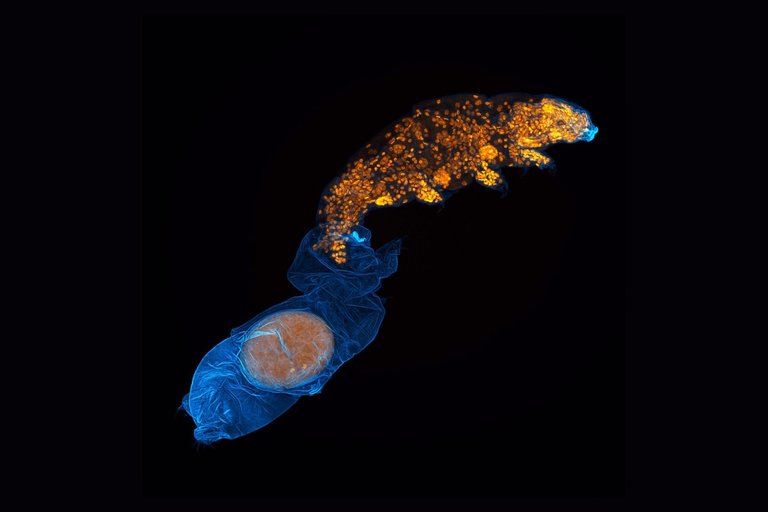
These microscopic animals usually reemerge several times, and some species take advantage of this moment to spawn their eggs. The tardigrade of the photo, together with the loss of the old crust, has placed the egg inside so that the next one is more protected.
The photo was taken by Dr. Gonzalo Quiroga Artigas, who was the 12th laureate at the 2026 Nikon Small World Photo Micrography Competition.
Tardigrade means "slow walker" and was named after biologist Lazzaro Spallanzani in 1777. more than 1,500 species of tardigrades are known, most of them terrestrial. They live mainly in mosses, lichens and ferns, although they can also live in ocean waters or fresh water.
Many studies have been carried out on these strange animals, which have the ability to survive in extreme conditions. Spallanzani himself observed that the tardigrades “died” by drying the moss in which they lived, but began to move when rehydrated. From this, it has been shown that tardigrades can survive in the vacuum of space, under a pressure of 6000 atm and at temperatures between -200°C and 150°C.
Irati Diez Virto
Elhuyar Zientzia