 Bilatzailea


5.0 in the industry, digital creatures and robots will become assistants to industry workers
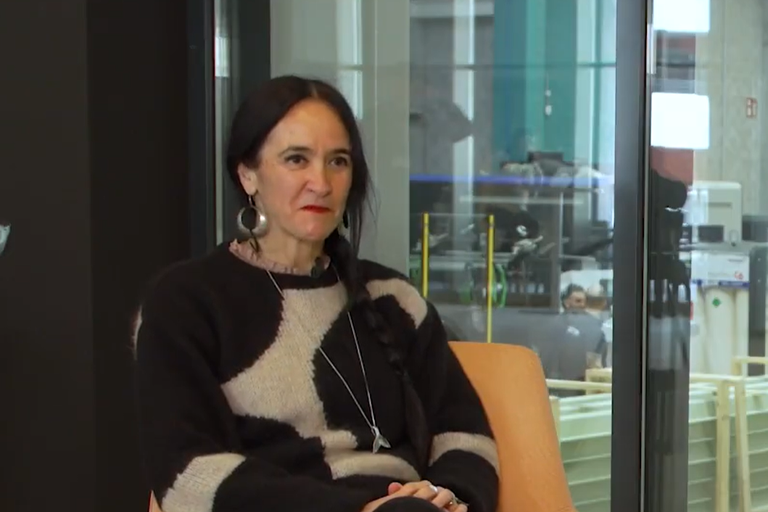
5.0 in the industry the technology will suit the person and not the other way around. After the fourth revolution brought hyperconnectivity, the fifth will focus on the human factor, sustainability and resilience. The engineering doctor Miren Illarramendi Rezabal, a reference researcher in the integration of advanced technologies in the industrial fabric, explains how this change will be carried out and its implications.
What does Industry 5.0 mean? is Industry 4.0 fully developed? Have you already given the right ones?
I wouldn't say so much. I don’t think it’s the end of Industry 4.0. Little by little this issue has been addressed a lot in recent years, digitalization has been incorporated a lot in some industries, but we have different types of companies and I would not say that the level of development is the same in all of them. There is still a long way to go, but it is also true that we must start thinking about the future. 5.0 we already have the idea of the industry here, and we are already beginning to investigate what the next strategies should be.
Let's start building the house from the base. What exactly is Industry 5.0?
industry 5.0 is a continuation of Industry 4.0, but it is intended to go one step further; the main idea is digitalization, putting robots and people working together. And taking advantage of this, it is intended that the whole system is sustainable and resilient.
Why should we bet on Industry 5.0? Why is it necessary?
The world has limits; resources are limited, and if we continue to do things as we have done so far, in a few years we will be faced with a problem. This is one of the important points. On the other hand, if we want to tackle global competition, and keep our industry alive, we need to make that leap.
It’s a nice idea to put people at the center, but what does it mean? How will this materialize?
Putting people at the centre means that digital creatures and robots will become assistants to industry workers. In other words, our idea is to protect the well-being of people in the industrial sphere.
Will it change the way we work?
I think so. Until now, in most companies, robots did a certain job and workers did another. With this change, it is intended to create a site with more interaction. In addition, depending on the needs, at specific times the mission of the system may vary.
At Mondragon Unibertsitatea you train the workers who will work in this industry of the future, right?
That's it. We must always take into account the profile of these workers that the industry will need and we are adapting our studies to that profile. To do this, it is necessary that we, the teachers, also dress up in these novelties and participate in research projects. In fact, we are working on research projects in Industry 5.0 to incorporate them into our studies and provide students with adequate training.
Miren, one of the main characteristics of Industry 5.0 is its ability to adapt to new situations. What does that mean?
He points out a number of issues. On the one hand, the international situation has a direct impact on companies, which must change their planning strategies to be competitive. In addition, it is necessary to make these changes as soon as possible.
On the other hand, even in the industrial field, resilience will become increasingly important. In the solutions we have had so far, the robots have been dedicated to a specific task, from now on it is also intended to incorporate the adaptability of the robots so that they perform one task or another according to their needs. We will have some libraries on the servers with different programs or models and we will modify them according to the needs.
So, can robots be reprogrammed to perform other tasks?
Yes, but the goal is not for us to program the robots directly and for someone to take care of it, it is about taking the modules that are already made and adapting the robot itself.
Another feature of this new industry that is coming is sustainability, but this was also used in Industry 4.0. What changes in Industry 5.0?
industry 4.0 was more focused on optimizing the sustainability of a specific process, such as energy consumption. But now we are going further: instead of talking about the sustainability of a specific process, we are going towards a more general concept, which is the circular economy. Therefore, the sustainability of the entire production process is taken into account. Through a global reading, the ecological footprint of each product is calculated and, based on these data, different regulations determine whether the product is sustainable or not. To be competitive, it will also be taken into account that they are sustainable.
What is the administration doing in general to promote Industry 5.0?
Two binding rules have been put in place from Europe. The first, called the AI Act, seeks to ensure that these technologies that will interact with employees are ethically appropriate. In such interactions, the fundamental rights of workers must be ensured. The second, the Cyber Resilience Act, includes the rules that hardware and software must follow from the point of view of cybersecurity.
So, do artificial intelligence and these cybersecurity regulations help drive and promote Industry 5.0?
Yes, they are important for the protection of people's fundamental rights. Outside Europe, however, the reality is different and there is a lot of competition because in other countries they do not need to comply with such laws. It seems that in Europe we are putting obstacles in our way, but I believe that these rules are necessary for the well-being of all.
What are the main challenges we have left to make the leap from 4.0 to 5.0?
Apart from regulation, the systems we currently use in our industry do not have the necessary adaptability. To achieve this objective, research and transfer projects are necessary. On top of that, we ourselves and the industry workers need to change our professional profiles in order to collaborate with technology.
What can industry 6.0 be like?
I think the key to the next big change will be quantum. Thanks to quantum, there will be a huge qualitative leap in data computation for analysis. When this tool is incorporated into the industry, I think we will find ourselves in another scenario: 6.0 in the era of industry or quantum industry
Buletina
Bidali zure helbide elektronikoa eta jaso asteroko buletina zure sarrera-ontzian
Bizitza




Aldizkaria
Kolaboratu
Zure lana argitaratzea nahi duzu?
Gai zientifiko bati buruzko artikulu bat baduzu, bidali eta sarean zein aldizkari inprimatuan argitaratu dezakegu.