 Bilatzailea


Zumaia's Flysh to the big screen
Our planet is about 5 billion years old... while humans are only the tiny reality of the last 8000 years of all that time. However, we have managed to find out the details of the transformations that the earth has undergone over this long period of time. As witnesses of this vast history, the testimonies that geologists read appear on the rocks. Without going too far, we have one of those testimonies close by that has nothing in common. A book that appears in the flysch of Zumaia along eight kilometers... that will tell us page by page the history of the planet.
Bringing this testimony to the big screen is the work of the directors Alberto Gorritiberea and Asier Hilario. With the secrets of the planet in the mouths of scientists and the objective of the camera turned into a witness.
What appears to be the recording of a fictional film is the filming of the documentary about one of the most important geological sites in the world.
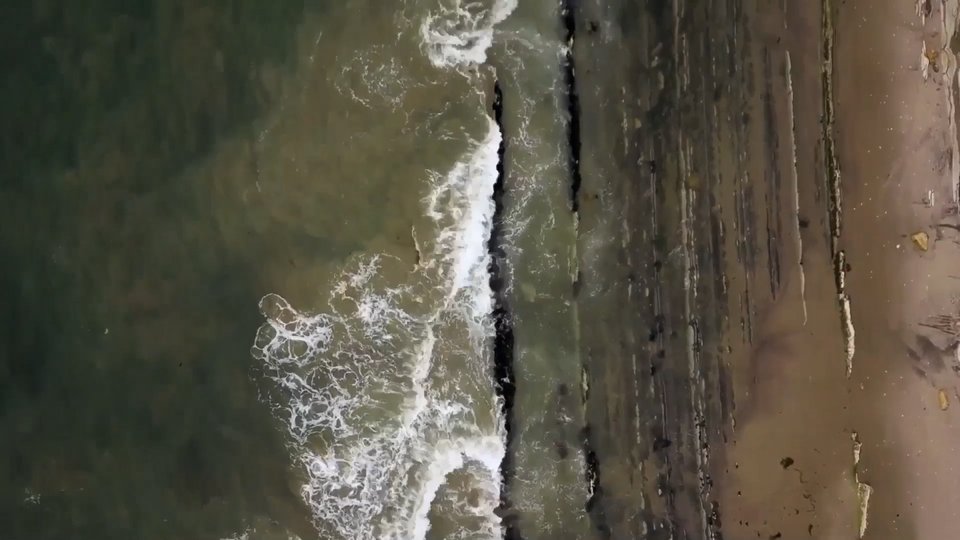
It is a gift of nature that extends for 8 kilometres between Mutriku and Zumaia.This cliff holds all the secrets of the evolution of the planet written on rocks.
The documentary “The Word of the Rocks” is an account of this testimony that is preserved in the rocks, a film that is being created under the direction of Asier Hilario and Alberto Gorritiberea.
It seeks to clarify the essence of the scientific theories that have been based on the studies of the flysch of Zumaia. To
do this, they want to put the instructions in the mouths of those who know how to read these rocks best. On the lips of 20 leading scientists from all over the world.
ESTIBALIZ APELLANIZ; PALEONTOLOGIST: From here to Deba, there are 5000 meters of deposits, sedimentary deposits, so this gives us a unique opportunity to do studies.
JAN SMIT; EXPERT IN THE MASS EXTINCTION OF SPECIES: This affliction is stupendous, it is always fresh, it is accessible, it is a story of the Earth during 50 million years. You can see everything. This
emergence is huge, it is easy to get to it and tells us the history of the Earth in 50 million years. You can see everything in it!JAUME
DINARÉS TUNELL; EXPERT IN PALEOMAGNETISM: A
general vision of us permite, with an ojead of point to point, see in our mind the geological record. A general look, the observation of the surface from one point to the other, allows us to see the geological record. The flysch is one of the few geological books that keeps all the pages and chapters of history intact, and retains its history from 100
million years ago to 50 million years ago.
The rock layers that we see standing up today were 100 million years ago under the sea.
At that time, the Iberian Peninsula was an island and Europe was separated from the mainland. The coast started in La Rioja and the Basque Country was under water. When the Iberian Peninsula crashed into the European Plate, the Pyrenees were formed, as well as the mountains of the Basque Country.
Jaume Dinarés Tunell is an expert in the study of the Earth’s magnetic field. He has linked the cyclical tendencies of Zumaia sediments to tectonic, climatic and astronomical processes.
In fact, by reading the history of these rocks, it can be noted that the planet has cyclical tendencies.
JAUME DINARÉS TUNELL; PALEOMAGNETISM EXPERT: The secuence of this intercourse is to be shared by an alternation of hard and soft rocks, margins that contain more clay, and hard layers that contain more calcium carbonate, which is more hardness, and the purchase itself makes you exaggerate that composure. This part of the cliff alternates between soft
rocks and hard rocks. The soft ones are tuparris and contain more clay. In contrast, the hard layers have a limestone structure. Being harder, the waves wear them less. The
hard and soft layers of the flysch alternate one after the other. Hard, off-white, they’re made from the shells of marine organisms, which is why they’re made from limestone. The soft ones are made of a structure mixed with clay and limestone. They are the result of the accumulation of clays carried by rivers and the mixing of
the shells of organisms. These hard and soft layers also have a direct relationship with the climate. In fact, the type of material that settles under the sea depends on the weather of the moment.
JAUME DINARÉS TUNELL; PALEOMAGNETISM EXPERT: The fact that we have a type of weather outside, or a type of rain or rain running in the continents, is that we have the rivers, the support of the deltas in the sea, the content of the barracks and the detritus, all this is made up of the type of material that is sedimented in the background. This is what the sedimentation of the ocean bottom in reality reflects, in part or in large part, what is happening at the climatic level in the environment. The climate of one kind or another in the outskirts, with more or less rainfall, affects the types of materials that
the rivers transport in their waters.If it is a rainy season, the rivers will transport more clay, and this material will settle under the sea. As a result, the type of sediment under the sea indicates the type of climate in the environment at that time.
When the climates were dry and warm, layers of limestone were formed. In cold and rainy climates, the rivers carried more clay, and soft layers were formed. Considering that the hard and soft layers alternate one after the other, it can be
seen that in the history of the planet, climate changes also occur cyclically one after the other.
The alternating layers have a similar thickness and each represents a period of 10,000 years. Every 10,000 years there has been an alternation of a cold and warm period in the history of the planet. Climate changes are
also related to the change in inclination of the Earth’s axis.
JAUME DINARÉS TUNELL; PALEOMAGNETISM EXPERT: The variation of solar energy that reaches the planet Earth, and indirectly by so much of the climate, and indirectly by so much of the rock type that we have, comes under the conditions of this energy, which is cyclic; it is deciding, the orbits of the planets, the variation of this energy class is only the night, which is the most humane, the most perceptive, the most perceptible, the most perceptive, the most perceptive, the most perceptive, the most perceptible, the most perceptible, the most perceptible, the most perceptible, the most perceptible, the most perceptible. We're talking about the geological stage, where the human being is no longer a layer of percivation, because life is more short.
In the meantime. at the geological level we know, and the astrologers calculate, all these orbital variations of the planets, and there are some models. it is called astronological solutions, of the cantidation of energy and of the solace that reaches the surface of the Earth. And this is refleja in the definitive climate.
The variation of the solar energy that reaches the Earth affects the climate and the type of material of the rocks that we have. This energy not only causes night and day, seasons or hot summers. It causes changes that cannot be detected by man, since the life of man is very short compared to the geological scale. At the geological level we know that the orbital changes of the planets affect the amount of solar energy that reaches the Earth. Astronomers can calculate changes using mathematical models. And this has a direct impact on the
climate. This is what the Serbian scientist Milankovich proved. According to his theory, the tilt of the Earth's axis changes every 20,000 years. The proof of this theory can be seen in
the layers of Zumaia. In these special layers we can find amazing stories written. Between
Deba and Zumaia there are layers of Cretaceous, that is, layers that were formed until 65 million years ago.
In the layers of this period, scientists discovered fossils and microfossils of more than 100 species. However, when we reach the deep tip, in one of the layers, the remains of 90% of the fossils have disappeared.
JAN SMIT; EXPERT IN THE MASS EXTINCTION OF SPECIES: I find myself studying, the Plactónicos forominifieds, they are small animals that live on the surface of the sea, and all of them, 60 species that go through the massive extinction, at the same time that we meet a layer of arches, a layer of 10 meters, and staring at what has happened in the ocean? He's going through something catastrophic. I
was studying the Plactonic Forominifers, which are small animals that live on the surface of the sea. And all of a sudden, all of the species in one layer disappear. more than 60 species. In the same place I found a layer of 10 cm of clay. what happened in the ocean, I asked myself? what kind of destruction?
The study of this layer, where no fossils were found, yielded incredible results. In it, the chemical element iridium was found in large quantities. This element is very common in meteorites, but very rare on Earth. The scientist
Jan Smit is one of the few Europeans who participated in the creation of the theory of the Mass Extinction of Species. He also discovered iridium in his analyses, a discovery that opened the door to catastrophic theories.
JAN SMIT; EXPERT IN THE MASS EXTINCTION OF SPECIES: And it has been found a method, which is called neutron activation analysis, for bombarding the sample with neutrons and salts of these radioactive materials and it is possible to detect some of the elements 34 - 35 together.
I have commanded all my people, and during the two months that I have been communicated there that I am, yes, you are also the iridium.
I have found that there is a method of analysis known as eutron activation. By bombarding the samples with neutrons, radioactive materials are obtained, so that 35-40 elements can be detected together.
I sent all my samples to them, and two months later they informed me that there was iridium in my samples as
well. ESTIBALIZ APELLANIZ; PALEONTOLOGIST: So when they found a much larger amount of this clay than they expected, they couldn’t explain it as concentrated sedimentation. Then it occurred to them that perhaps this iridium had come with the meteorite, and that after a great impact of the meteorite this dust had spread into the atmosphere and accumulated. According to
this theory, the mass extinction of the species was caused by the meteorite that fell in the Mexican province of Yukatan. the impact formed a hole of 200 kilometers, where the dust and sulfur that rose caused terrible fires. Adding to this situation the violent activity of the volcanoes at that time, they conclude that the planet stopped in darkness. Without sunlight, photosynthesis could not be performed, resulting in the successive death of plants, herbivores and carnivores. Dinosaurs lived on the planet for 130 million years. One
of the proofs of this mass extinction is the iridium layer at the tip of the Zumaia Depths, which has become the boundary of the Cretaceous and Tertiary geological periods, the K/T
boundary. Zumaia’s Itzurun Beach is not far from the Depths. There is a boundary between two geological epochs Between Paleocene and Eocene. This reddish layer of clay shows the violent warming experienced by the planet 55 million years ago.
ESTIBALIZ APELLANIZ; PALEONTOLOGIST: Is that supposed to be a warm-up period that didn't quite happen? Compared to the current one, quite a lot, about 10, 18 degrees, and maybe that's why he's studying so much now, because they want to model that somehow. In fact, the experiences of climate change that the planet
has undergone in its history can serve to predict the changes of the current climate.
JAUME DINARÉS TUNELL; PALEOMAGNETISM EXPERT:The climatic change is currently observed from the point of view that there is an industrial era in our society. Until cierto point equivale, or is equivalent, to something that has already happened in the past by other motives that are not human; by so much, the study of other recorded phenomena in the sediments allows us to elucubrate, hypothesizing possible scenarios of development of this. Climate change in our society has been observed since the beginning of
the industrial era. In part, it is equivalent to something that happened in ancient times without the participation of man. Therefore, the analysis of other events that have been recorded in sediments allows us to reflect and make hypotheses about the possible behavior of current climate change. The secrets of the flysch put
into the mouths of experts from all over the world. Pictures of Flysch: The Word of the Rocks, a documentary that will be a witness of the past of the rocks and a predictor of the future.
Buletina
Bidali zure helbide elektronikoa eta jaso asteroko buletina zure sarrera-ontzian
Bizitza

Aldizkaria
Kolaboratu
Zure lana argitaratzea nahi duzu?
Gai zientifiko bati buruzko artikulu bat baduzu, bidali eta sarean zein aldizkari inprimatuan argitaratu dezakegu.