
 Bilatzailea
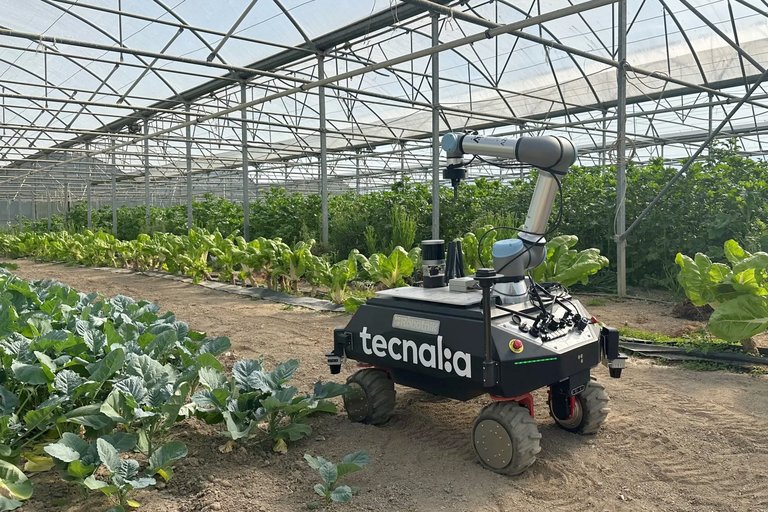
Robots could be suitable for a wide range of agricultural tasks. At Tecnalia, in addition to developing robots that facilitate the work of farmers, they seek to collaborate with the farmer.
“We know that many jobs in agriculture are not very comfortable, they are not very ergonomic, so we are resorting to robotics to automate all these tasks and make farmers more comfortable,” explains researcher Urko Esnaola Campos.
At Tecnalia we are working with a robot capable of collecting the fruit without damaging it. In addition, through artificial vision cameras and different sensors, the robot can know the degree of humidity and temperature of the soil, analyze the state of a plant and detect diseases before they spread.
The robot can operate autonomously or under the remote supervision of a person. This combination of artificial intelligence and human control allows us to adapt to real situations in the field. “For example, the robot collects fruits autonomously, but imagine that it has left some uncollected because it has not detected them or who knows why Then a person can control this work from home or from the work center to finish it well,” says Esnaola.
Also, every time a person takes control, the robot learns. It is a continuous training in which the human experience becomes data for the machine. “This is the revolution that is coming in robotics: the ability to learn,” says Esnaola. “We are automating applications that were very difficult to automate.”
Tecnalia’s prototype is versatile and can perform different functions, simply by changing the tool of its robotic arm. Depending on the use you want to give it, you will be given one tool or another, and even the robot itself could be different. “We actually make software to be useful in any robot,” says Esnaola.
This technology aims to improve agricultural production, but at the other end of the food industry, Tecnalia is working to convert food waste into ingredients of high nutritional value. To do this, they work with microorganisms in their laboratory in Miñano. “We usually start from the by-products of the agri-food chain; we transform them and increase their value,” explains researcher Thomas Dietrich.
First, they analyze the residues of food. Some contain natural antioxidants or dyes that can be extracted directly. “For example, several products can be extracted from tomato waste,” says Dietrich. “Lycopene, for example, is a very strong antioxidant.”
And they don't throw anything away. The remaining tomato residue is introduced into bioreactors for the feeding of microorganisms such as bacteria, yeasts and microalgae. These microorganisms will produce new components of high nutritional value.
For example, they obtain omega-3 fatty acid from biodegradable waste, specifically DHA, a fatty acid essential for the brain and nervous system, which is also key for the development and maintenance of the retina.
The list of products obtained in this way is long. They are then incorporated into conventional foods without altering their taste and texture. To do this, they use nanoencapsulation.
These new ingredients of high nutritional value are ideal for consumers with special needs: athletes, elderly people With the help of artificial intelligence, they design food adapted to different profiles.
Elhuyar Zientzia