 Bilatzailea
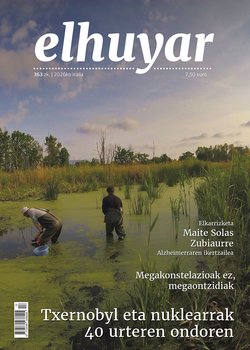
Amaia Ortiz Barredo, together with other colleagues from NEIKER, is collecting escarola early in the morning before her appointment with Elhuyar magazine. Some escarolas are exposed to the sun, others to the shadow of the solar panels. The difference is clear: those that grow in the sun are larger, while those under the plates are smaller. But sun-grown escarolas need to be covered to whiten the center and thus make it sweeter, while those grown under solar panels have not needed this work. “There’s the need to look for balance, what’s more interesting,” says Ortiz, probably unaware of the extent to which this phrase represents the very core of agrovoltaics.
Agrovoltaics are spreading in Europe and other parts of the world, especially in drier areas. “The European Commission is committed to agrovoltaics to avoid the problems posed by photovoltaic installations,” explains Ortiz. “Agriculture and photovoltaics are in competition when it comes to land, and agrovoltaics was created to solve this situation: to continue generating energy and food, both of which are absolutely necessary.”
“Agriculture and photovoltaics are in competition in terms of land, and agrovoltaics has been created to remedy this situation.”
But in addition to avoiding competition, the results show that agrovoltaics can also contribute to the adaptation of agriculture to climate change. The crops under the plates are in the shadows or semi-shadows, which may be beneficial in some cases. In fact, according to a scientific review of 2025, solar panels can create a microclimate in which the temperature is 1-4°C lower than that of the environment and evapotranspiration is reduced by 20-47%.
Solar panels can perform various functions in orchards, such as saving water, protecting crops from extreme events (heat waves, storms) and protect the soil (less erosive). “All things considered, it shows that the system is efficient and sustainable and can offer many benefits in the current context,” says Ortiz.
At NEIKER they began to investigate the possibilities of agrovoltaics in 2023, because they realized that agrovoltaics were expanding in Europe without sufficient scientific basis. “There was no scientific literature; there was no scientific data to make decisions,” says Ortiz. “That’s why we thought we had to provide scientific data as soon as possible so that we could properly design an agro-volt system.”
Eight thousand square meters of laboratory
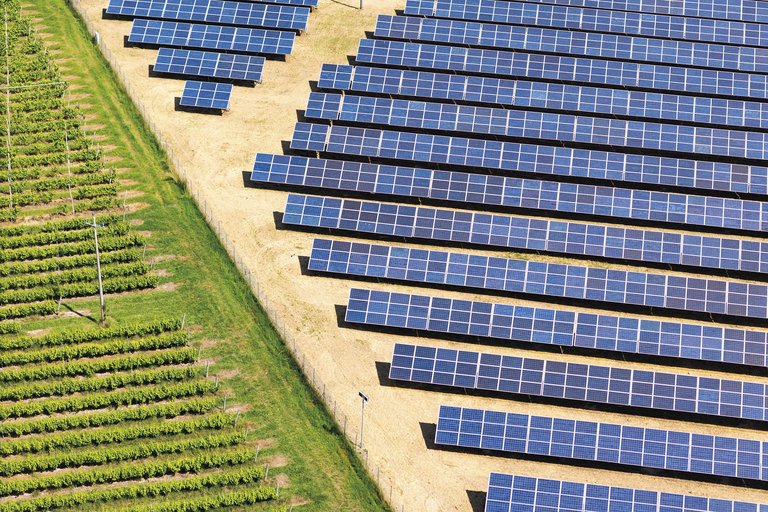
For this purpose, the experimental unit of Arkaute was created. it has 8,000 M2 and the solar panels are placed at four meters of height. This is the most used height in Europe, since it allows machinery to pass underneath, although there are other configurations: lower height, vertical, etc In Arkaute, one area is 100% covered by photovoltaic panels and another area is 50% covered.
“It is not a model for direct use in agriculture, it is to carry out experiments to obtain scientific data with which photovoltaic companies or agronomist engineers can design an agro-photovoltaic system adapted to the needs of the farmer and the crops he will cultivate,” explains Ortiz. “In fact, the first objective of agrovoltaics is agricultural production and the second is photovoltaic production.”
in April 2025, the first plantations in the experimental unit began. In a year and a half, 11 cereals have been tested: potato, beet, onion, carrot, lettuce, escarola, beans And the results are varied.
In terms of production, as in the case of potatoes, they have not found the increase, but not the decrease, that has been observed in other European studies. “In our case, we have seen that it does not affect production, which is also good because you have the possibility to place solar panels without damaging the production,” explains Ortiz. “Onion, on the other hand, cannot be made under solar panels; there has been a significant reduction in production, size and taste.” In the case of lettuce and escarola, the size decreases, but there does not seem to be any loss in quality. And in the case of beans and chickpeas, the conclusions are still pending. In addition, the latter are dependent on pollinators and want to study how solar panels also affect this factor.
“We haven’t seen a crop that improves the shadow yet,” says Ortiz. But he adds that there is another factor that could condition production: “When you do a phytosanitary treatment, the physiological situation is different in the shadows and in the sun, for example, the stomata may be open or closed. This makes the treatment not work the same under these two conditions. And this, that is, the agronomic management itself, also influences production; it is not just a question of how much irradiation is received.”
“The first objective of agrovoltaics is agricultural production and the second is photovoltaic production.”
“We’ve found that there are a lot of factors that we didn’t expect when we started this,” Ortiz says. “Surely if we could control these factors well, we could increase the production of some crops in the shadows.”
In addition to the crops, some livestock tests are being carried out in Arkaute with sheep. In this case, the plates have been replaced by awnings to simulate their effect. On the one hand, how it affects the behavior of sheep and, on the other, how it affects the grass are studied. They see that the sheep are looking for shade, so that no grass grows under them. “We have to find a balance between the density of cattle and the density of solar panels,” explains Ortiz. In addition, this year the data obtained are scarce due to the total drying of the pastures. “The grass survived a little longer in the shade, but it has also dried up in the end,” says Ortiz.
European projects
The Arkaute unit is part of the European AgriPower project. In addition to NEIKER, the Engineering School of the UPV/EHU studies the energy aspect, while in Navarra INTIA has built a special greenhouse with flexible photovoltaic panels on the roof, manufactured by Tecnalia. In addition, other studies are being carried out in France on vineyards, livestock and an irrigation pond with floating plates installed to prevent the evaporation of water.
Researchers from the Public University of Navarra are participating in a similar European project, together with other groups from France, Spain and Portugal, in the AgroSOL project. A total of five pilot projects will be launched.
The Navarre project will be developed in a series of almond trees. Rows of solar panels will be placed between rows of trees, as well as multiple sensors for measurements. The energy obtained from the solar panels will be used to power the irrigation pumps. They now use a kerosene generator set for this purpose, which will be replaced by photovoltaic energy generated in the field. “In this way, the photovoltaic plant strengthens agriculture,” says UPNA researcher Marian de Blas Corral.
Another important contribution has already been made in the AgroSOL project, which has developed a method to analyze the agrovoltaics potential of a region, in order to determine which areas are suitable for agrovoltaics (slope, orientation, special protection areas, etc.). “It is important that before you start implementing an agro-electric system, you have a good look at whether the site is appropriate. Then you have to do more detailed studies for each plot,” says De Blas. With this method, a fairly detailed study has been carried out for the whole of Navarre, which will now be extended to the rest of the regions of the project.
“We want to look for an opportunity for small- and medium-sized farmers to diversify their sources of income so that they do not abandon their farms.”
It has been concluded that it could be viable in many parts of Navarre. And he mentions the case of the vineyards: “It was not so clear in our latitude that shading the vines could be beneficial, but as we are having warmer summers, it is very likely that they will be ideal for dealing with hot flashes and excessive evapotranspiration.” The leaves of almond trees that will now be used for the pilot project are covered with kaolin clay in recent years to avoid evapotranspiration. “Solar panels can perform this function in part,” says De Blas.
The AgroSOL project is aimed at medium and small farms. “With this project we mainly want to publicize agrovoltaics, which is not yet very well known.” Through pilot experiences, the aim is to show farmers, institutions, municipalities, etc., the existing opportunities. “We want to look for an opportunity for small and medium-sized farmers to diversify their sources of income so that they do not abandon their farms,” says De Blas.
They believe that agrovoltaics can be profitable for farmers. “When energy is for self-consumption, it is necessary to reconcile energy needs with what the installation can provide. Another option is to sell the energy to the grid, which is even more profitable,” explains De Blas.
“We must avoid greenwashing, so that the installation of some crops is not an excuse to install a conventional photovoltaic installation.”
One of the challenges ahead is the development of clear legislation to establish the conditions and standards that an agro-electric plant must meet. “Greenwashing must be avoided,” says De Blas, “so that the installation of some crops is not an excuse to receive subsidies and install a conventional photovoltaic installation that generates and sells electricity.” In Spain and Portugal, laws have not yet been developed, but de Blas believes that countries with developed legislation, such as Germany, France and Italy, have done so with great caution.
Farmers in the center
On the other hand, the participation of farmers in the development of agrovoltaics is essential, according to De Blas: “It is necessary to talk a lot with them to know their concerns and needs, to know the characteristics of the crops, and to make the appropriate facilities for each plot, for each farmer.”
In Navarre they have not yet been able to teach farmers much, because they are in the initial phase, but in France they have been shown some pilot projects that have been well received by farmers. “In general, farmers are open. If they are assured that crop productivity will not be reduced, they will be able to diversify their sources of income, and if the cost of investment is not excessive, I think it will be well received, even better if there are additional benefits, such as protection against excessive insolation, or even against winter ice.”
For Ortiz, it is also essential to design the appropriate systems for each crop and plot. And for him, there is another challenge, which is to deepen agronomic management: “As important as knowing which crop works in the shade is knowing how to manage that crop in those conditions.”
Like Navarre, Ortiz believes that Álava could be an ideal area for the expansion of agrovoltaics. “There is no doubt that the first data show that agrovoltaics can be efficient in obtaining energy and food. We are convinced that the agrovoltaics will expand.”
Egoitz Etxebeste Aduriz
Elhuyar Zientzia