
 Bilatzailea

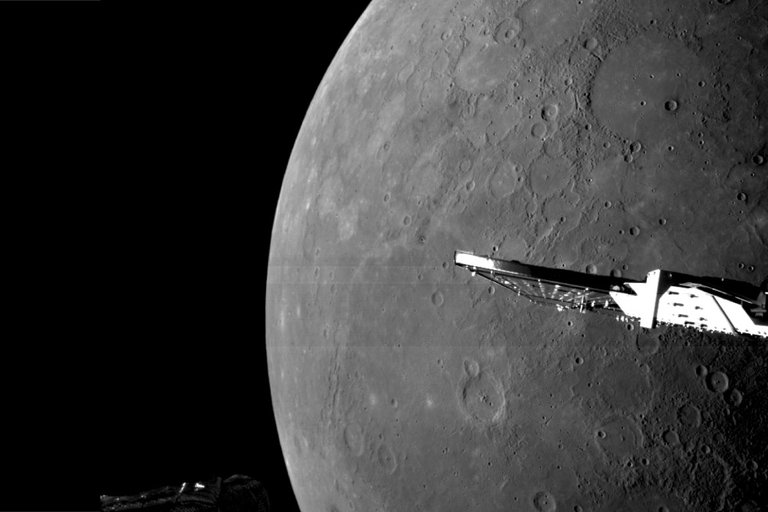
The unmanned BepiColombo mission is jointly developed by the European Space Agency (ESA) and the Japan Aerospace Exploration Agency (JAXA). The launched ship consists of four modules that will be distributed in different phases.
“In a straight line, between Mercury and the Earth there are 77 million kilometers, but the ship has traveled 9 billion kilometers.”
The mission, launched in October 2018, took just over eight years and a month to enter Mercury’s orbit. In a straight line, between Mercury and the Earth there are 77 million kilometers, at the closest point according to the orbits, but the ship has traveled 9 billion kilometers, since it has completed a spiral route instead of going directly.
Like the planets of the Solar System, the BepiColombo mission has been orbiting the Sun. It has made eighteen complete turns around the star, but the turns have been increasingly closed and it has been approaching the center of the Solar System. Mercury is the planet closest to the Sun and if the ship is guided directly to it, the star's force of attraction would accelerate considerably. That’s why it has been circling several planets and losing speed due to the force of attraction they exert. The ship passed very close to Earth once, twice by Venus, and has approached Mercury six times before reaching the correct speed and entering its orbit.
“The two remaining modules will remain in the orbit of Mercury, but they will draw different orbits.”
After the last passage near Mercury, in September 2026 the ship released the first module, which until then had driven the ship on its journey to the planet. The other three modules are now still coupled, and the JAXA module will be decoupled in December 2026. A few days later, the ESA module will release the module that functions as a thermal shield, and the two remaining modules will remain in Mercury's orbit, but will draw different orbits.
The JAXA module will study the magnetic field of Mercury and its interaction with the solar wind, while the ESA module will study the chemical composition of the surface, volcanism, tectonic activity and ice at the poles. Mission officials hope that by April 2027, the two modules will begin gathering scientific information.
Irati Diez Virto
Elhuyar Zientzia