 Bilatzailea


Eggs and embryos of trout to evaluate alternatives to antibiotics

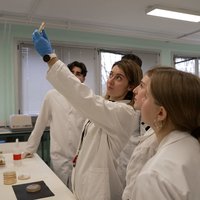
Antibiotics used in fish and animal farms increase the risk of resistance... To solve this problem, the Public University of Navarra has researched a method of evaluating alternatives to antibiotics to be safe in aquaculture, veterinary and human medicine. Specifically, they propose the use of embryonated eggs and vesiculated larvae of trout for the evaluation of beneficial bacteria (probiotics) and their metabolites (posbiotics) with a Unique Health approach.
Probiotics are live microorganisms that, if administered in adequate amounts, provide health benefits to the host. Its postbiotic derivatives are substances produced by these microorganisms, such as organic acids, bacteriocins or peptides, which also have advantageous properties. Traditionally, they have been tested on fish using either young or adult specimens, resulting in high costs and significant animal use. In their thesis at the UPNA, they have shown that embryonated eggs and vesiculated larvae of common trout can be simple and ethical vertebrate models for rapid screening of probiotics and postbiotics.
“The thesis provides essential knowledge for designing preventive treatments for fish and reducing their dependence on antimicrobials.”
In fact, the use of organisms at early stages of development is in line with the principles of Substitution, Reduction and Refining, since the use of adult animals is avoided. Thus, the thesis provides essential knowledge for the design of preventive treatments for fish and to reduce the dependence on antimicrobials. This has direct implications for food security and contributes to the global fight against antibiotic resistance.
Buletina
Bidali zure helbide elektronikoa eta jaso asteroko buletina zure sarrera-ontzian