 Bilatzailea


Power line communications: the backbone of low voltage power grid control
What happens if the power grid is not only used to distribute energy, but also to send information? This is the basis of power line communications (PLC): using the same cables as the power network to transmit data. This technology is not a proposal for the future, but a strategic technology that is currently used to carry out the control of the low voltage electrical network.
Devices that can be found in modern electrical networks.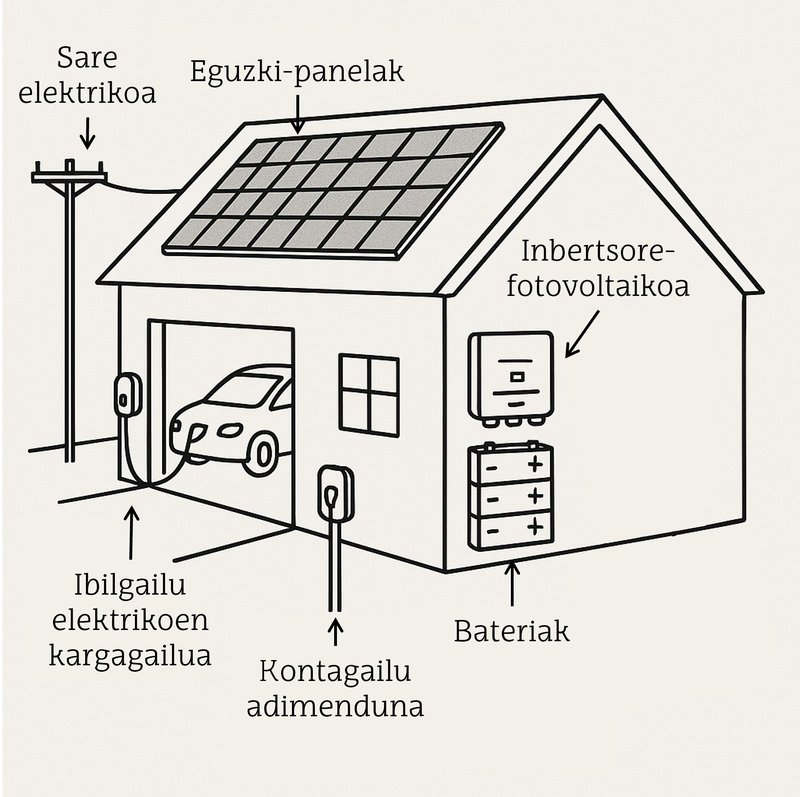
one of the main objectives of the 2015 Paris Climate Agreement, promoted under the auspices of the United Nations, is to achieve a global economy focused on carbon neutrality. This agreement sets clear long-term goals for all countries, including reducing greenhouse gas emissions with the aim of limiting the temperature increase of this century to 2°C. The European Union has incorporated these commitments into its regulatory framework through the European Green Deal 2019 and the European Climate Law 2021. These regulations specify a 55% reduction in emissions by 2030 compared to 1990 levels. In this context, electro-mobility (e-mobility) and the distributed generation of renewable energy are key elements to reduce society’s dependence on fossil fuels and pave the way for a sustainable energy transition.
In recent years, electricity networks have undergone profound changes as a result of the integration of new technologies and renewable energy sources. Previously, a centralized system based on large power plants predominated, in which the role of all the participants in the electricity network was very well defined: generation, was the responsibility of power plants; transport and distribution, was the responsibility of electricity companies; and consumption, was made by users and companies. However, today there are more and more energy producing users, such as homes with solar panels or energy communities. Many consumers of distributed renewable energy sources have become “prosumers” (from the English words “producer”/producer and “consumer”/consumer): they not only consume energy, but also produce it and incorporate it into the grid. This has completely changed the structure and operation of the network. In addition, the proliferation of charging points for batteries and electric vehicles that accumulate the surplus of energy generated by solar panels has changed the grid energy demand models, which requires greater flexibility and coordination.
In this context, the distributed generation of renewable energies and the intelligent control of consumption have become essential. To guarantee the stability of the electricity network, it is necessary to balance production and consumption at all times, for which monitoring and automation through new technologies are essential.
This change has led to the transition to smart electricity networks, that is, systems capable of managing the variability of renewable energy in real time, optimizing consumption and improving efficiency. Digitalization has played a key role in this process, integrating sensors, monitoring systems, smart meters and energy management platforms to control the state of the network at all times and make decisions according to demand.
Modern grid automation would not have been possible without a communication system. In this context, power line communication (PLC) technology has become essential. PLC systems use the electrical network itself as a support for sending and receiving data without additional cables. This is because PLC transmissions are superimposed on the 50/60 Hz power signal, so that the power flow at 230 V effective voltage and data communications are propagated simultaneously through the power grid. This has made it possible, by taking advantage of the infrastructure of the energy distribution network, to facilitate communication between smart devices and to reduce installation costs.
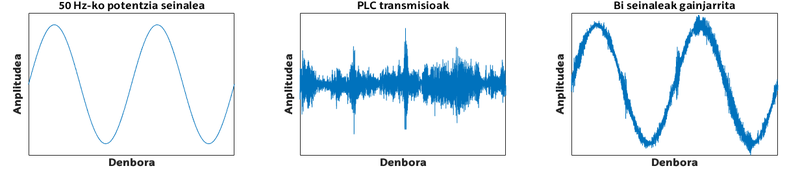
Superposition of the 50 Hz power signal and PLC transmissions.
PLC technology allows smart meters, transformers and other components to be connected to the network to exchange information in real time. This allows to monitor consumption, detect faults and optimize the operation of the network. This technology uses different protocols in the frequency range of 2 kHz and 500 kHz, such as PRIME, Meters&More and G3-PLC, each adapted to different applications and technical requirements.
Each house and company has at least one smart meter that stores data on energy consumption or generation. This data is transmitted in an automated manner and the presence of a technician is not required to manually record the readings. This information is sent through the cables of the electrical network to the data concentrators located in the transformers. The concentrators collect data from various meters and then send this information to the energy companies. To do this, different technologies are used, such as 3G, 4G, optical fiber or local networks, depending on the distance of communication and the technological environment.
In addition, PLC systems have mechanisms to increase the reliability of the network. Smart meters can act as repeaters. That is, when another counter cannot be directly connected to the concentrator, the information can be redirected by some surrounding counter. In this way, the network creates alternative communication paths and maintains the ability to transmit data reliably even in high interference or low coverage environments. This mechanism significantly improves the resilience of the network and the robustness of the communication system, and is essential for an intelligent and stable distribution of energy.
PLC communications are used worldwide and have been particularly popular in several European countries such as Spain, France, Italy and Germany. In Spain, for example, the deployment of smart meters has been carried out mainly through PLC, and companies such as Iberdrola and Endesa have used this technology to promote the digitization of the network.
PLC technologies have several technical challenges. First, the power grid is not designed to transmit data, and in some cases communications are not performed properly. The most important phenomena that prevent PLC communications are the interference of unwanted guided emissions, the variable impedance of the network and the strong attenuation of the signals.
For starters, unwanted guided emissions are electromagnetic noises generated by all appliances and electrical devices connected to the electrical grid. These may interfere with PLC communications signals because both phenomena may occur in the same frequency band. In addition, these guided emissions are more pronounced in devices that implement power electronics, such as photovoltaic plate inverters and electric vehicle chargers, which generate or consume large amounts of energy. On the other hand, signal weakening occurs over large distances, which reduces the transmission quality. In addition, PLC systems have limited bandwidth, which limits their ability to transmit large amounts of data that can impact complex applications. In terms of security, since data is sent over the power grid, encryption and authentication systems are necessary to ensure data confidentiality. Finally, in old or complex electrical networks, the coverage may be irregular, which may lead to communication gaps. However, despite these challenges, PLC technology still plays a key role in the development of smart grids and the digitization of the energy system.
Looking ahead, PLC communications will evolve significantly to adapt to the growing demands of smart grids. In this evolution, the Broadband over Power Lines (BPL) technology stands out, an advanced version of PLC operating in the frequency range of 1 MHz to 30 MHz. BPL systems offer a wider bandwidth, which significantly increases the speed and capacity of data transmission, enabling more complex applications and real-time services. This technology allows, for example, the integration of advanced energy management and detailed monitoring of network status via PLC. In addition, BPL systems are more resistant to interference and offer better coverage in both urban and industrial environments. As a result, the BPL is becoming one of the foundations of the smart energy networks of the future, and energy companies are increasingly testing and implementing this technology, paving the way for a deeper digitisation of the network.
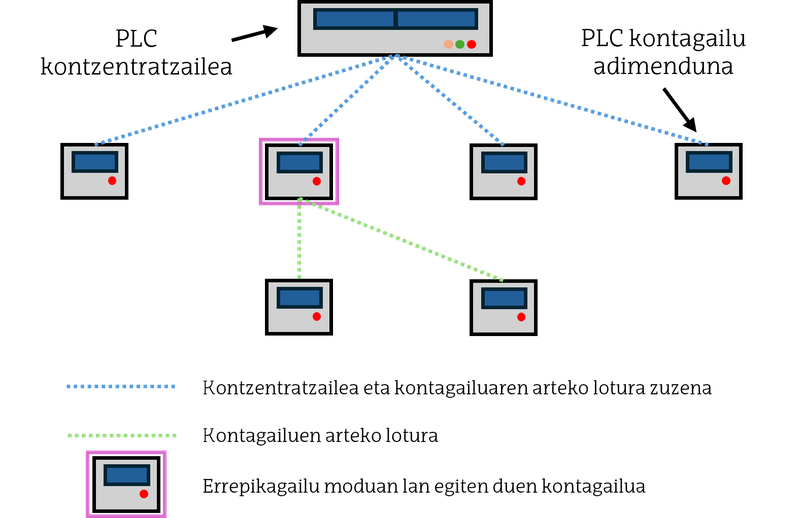
Communications between the concentrator PLC and the smart meters with a counter in repeater mode.
The TSR (Signal and Radio Communications Processing) research group at the Bilbao School of Engineering at the University of the Basque Country has been working for ten years on communication systems for intelligent electrical networks, especially in the application of PLC technology. One of the Group's main investigations is to analyse the characteristics of the PLC communication channel in order to improve the performance and reliability of data transmission over the electricity network.
To this end, the TSR group has developed its own measuring devices to characterize the behavior of the network between 9 kHz and 10 MHz, as well as tools to analyze the attenuation of PLC signals, the impedance of the network and the mechanisms of interference. These measurements have been essential for the identification of interference mechanisms in communications using PLC technology, both in laboratory experiments and in tests carried out on real networks. The data collected have also been used in metrological research to analyze the uncertainty of the techniques used by power quality measuring instruments.
The work of the TSR Group has also had a great impact on international standardisation: it has participated in the European projects EURAMET and EMPIR-SupraEMI, EPM-Met4EVCS and EPM-SBS Uncert, funded by the European Union, and has contributed to the working groups of organisations such as IEC, CENELEC and CIGRE in the processes of defining new standards and preparing technical reports.
In short, PLC systems have become one of the main technological bases of today’s smart electricity networks. Its capacity allows the transmission of data through the same electrical network infrastructure, allowing real-time control of consumption and distributed generation. PLC systems allow the monitoring of the state of the network, the automatic detection of faults and the optimization of energy flows, thus contributing to guarantee the efficiency and stability of the network. Looking to the future, advanced technologies such as BPL will increase the capacity of data transmission, but it is already clear that PLC systems are essential in the process of digitization and automation of the electricity network.
Acknowledgements
This work has been financed by the Basque Government through grants IT1910-26. This work has also been funded by the Spanish Government grant PID2025-170561OB-I00 (SEFONIS project), MCIN/AEI/10.13039/501100011033 and the European Regional Development Fund (ERDF/EU).
Bibliography
[1] Https://unfccc.int/process-and-meetings/the-paris-agreement
[2] Https://commission.europa.eu/strategy-and-policy/priorities-2019-2024/european-green-deal_en
[3] Jon González-Ramos, Alexander Gallarreta, Itziar Angulo, Igor Fernández, Amaia Arrinda, David de la Vega. 2023. “A review on the empirical characterization of the low voltage distribution grid as a communication channel for power line communications”, Sustainable Energy, Grids and Networks. 36. DOI: 10.1016/j.segan.2023.101217.
[4] Alexander Gallarreta, Jon González-Ramos, Stefano Lodetti, Peter Davis, Igor Fernández, David de la Vega, Itziar Angulo, Amaia Arrinda. 2025. “Measurement framework for the consistent and fast measurement of conducted grid emissions in the 9 500 kHz range”. Computers and Electrical Engineering, 124, DOI: 10.1016/j.compeleceng.2025.110314.
[5] Angela Espín-Delgado, Sarah Rönnberg, Shimi Sudha Letha, Math Bollen. 2021. "Diagnosis of suprharmonics-related problems based on the effects on electrical equipment". Electric power systems research. 195. DOI: 10.1016/j.epsr.2021.107179.
[6] R. Oh. Oh. Anders Larsson; Math H. J. J. Bollen; Mats G. Wahlberg; C. Martin Lundmark; Sarah K. Rönnberg 2010. “Measurements of High-Frequency (2–150 kHz) Distortion in Low-Voltage Networks”. IEEE Transactions on Power Delivery, 25. DOI: 10.1109/TPWRD.2010.2041371.
[7] Igor Fernández, Alexander Gallarreta, Jon González-Ramos, Paul Wright, David de la Vega, Itziar Angulo, Amaia Arrinda. 2023. “Measurement System of the Mean and Sub-cycle LV Grid Access Impedance from 20 kHz to 10 MHz”. IEEE transactions on power delivery. 38. DOI: 10.1109/TPWRD.2023.3238647
[8] Jon González-Ramos, Alexander Gallarreta, Igor Fernández, Itziar Angulo, David de la Vega, Amaia Arrinda. 2024. “Comparison of conducted emissions due to electric vehicle charging processes under isolated and on-line conditions in the 9–500 kHz frequency range”. Sustainable Energy, Grids and Networks 36. DOI: 10.1016/j.segan.2024.101333.
[9] Jon González–Ramos, Itziar Angulo, Igor Fernández, Alexander Gallarreta, David de la Vega, Amaia Arrinda. 2024. “Characterization of the potential effects of sub-cycle impedance variations on PRIME v1. 4”. Engineering Science and Technology, an International Journal. 56. DOI: 10.1016/j.jestch.2024.101775
[10] Tim Slangen, Vladimir Ćuk, Sjef Cobben. 2023. “Summation of suprharmonic currents (2–150 kHz) from EV fast charging stations”, Electric Power Systems Research, 220. DOI: 10.1016/j.epsr.2023.109371.
[11] Vineetha Ravindran, Selcuk Sakar, Sarah Rönnberg, Math H.J. Bollen. Bollen. 2020. “Characterization of the impact of PV and EV induced voltage variations on LED lamps in a low voltage installation”. Electric power systems research. 185. DOI: 10.1016/j.epsr.2020.106352.
Buletina
Bidali zure helbide elektronikoa eta jaso asteroko buletina zure sarrera-ontzian