 Bilatzailea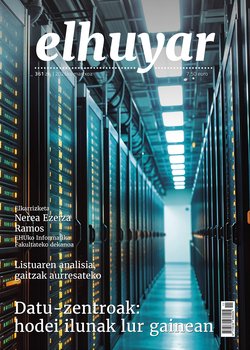


In computer science, it is essential to work on the humanistic side; it is not just a technical issue
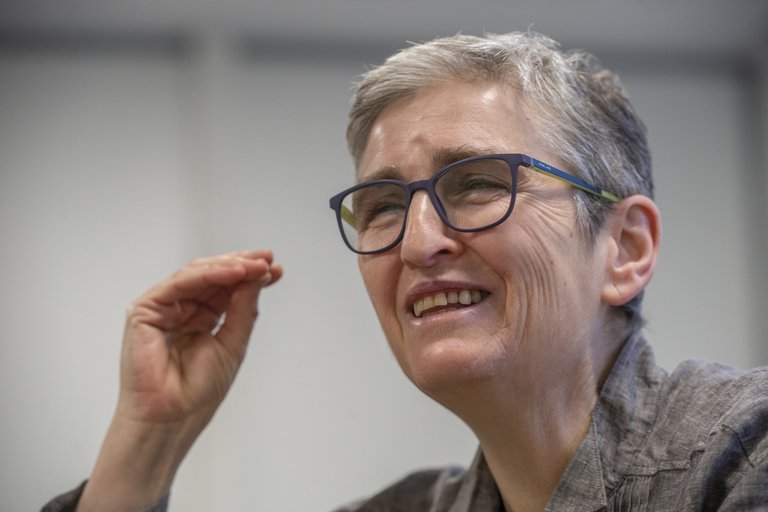
Nerea Ezeiza Ramos (Donostia-San Sebastián, 1970) was recently appointed dean of the Faculty of Computer Science of the UPV/EHU, and the Faculty of Computer Science has been doing so for 50 years. It is therefore a good time to look at the trajectory of Ezeiza and the evolution of the Faculty of Informatics. But Ezeiza looks back and out as much as he looks inside; he has his eyes set on the future and on society. And in women: at the door of the office, two quotes are attached, next to the photo and the name of the authors. One is from education activist Malala Yousafzai and the other is from computational scientist Karen Spärck Jones.
First of all, you tell me that you want to talk about the 50th anniversary of the Faculty of Computer Science. In fact, you have a strong connection with this faculty.
I started here in 1988, but this faculty, physically, was founded in 83. In fact, the first computer science faculties in the state were created in 1976. The newsletter was published in March and there are three of us
Pioneers: the Polytechnic University of Catalonia (UPC), the Polytechnic University of Madrid (UPM) and the Polytechnic University of San Sebastian (initially integrated into the University of Valladolid and later transferred to the University of Bilbao, which would become the UPV). Previously, Computer Science was taught, but it was not regulated as it is now, and the degree of Systems Technician of the Institute of Computer Science was taught.
When the faculties were created, it was not considered engineering, but science: computational sciences. In Donostia-San Sebastián there was a calculation center and in 1970 the computer center was created, which under the Institute of Informatics of Madrid taught official computer studies. Although the Faculty of Computer Science was officially created in 1976, the studies did not begin until the next academic year and began with higher courses, where doctors were needed to teach. Then they started at the Faculty of Computer Science from the first level. But there was a time when both centers taught at the same time, both teachers and professionals were needed.
When did they start?
The first two subjects in Basque were offered in the 1984-1985 academic year, and from there the offer gradually increased. When I started, there was still not a full degree in Basque. The first and second courses did, but in the third we already had some subjects in Basque.
And how did you come up with studying computer science?
I think it was by default. We are six brothers and I should have stayed in Donegal. One of the brothers encouraged me to choose Informatica. My neighbors told me that I wouldn’t touch any computer, but when we entered there were terminals, they brought the first PCs and there was the possibility of doing practices. Of course, we also had to make gaupas, because we had to ask for a shift to use the computer.
“This is a public university: we have to give them the resources and places to study.”
Now, of course, the issue has changed a lot, the students have at their disposal the equipment they need. For example, when they come on open days, young people ask us what computers they should buy to study Computer Science. In fact, they want an excuse to buy them a powerful computer, but to get in here, they don't need a computer. This is a public university: we have to give them the resources and places to study. Many families in difficulties send their children to study, they too have every right, and the UPV/EHU tries not to leave anyone behind.
You started with scarce resources, but if you didn’t, the computer itself and your activity would have changed a lot since then.
Well, when I started, I liked math, physics, programming, statistics and stuff like that. In the third grade, I was told that there was a scholarship in the language processing research group, and I didn’t even know what that was. Then I thought that if I did computer science, I would go to a company, to make programs for a bank, which was what happened in many companies around here at the time. Therefore, my vision changed radically: to be related to the Basque language and not to be something related to the economy, but to be able to contribute to public utility and society... He changed the chip.
I saw it as an opportunity to make a contribution to society. And we also collaborated with linguists, and there, in that interdisciplinary work, you learn a lot.
I think that people don’t realize that IT is everywhere, and if it is everywhere, you have to have all kinds of profiles. That's important.
Where does the stereotype come from, then, an isolated boy or a man, in front of the computer screen, outside the world?
Well, it is true that there are jobs that are done individually, because you have to be focused, for example, doing development. But, as I said before, since computer science is everywhere, you have to be open. In this stereotype, I think that movies and series have done a lot of damage. Reality can and is another, but it is very difficult to transmit it to people, because you are constantly bombarded with this image: one person with seven screens. Well, if you’re a computer scientist, you probably don’t need seven screens and you can also contribute a lot.
“Computing is everywhere, so it is necessary to have all kinds of profiles.”
At one point, our studies changed: we went from science to engineering. And that has had an impact, all over the world. It’s not just about changing the title. When we went to engineering, in our promotions we were about half and half or 45/55 ratio men and women. Now we are 10%. And that's not possible, it's not possible. Women have something to say. We have another vision, and it is essential that there is also that vision.
A lot of research has been done to analyze why IT is not attractive to women. But it's not that. Women want to do science, research. Now, scholarships and grants have gone to artificial intelligence, where it may seem that research is not done or that social issues are not addressed.
But you work on social issues, right?
Yes, of course. For example, some groups develop supports for people with disabilities; technologies, not only physical, but also software. They also do things related to medicine, for example, nowadays many people wear sensors to control their diabetes, the mobile is brought closer and read. A lot of sensors and systems are also developed for environmental monitoring. All this is done.
“If women are not there, who will decide what content to develop, what is important, how to design it? The men.”
What happens is that you don’t see what’s behind these apps. We all have a mobile and we use it for everything, but we are not aware that what is behind has been developed by someone. And if women are not there, who will decide what content to develop, what is important, how to design it? Men. Men.
There, at the door, we have a couple of posters. One is from computational scientist Karen Spärck Jones, who said: “Computation is too important to leave it to men.”
Although it has been a long time since he said this, there is still no parity.
It’s not just that women are missing; there are biases in the models. Today, we use artificial intelligence for any nonsense, and if you ask for an image of a high office without specifying the gender, it will show you a man. And if you ask her for a woman, she'll give you a woman with an aggressive attitude and a masculine outfit. I mean, to be there, you have to be a man, or you have to have the look and the attitude that men seem to have, the model has internalized that.
The same with sexual choices, religion, languages and so on. That is, male, heterosexual, white, Anglo-Saxon and everything that does not exceed a certain social class is excluded.
In order for apps to be useful to everyone, you need to consider the real world. If you work for a city council, you need to know the rules, but you also need to know how people live. Even with good will, if you don’t take this into account, you will leave many people on the sidelines.
“You have to know how people live. Even with good will, if you don’t take this into account, you will leave a lot of people on the sidelines.”
In addition, it should be noted that nowadays people are forced to use technology, since many things are only online. A lot of work can be done to help those who have difficulties, for example, with voice assistants. For those with voice problems, technology has advanced a lot. At Aholab, for example, they have done a lot of work to take into account people with diseases that can distort the voice, such as Parkinson’s, whose voice would not be well recognized by a normal model. These things need to be worked out specifically. Much work has been done, and even more can and must be done. To do this, it is necessary to attract people with an inclusive vision.
It seems that here, in computer science, work is done with numbers and machines. And what is missing is that society is aware that work is done for people. I think that this social aspect is hidden, that it is not visualized so much, or that people are not so aware of it.
And you need people who are creative, able to imagine a situation and think about solutions. And besides, these things are done together. You have to listen and work as a team.
And are we aware of the environmental impact?
It's not easy. In fact, it has become much more invisible. Before, the computers were huge, they filled the whole room. You saw how much they spent. Now we have personal computers, tablets, mobiles. It is true that now we also have a quantum computer, right here, and the cold it needs to work requires having a very large, protected room. This is seen. But in the evolution of technology, material needs have become more invisible.
We are connected at all times and it seems like magic. Suddenly we have the information in the cloud, but in reality we do not have it. We have no responsibility where he is. Here’s the paradox: students seem to be very concerned about natural resources, but then we don’t know how much technology we use consumes. It's like the one who takes a shower in the gym and says he doesn't spend water at home. And with artificial intelligence, the same thing: we use it to ask or do any nonsense without thinking about how much it consumes.
We don’t care about consumption, privacy, security. We accept everything without even reading it and we put anything on social networks without being aware of the consequences. In the Faculty of Computer Science we must teach how to take care of these aspects, and we must also do pedagogy in society, because this irresponsibility is very dangerous and has a high economic and ecological cost.
As a university, we have that responsibility. We have courses and in our degree we also have several cybersecurity subjects. In addition, in Gipuzkoa we have the Ziur industrial cybersecurity center, with which we have a university-business classroom. Now we want to put it as optional, related to cybersecurity and artificial intelligence.
What other plans do you have for the future?
Areas that seem to be moving today are artificial intelligence, cybersecurity and quantum computing, areas to which subsidies have also been directed. But other areas have been left as orphans, which are also necessary. For example, the bases, methodologies, developments, etc. necessary to be able to achieve quality, guarantees, etc. in the field of software engineering, as well as people to investigate how to carry them out and what technologies are available.
Not everything is artificial intelligence. What has happened is that it has reached all people, but we have been working with artificial intelligence since at least the 1960s. There’s also what they call green computing. How to reduce energy consumption?
“We use artificial intelligence to ask or do any nonsense without thinking about how much it consumes.”
We are currently developing strategic plans [he has pointed out a clipboard full of notes] and the first thing we have to analyze is how the profession of computer scientist is changing. Probably now a computer scientist won’t generate as much code, but he needs to control more technologies. You must know what is on the sides, where the information is located, what legislation is applicable to it, how to manage it, how to protect the information. Maybe the professional has to have a different perspective and we have to figure out how to incorporate it into the studies.
The world is also like this, and we are affected by geopolitics and the development of large companies. However, looking to the future, we are clear that we must continue to investigate, which has always been a characteristic of our own identity. We must also continue to provide quality training. And to be of quality, we have to review all the time how the contents have to be adapted. Above all, we can play with the optional ones, for example, as when we started in cybersecurity, and in Quantum, for example, a bet has been made, bringing the quantum computer to Gipuzkoa, to San Sebastian. We hope that it will work out well, but there is still a point of uncertainty.
There is one thing that is not done in other parts of the world, and it is the one that is done in and for the Basque language.
That's right, yeah. I started with Xuxen and today we continue with the research projects and master’s degrees of the IXA group. Now, with artificial intelligence, there is an enormous potential to treat large corpus statistically, and it seems that it is not necessary to know syntax, morphology, semantics, etc. But behind the analysis and processing of language there will always be language, and language is more than words and statistics.
It is our responsibility to respond to society and we must also work on the humanistic side. I think that in this direction we must continue to see what the needs are going to be. Not with what we're going to get rich, but with what we're going to need to live well. This is not just a technical issue, and it’s important for people to see it.
“It is our responsibility to respond to society, and the humanistic part must also be addressed.”
Does digital sovereignty fit into this humanistic dimension?
Well, look, we also have a concern about that. The university itself has made a Microsoft service available to students. And there are insubordinates, but to a certain extent it is very difficult to be insubordinate. The European Union has a project to develop free software that universities and public institutions would need. If this were to be done, it would be easier, but, at least in the short term, I do not see it possible.
The European Union should break its technological dependence on the United States, which is made possible by free software. But these things must be well coordinated and the needs of the users must be foreseen, for example, the training of the personnel of the organizations in the new software. I believe that, if Europe were to succeed in carrying out this project, it would be a very good opportunity for both public and private institutions to overcome these dependencies. We’ll see, I think it would also be a great opportunity for the UPV/EHU to make a change.
We have many things for the future [he points to the board of the strategic plan]. Let's see if we can find the right direction.
Buletina
Bidali zure helbide elektronikoa eta jaso asteroko buletina zure sarrera-ontzian