 Bilatzailea


Truth needs a solid scientific foundation
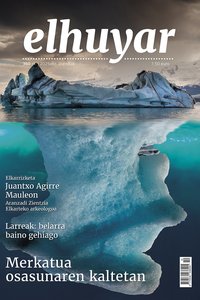
“Free Sciences accessible to all”, according to the motto of the Aranzadi Science Society. it turns 75 years old in 2022, so part of society has known the association and its activity for a long time. And many of those who did not know him before also met Aranzadi that year, when he made known the hand of Irulegi. Juantxo Agirre Mauleon has been the general secretary of the association for the last 25 years, and with his help the magazine Elhuyar has deepened both the history of Aranzadi and the trajectory of Agirre himself. Above all, it has been extended to two issues, the history of the Vascones and the exhumations of the civil war, but it has also pronounced on the current situation and its political involvement.
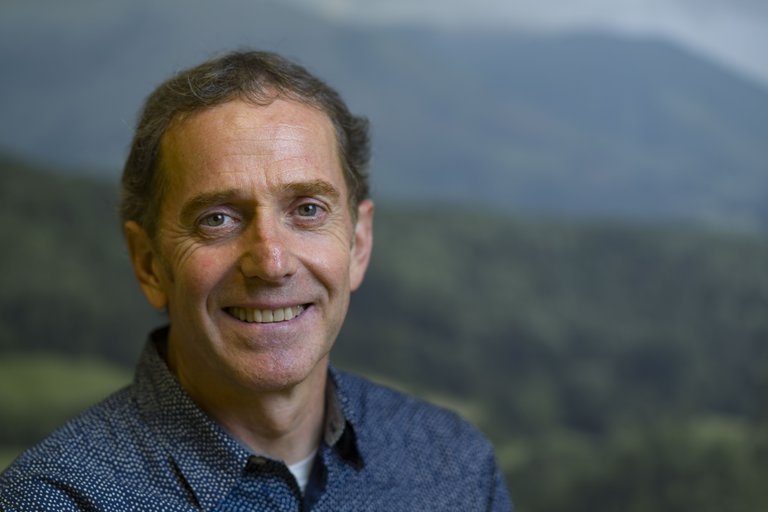
Your name is always associated with Aranzadi. How did you get into the association?
From a very young age I had a great fondness for archaeology and history, probably inherited from my father. So I started studying history at the UPV and then, on vacation, I volunteered for the excavations of Aranzadi. The atmosphere that was created in the two weeks of summer—a group of young people in the mountains looking for footprints under the ground—struck me and caught me. In addition, deep relationships are established with archaeology, the geography of different countries and their people, you are not locked in a laboratory. Archeology has a very social practice.
You're the director of the Amaiur site. What is Amaiur to you?
This place is not only key from the historical point of view, but it has also been a way of life. For me, it wasn’t just research: I’ve made friends, I have a family there too, and it’s part of my sentimental landscape. I've got it very internalized. And above all, there has been a cradle to encourage young researchers. It has been useful to work in Basque in auzolan, in collaboration with the people, from a scientific point of view and with humility. We have worked on all these areas, and that is where six to seven young researchers have emerged who will give great results in our history and ethnography in the coming decades.
It is also of international importance, since it has become a place of interpretation of the Conquest of Navarre, a place of memory. For this reason, now, on this mountain peak, the castle has entered the landscape, where we are creating a definitive museum. These have been our main objectives, the socialization of this heritage. The next step will be to write all this down.
And from the exploration of the land in the fields, to the general secretary of Aranzadi. How did you take that step?
Despite being a long-standing scientific institution, Aranzadi had very few economic resources, so it was relatively easy to achieve this unpaid responsibility. These attitudes may be less and less understood today, but this work, which many people do beyond their own labour agreements, is very important in many areas. That is how I understand that the country is made. It's a matter of attitude to life.
Some of us have known Aranzadi forever, but there are those who have not heard it until you found the hand of Irulegi. We'd like to know what Irulegui's situation is.
It is a basic testimony, a new objective test that we have given to specialized linguists and epigraphers. We have exhumed it with a specific methodology, but we do not know how to read or understand what is written. To do this, networking is very important, in this case with the experts Joaquín Gorrotxategi and Javier Velaza.
Here, the Roman culture has been evident. However, the indigenous language was preserved, which makes us unique throughout Europe. To know the mechanisms of this survival of the language, we need written testimonies before the Roman presence, as well as from the Roman period, such as the hand of Irulegi and the altar of the Sabbath.
The altar of Larumbe has become the oldest testimony of the Basque language in the north of Navarre, and I would also like to highlight that the protagonist is a woman.
What can we expect for the future?
I am sure that in the coming decades there will be more written testimonies about the origin of the Basque language in the Western Pyrenees. As we have more objective evidence—ancient written testimonies—we will be closer to the judicial truth about its origin. In the cross-border scientific fields of Europe, and thanks to the new generations of archaeologists, we will begin to see the natural world of Vasconia, beyond the political borders that have been deforming and conditioning the scientific vision of that past.

Jon Urbe/©Focus
What do you mean by political boundaries?
It makes no sense that the current Venta Peio in Dantxarinea or the Gendarmeria in Behobia is the limit of the cultural realities of two thousand years ago, they are not the limits of the Vascones. It is ridiculous to study the past based on the limitations and modern political dynamics that emerged many centuries later. We must approach the reality of the population at that time, based on our own territorial dynamics and the natural environment.
And what do you have to do for that?
Teach new generations of archaeologists the passion of archaeology and the importance of work culture. In this area, we need new scientific leadership in the development of archaeological excavations from valley to valley, with the collaboration of local communities. And humbly, a researcher, alone, who doesn’t have all the answers and doesn’t know everything, has to work in a network. Today, the fields of science are highly specialized: archaeologists, linguists, epigraphers, geneticists. We must work together, so that, among all, we can advance in the knowledge of the historical origins of our language. Arrogance is one of the main mistakes of those who investigate our past.
Leaving aside the past of the Basque language, Aranzadi is also known for the discoveries of the civil war. It is a clear example of how the association works for the benefit of society.
One of the characteristics of Aranzadi has been its proximity to the town and its response to its demands through science. This year marks 25 years since we moved to the Bierzo de León, where family members requested technical and scientific support. It was Aranzadi’s first work of this period of Spanish historical memory.
Previously, at the end of Franco’s regime, and in the years following his death, several tombs were opened throughout the State, but they were opened by the relatives themselves, with their hands, with their hoes.
But in this phase of historical memory science has had its place, and we have given dignity to this initiative, because the truth needs it. Here there was a department of Physical Anthropology under the direction of Francisco Etxeberria, and that was when we made the decision, 25 years ago, to go there to help them. It wasn’t easy to get into that at the time. The superiors here told us that it was half political, and it was scary that we were going to lose the subsidies. And yet, we went there. And it has been the greatest contribution of this association, not only to the Basque Country but to the whole State.
In the field of human rights, this work has always been carried out by relatives and associations of memory. We have also been collaborating with the Basque Government and the Government of Navarre for many years, and it should be noted that hundreds of researchers have been working in the field of auzolan and we continue, always with the same philosophy: If we go to Seville, we will work with anthropologists from Seville, with our partners from Seville, and with relatives from Seville. In fact, truth needs a solid scientific foundation.

Jon Urbe/©Focus
What other areas of Aranzadi stand out? In astronomy, for example, you organize many initiatives and next year there is a total eclipse of the Sun. You will already be preparing
Yes, that's what Virginia Garcia Pena is all about. I don't really know much about that. It’s going to be a special year, though.
To highlight other areas, I would mention ornithology, herpetology and mycology. In all of them there are very good researchers, doing cutting-edge research, with international recognition. For example, Aranzadi is a pioneer in the anillation of birds.
In addition, our task is not only to carry out actions, but also to leave a memory in writing for the future. Thus, each year it publishes approximately twelve publications of its own: the traditional Munibeak, of natural science and archaeological anthropology, the monographs of history in Navarre, the collection entitled Nafarroa Arkeologia Auzolana, the monographs of memory of the civil war and recent history. Therefore, our publications are quite solid and of high level.
Finally, in these times of disinformation and post-truth, what is Aranzadi’s role? Are you worried about the Trump administration’s stance against science? How to face it?
Trump is a direct reflection of our world where everything counts for success in the economy. And, of course, those who despise human and civil rights do not like to train citizens in scientific and political culture. The new generations must have a good education, not only in science, but also in political culture.
Dictators always want citizens to function as flocks, with sheep without a critical conscience, and those of us who are lucky enough to work in science must convey the need for critical reflection and politics to advance properly as a free society.
I have heard for myself that the scientist must be neutral and not politically biased. And those who say that, almost all, are positioned. And I think the opposite: today it is essential to get involved, and to say that you are interested that you should not get involved.
In Aranzadi we have the courage to express our opinion on environmental or human rights issues. For example, in the case of the nuclear power plant of Deba, and with the slopes of Aralar and the pine insignis before, and now on the eucalyptus... Even the ones that disappeared during the Franco regime! And we have put the Castle of Amaiur in sight. And now we are doing research on the creation of the Basque language, and we know what our field of work is. We work on these areas, which are sometimes not very pleasant, but yet we are there.
Buletina
Bidali zure helbide elektronikoa eta jaso asteroko buletina zure sarrera-ontzian