 Bilatzailea


Mapping: show and technology
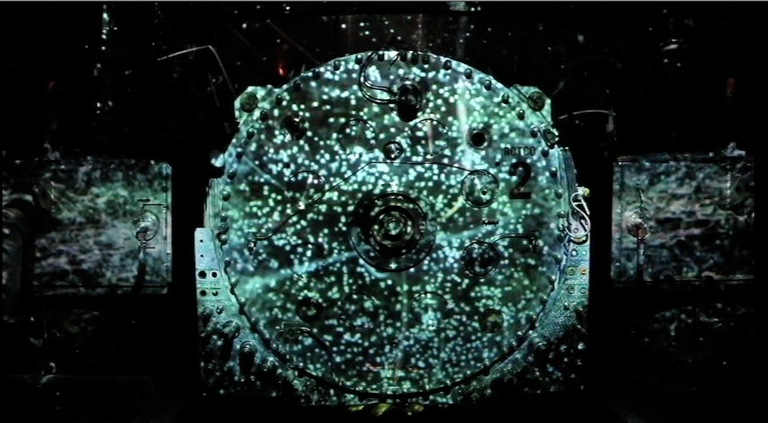
1949.
After World War II, Europe is being restructured.
Many great scientists have fled to the United States, and the level of research in Europe is not very good.
In an attempt to reverse the situation, the visionary Nobel Prize winner, Luis de Broglie, proposes the creation of a laboratory that will be the reference of physics and the engine of peace.
Eighteen months later, 12 European countries agree to create the laboratory “Conseil Européen pour la Recherche Nucleaire, CERN.
Geneva is chosen for the construction of the residence.
The construction of two accelerators begins: the synchrocyclotron and a larger one, the synchrotron proton. CERN is on the move!
1954 Near
Geneva, in the village of Meyrin, work began on the construction of a new laboratory.
Within a year, the necessary workshops, offices and buildings were built to house the accelerators on agricultural land.
The 5 meter thick walls of the synchrocyclotron building were immediately picked up.
Bringing the magnetic coils of the synchrocyclotron to Meyrin is a carefully crafted task.
The synchrocyclotron is taking shape piece by piece until a 2,500-ton machine is formed.
Two magnetic coils with a diameter of 7.2 meters are then placed with a current of 1,800 amps with the ability to generate a magnetic field of 2 teslas.
by the summer of 1957, the synchrocyclotron, the first accelerator of CERN, is ready.
The new machine is capable of placing protons at high speed, so that when they collide, the protons produce millions of new particles - so that scientists can make as many measurements as they want.
1957. During the year, scientists from all over Europe came to CERN. Among them were Maria and Giuseppe Fidecaro.
Giuseppe wanted to investigate a very short-lived particle, the pion. Theoretically, in the attenuation, the pion had to be converted to electrons and neutrinos, but it was not proven.
The program, prepared by the Giuseppe team, was able to verify the evolution of the pion in a few hours.
The discovery quickly spread the name of CERN around the world.
In the years that followed, scientists performed numerous measurements of particles, atoms and nuclei in the synchrocyclotron until its mission was terminated in December 1990.
Buletina
Bidali zure helbide elektronikoa eta jaso asteroko buletina zure sarrera-ontzian