 Bilatzailea


Infrared to the smallest
The wave is the result of a perturbation, a form of energy transfer. There are several types of waves in the world. The waves of the sea or the rain in the wells, for example, are waves.
There are also waves in the microscopic world. Light, for example, is composed of waves. The human eye distinguishes colors, that is, it is capable of distinguishing between waves of different wavelengths in the visible field. But there are many other types of waves outside the visible area. Although they have not been seen, researchers have learned how to manage them and benefit from them, such as light or infrared waves. Infrared waves are emitted by hot bodies and are used in some very special instruments: spectroscopes. Spectroscopy is used to characterize the material present in a sample for identification purposes, i.e., it tells what it is composed of.
The spectroscopes for this characterization work have been improving to operate with the smallest possible samples, but they have reached a limit. Similar to concentrating sunlight by focusing it with a magnifying glass, with the help of lenses, infrared light is focused to a certain limit.
IBAN AMENABAR; CIC-nanoGUNE: With the millimeter samples to be used in this particular technique (infrared spectroscopy), they became increasingly focused with conventional classical optics over time. They had reached an intrinsic limit, a physical limit, which could not be focused below 10 microns.
RAINER HILLENBRAND; CIC-nanoGUNE: What you see here is a rather special optical microscope, capable of seeing nanostructures. With conventional optical microscopes this is not possible, the reason: the diffraction limit. We cannot see nanostructures smaller than the wavelength of light. And nanostructures are typically ten to a hundred times smaller than the wavelength of light. That is why we have been developing a microscopic technique that helps us visualize nanostructures with light for years.
This technique is a variation of Fourier transform infrared spectroscopy in the marrow, abbreviated FTIR, and since it operates on the nanometer scale it is called nanoFTIR. And it's a microscope and a spectroscope, both in one.
IBAN AMENABAR; CIC-nanoGUNE: We put the sample here. And we can hardly see anything by sight.
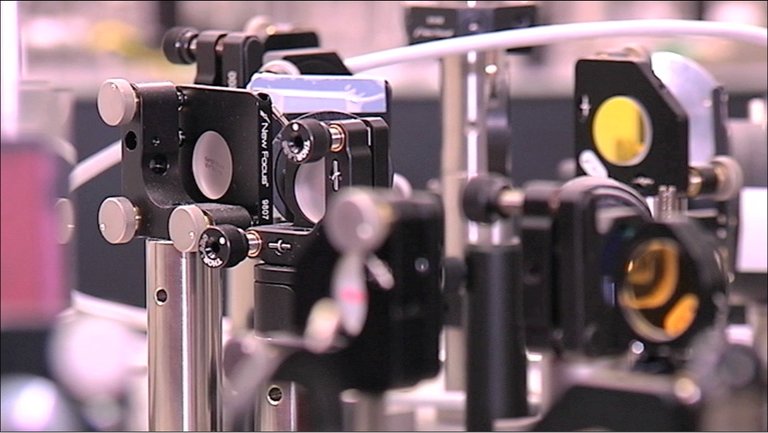
Infrared light is directed from the source to the focus by this lens system. The heart of the microscope is a tiny needle. At the tip of the needle is the key to the resolution of the technique, since the light is directed to the tip and concentrated there. Thus, the resolution of the microscope depends on the diameter of the tip: 20-30 nm.
RAINER HILLENBRAND; CIC-nanoGUNE: The principle is as follows: we can bring the old disc headphones to the example, like them the needle scans the sample. It's like we're touching the surface, we're taking out the height profile. On top of that, we direct the light to the tip of the needle, and the tip acts as a radio antenna, collecting and concentrating the light at the tip. It is very sharp, a few nanometers, less than the wavelength of light. In this way we concentrate the light in an impressive way, as if we were doing it with a lens, but on the nanometer scale. With the light coming back and the position of the needle we get an optical image on the computer in resolution according to the size of the needle tip.
In this case, it is a virus that is visible on the screen. A few years ago few would have dreamed of measuring the infrared spectroscopy of a single virus.
The biologists of Nanogune have placed great hope in this instrument because they can not only see the appearance of a structure, but also know its composition. The spectrum is similar to the fingerprint of the molecule, which allows the identification of the molecule or molecules that make up the structure. Therefore, at the same time they receive two data on the computer: one on the nature of the sample and the other on the structure. This would be a major step forward, especially in protein research.
SIMON POLY; CIC-nanoGUNE: We are interested in proteins in their three-dimensional structures. In fact, it is the structure of these molecules that gives them function. That is, by altering the structure of a particular protein, the function is also altered. Therefore, it is interesting to know the structure of a protein, since you can guess its function accordingly. Behind all this there is an idea, and it is the idea behind some diseases that some protein has an unusual structure, has been transformed and has become harmful to the body.
The nanobiotechnology laboratory is investigating the proteins that underlie neurological conditions such as Alzheimer’s, Bovine Disease and Parkinson’s, some proteins with altered configuration. One of the keys to the spread of the disease in the case of Alzheimer's is the beta-amyloid protein, which forms amyloid plaques and interferes with the functioning of the brain. Imagine what it would be like to see a single protein under a microscope.
IBAN AMENABAR; CIC-nanoGUNE: Being able to perform infrared spectroscopy at this low resolution is one of the applications that this microscope can provide. And right now I'm developing that, trying to increase the sensitivity of it and measure smaller and smaller things, trying to come up with a single protein... On the one hand is the development of the same technique experimentally and, on the other hand, also the application in which it can be used and how to interpret it.
Rainer Hillenbrand has been developing the technique for ten years in Munich, Germany. With his team there he has commercialized the microscope in the belief that it could be of interest to many industries. Now, in San Sebastian, it’s time to take advantage of the research.
RAINER HILLENBRAND; CIC-nanoGUNE: We want to develop new applications, we need to see what we can use this tool for. In recent years we have been developing the technique, now we want to use it.
Buletina
Bidali zure helbide elektronikoa eta jaso asteroko buletina zure sarrera-ontzian