 Bilatzailea


From the thread of Balenciaga
Assisted by Igor Uria. Cristóbal Balenciaga Museum: What we need to see now is a dress by the American Barbara Hutton. He was one of the greatest millionaires of the 20th century and was married to Cary Grant. When he lived in Tangier, he gave the dress to another American, and when he died, his nephew took it. He brought us to the museum to drop us off at the exhibition, and now we'll see.
Barbara Hutton's is a night dress. When he arrived, he seemed to be doing very well. The only problem was that the armpits were broken. On the one hand, we have to protect what comes to us and, on the other, we have to fix it. The public will see the new as it was, even if it is not as new. It's this arrangement: make it look like it's complete. It is not complete at this time. All this has been broken, and we must return to its original form. This tarlatan was actually covered in silk. When we picked it up, it was all dust. We wanted to know what the tarlatan was made of and how it affected the silk to break it. We contacted the university, Alazne, for analysis, etc.
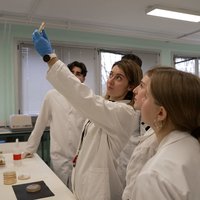
Assisted by Alazne Porcel. From the UPV-EHU: The canning company Nardin has offered me and another guy a grant to carry out the restoration process of a certain garment. What we have here are the three-dimensional, non-textile elements that we have found in the garment: sequins used for decoration, small ornaments... All of them are catalogued as chipboards in the material identification sheets of the garment. The magnifying glass is interesting to see the links that appear on the fabrics. In this case, to confirm that it is a velvet. This is a stereoscopic microscope. If this magnifier magnifies the image 60 times, it can magnify it 200 times. Here you get very good quality photos, but we don’t get any chemical data, so we often don’t know what material it is.
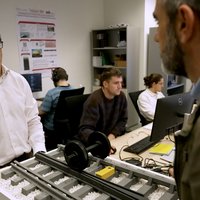
This is Alfredo, a RAMAN spectroscopy technician. I usually bring samples that I can't analyze here. I can see in the binocular magnifier what the material in front of me is. He, however, with his instrumental, can measure the chemical composition of each material and show the result through a spectrum.
Assisted by Alfredo Sarmiento. From the UPV-EHU: We decided to use RAMAN spectroscopy because it is a non-destructive technique that can provide a lot of information. In the case of Alazne’s samples, it is essential that the technique is not destructive, since it is in a process of restoration and must be returned to its original owner. Alazne knows better than I do what kind of materials were used in those times; what can be a glue, what can be a polymer that used to be used in the 40’s or 50’s... And I focus on chemistry. That is, to the molecules or functional groups possessed by the compounds under study. Taking these two pieces of information and consulting the bibliography allows us to know more or less what the samples are made of.
Assisted by Alazne Porcel. From the UPV-EHU: This is Richard, who is in charge of the Biomedical Microscopy Service. In this case, we have brought samples of various fabrics that we have found in the garment, from which we will extract the fibers to see if, as we think, they are made of silk.
Assisted by Ricardo Andrade. From the UPV-EHU: We'll use a scanning electron microscope to visualize the fibers. It is a very good technique for these Alazne fibers because it shows the sample with a large depth of field, i.e. with many focused planes. Instead, the magnifying glass requires you to play with the focus in order to see the details of the sample. The sample must be prepared in advance. We put a carbon tape on these aluminum supports where we glue it. To obtain an image of better quality, we cover it with a metal, in this case gold. One of the drawbacks of this technique is that it is destructive, since we will not be able to recover this fiber. Finally, we put the sample in place, vacuum it and wait a few minutes. Assisted by
Igor Uria. Cristóbal Balenciaga Museum: We did an analysis with Alazne to find out what the tarlatan was made of, and whether these pebble stones were actually pebbles, or whether they were plastic... Based on this, the treatment would have changed. The treatment proposed and carried out has been: the removal and protection of the shoulder straps, the tarlatan and all the fabric that was here has been protected with a nylon... After carrying out the protection tasks, we have started to clean. We've mechanically cleaned the rocks with a swab and ethanol. When he told us what the tests were, we knew we could use ethanol. The ones we thought were made of a glass-lined plastic. In a second phase, we did microaspiration. This is the only way to get rid of the dust, because since it's a velvet, we can't get into the water.
We are very pleased with the result. Everything went as planned. One of the most serious problems we're going to have here is dust. That's why it's inside a showcase. Temperature and humidity are controlled it will be at 18 degrees and 50% humidity. It is illuminated by LEDs in 50 luxuries. Then, as we have done with all the other things, we will keep it, and it will be kept three times as long as it has been in the exhibition.
Buletina
Bidali zure helbide elektronikoa eta jaso asteroko buletina zure sarrera-ontzian