 Bilatzailea


Nanotechnology on the plate
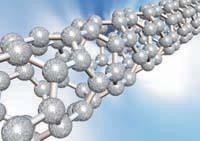
Nanotechnology generates new products and processes from materials measuring between 0.1 and 100 nanometers. Considering that a nanometer is a million times smaller than a millimeter, it is no wonder that nanotechnology is the science of the tiny. The diameter of a hair is approximately 80,000 nanometers.
However, the only peculiarity of nanomaterials is not its reduced dimension, in which materials have different characteristics than those on a larger scale. And that's what makes it so interesting for researchers, as at this level materials are harder or more conductive, or transfer heat better, or have greater light absorption capacity...
With these characteristics, the researchers have developed nanocomposites for applications in building materials, nanocrystals in solar panels and semiconductors, for non-stained tissues of nanoparticles and solar creams, nanotubes for tennis rackets and nanocatalysts for the development of new drugs.
Multiple applications in the food industry

Nanotechnology can be used in the food industry in different aspects. One of the objectives is to increase process efficiency, reducing the use of energy, water and chemicals and reducing waste generation.
In addition, researchers believe that nanotechnology will have interesting applications in packaging, food security and sensory characteristics of food (color, flavor, structure) and functional (related to nutrition and special needs).
There are examples. For example, smart packaging is being developed for the comprehensive monitoring of raw materials. That is, all the way from the hamlet or nursery to the dish would be recorded in the same boat. In this way, if there were any problems, it would be easy to go back and know where the error occurred.
Nanotechnology can also be used to produce harder, heat-resistant or light-resistant, lighter or more flexible packaging. This would allow food to be well protected and last longer. In addition, the use in the packaging of antimicrobial nanoparticles would make food safer. These nanoparticles can also be used in food preparation instruments.
Later they also want to make nanosensors, for example, to detect the molecules that occur when starting to deteriorate food and communicate it to the consumer, for example changing the color of the container.
Very special meals
In addition to packaging, nanotechnology can be used in food to produce new products. Nanocapsules can contain molecules or drugs with the desired flavor that would be dismantled at a given time, thus releasing the content.
In the long term, researchers believe that it will be possible to produce food adapted to each person. Nanosensors would detect consumer needs and peculiarities, and nanocapsules would only allow access to the compounds that suit you.
Although it seems like a science fiction, it is becoming a reality. Want a lunch?
Published in Deia.
Buletina
Bidali zure helbide elektronikoa eta jaso asteroko buletina zure sarrera-ontzian