 Bilatzailea


Mussel shells to wear jeans
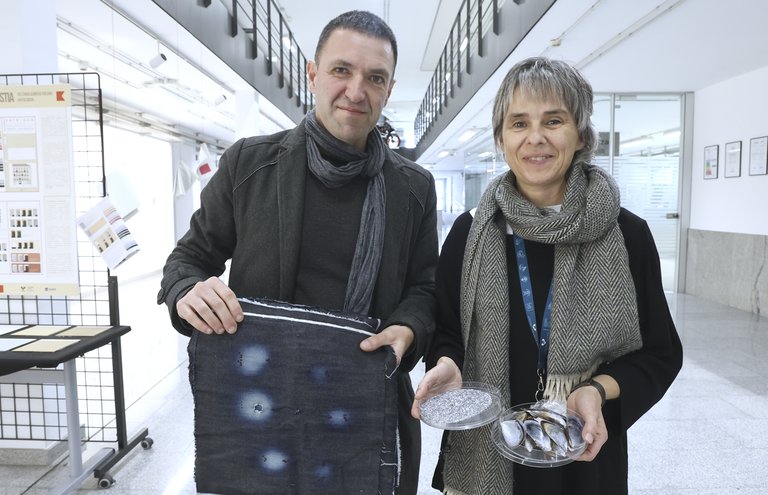
Researchers from the UPV/EHU have found that mussel shells are a suitable and sustainable material for the wear of jeans. It has been found that the sand obtained by crushing mussel shells has better abrasive properties than other materials used by the textile industry. In addition, it is more sustainable, since it transforms a waste into a raw material.
The conventional treatments used to obtain a worn appearance of the denim cloth have several drawbacks. Traditionally, cowboy fabric was eroded by throwing the silica sand at high pressure against the fabric. But the workers who used this technique, due to the use of inadequate safety measures and protections, developed silicosis. In this way, the technique based on the waste stream was discredited and abandoned by the textile industry. Instead, he began to use other methods. For example, oxidative chemical treatments or thermal laser treatments. In contrast, it has been found that these can be more toxic and do not achieve such good erosion results.
“They used the sand produced by grinding the shells to throw it under pressure against the cowboy, and they have seen that it gives very good results.”
Thus, a large textile company was looking for a sustainable technique. Considering that the sand blasting technique with adequate protection does not have to cause any disease to the operators, it was intended to review this technique, but using some more sustainable material, that is, more sustainable than the garnet (silicate mineral) that is usually used as abrasive. At the suggestion of the textile company itself, the Materials and Technologies research group of the UPV/EHU began to test mussel shells. Specifically, with shells that are rejected by the food industry. The sand produced by the grinding of the shells was used to throw it under pressure against the cowboy, just as it is done with the granate sand. And they have seen that it gives very good results, better than the garnet.
It is concluded that the remains of mussel shells have a lower fragility than the silicate mineral and, consequently, a better performance. To erode the same amount of jeans, less mussel remains are needed than the granate. In addition, it has been confirmed that the finish obtained by projecting the sand of the mussel shells is also of good quality, that is, it is able to create the colors that fashion designers and consumers love and leaves the fabrics soft, unlike other chemical treatments.
“It has less impact on the environment than traditional abrasives and chemicals.”
They have underlined the material’s sustainability. It has a lower environmental impact than traditional abrasives and chemicals. For example, garnet is not renewable and shells are. The first is a mineral that must be extracted from nature. The others, however, are a by-product. The consumption of mussels generates 1.5 million tons of shell waste per year worldwide, which is currently unused.
Although this study has found a specific application for the abrasion of denim cloth, the researchers believe that mussel shell sand may also be a suitable abrasive for many other applications and may be useful in other industries, such as cleaning mechanical parts or boats. It also does not require new equipment. Machines commonly used in sandblasting processes have been used.
Buletina
Bidali zure helbide elektronikoa eta jaso asteroko buletina zure sarrera-ontzian