 Bilatzailea


[Saliva analysis for disease prediction]
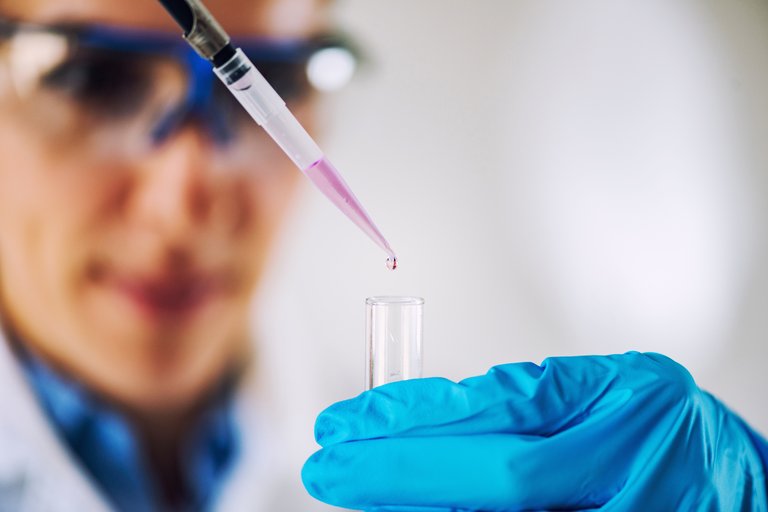
The body fluid commonly used to measure health parameters is blood. It is very useful to assess the functioning of organs, make diagnoses, measure the effectiveness of treatments or detect the risk of certain diseases. But it's not the only fluid available. Researchers at the UPV have used another fluid that is easier to access, cheaper and safer: saliva. And they have proven to be ideal for detecting and measuring the risk of various complex diseases such as cancers, cardiovascular pathologies, diabetes and Parkinson’s.
In recent years, the researcher Alba Hernangómez-Laderas has been working intensively on the project of prediction of the risk of complex diseases in saliva, which has been the subject of her doctoral thesis. Under the direction of José Ramón Bilbao Catala and Nora Fernández Jiménez, in the Department of Genetics, Physical Anthropology and Animal Physiology of the UPV/EHU, the result has been fruitful. In fact, the largest public database of genetic data derived from saliva has been developed and made available to any researcher through an open access platform.
It has been a great and innovative work, since previously there were not many genetic studies based on saliva. According to Hernángomez, it is common to use saliva in kinship tests, since it is proven that the results are as reliable as those obtained with blood.
But, in general, it has always been considered that saliva is not suitable for genetic studies. “In fact, saliva contains enzymes to aid digestion and protect against infections. And it was thought to degrade DNA as well. That is why there is a tendency to use blood. In fact, blood is the main fluid to make diagnoses when it is difficult or impossible to reach the affected tissue, for example, to detect celiac disease in the intestine or neurodegenerative diseases in the brain,” explains Hernández.
“The largest public database of genetic data derived from saliva has been developed and made available to any researcher.”
It confirms that blood tests are highly standardized and that there is strong evidence of markers of systemic diseases in the blood. In saliva, however, there were not so many studies and they did not know if they would find markers of systemic ailments. But it has some advantages over blood, so they decided to investigate.
Hernángómez cites examples of advantages: “Saliva is very easy to take, you don’t need a professional as it is needed in the blood. There are also people who have difficulties going to the doctor, or who are afraid of the needles, or are young children. In addition, you can take it much more often. In the case of blood, you should leave a gap between one occurrence and the next. For monitoring, it would be much easier to use saliva, as long as there are markers in saliva.”
Detect and monitor the risk
This has been the first objective: to see if in saliva it is possible to detect and monitor certain markers that warn of the risk and evolution of the development of diseases. The focus has been on complex diseases, that is, those that have a genetic basis, but are also influenced by the environment.
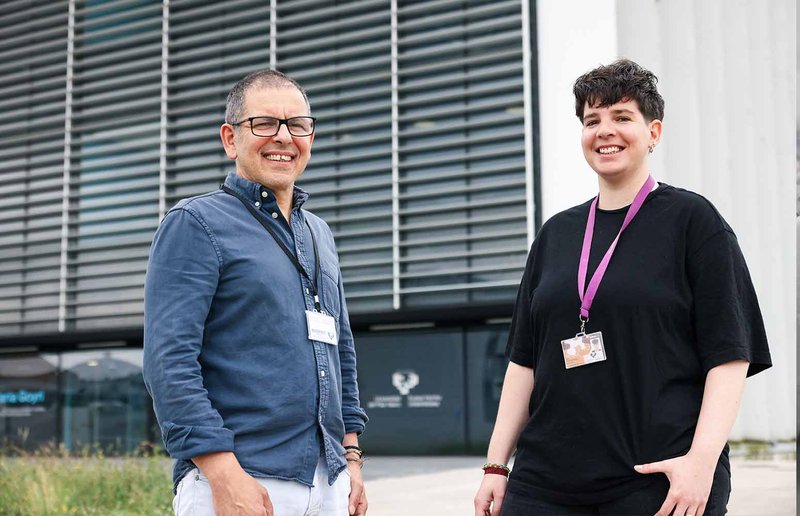
José Ramón Bilbao Catala and Alba Hernangómez-Laderas. Ed: Egoi Markaida/UPV
Bilbao explains: "In recent decades, great advances have been made in the field of genetics, and the genetic basis of many complex diseases is well known. Whether it’s hypertension, diabetes, or Alzheimer’s, we know there’s a genetic basis that puts you at risk of developing the condition. You cannot be sure whether you will develop the disease or not, but you are born with this risk. So our first question was whether it is almost possible to know if a person is in danger at birth. And, regardless of this risk, if it can be monitored in the future, to know if it is approaching the development of the disease or not. So the idea was to be able to follow up, based on genetics and using saliva as a sample.”
“Saliva is very easy to take, you don’t need a professional, and you can take it more often than blood.”
This would contribute, in part, to the adoption of preventive measures, adds Bilbao: "If we see that the risk is increasing, we may have some intervention or treatment to slow down the development of the disease. For example, in obesity or diabetes, we know that proper exercise and diet can delay the onset and development of the condition.”
Epigenetic changes
Once the objective was decided, the next step was to take saliva samples and analyze them. It has been determined that we recruited about 380 volunteers who took the sample themselves. Then, in the laboratory, the researchers extracted the saliva genome and catalogued epigenetic changes in the DNA that could affect its functioning.
“Epigenetic changes are changes in the structure of the genome due to the environment. They do not change the genetic code, but they have consequences on the functioning of genes,” explains Hernángomez. For example, a common change is methylation, the cornerstone of epigenetics. It consists of the addition of a methyl group in the DNA molecule, which can condition gene expression, RNA processing and protein function. This can lead to diseases or accelerate their development.
Bilbao explains the next step: “So we used a complex statistical method to see how each position in the genome is involved, on the one hand, with methylation and, on the other, with disease. This method compares the strength of the involvement, the directions, the frequencies... and indicates, for example, the risk of someone being diabetic through the methylation of a certain point. Or how methylation at another point increases the risk. So we’ve seen, point by point, the relationship between methylation and genetic risk.”
With all this data, they have created a catalogue of the relationship between genetics and methylation, making it available to the entire scientific community. “Everyone has access to the application we have created, so it will be enriched with new data. And through statistical and bioinformatic tools, it allows to analyze the relationships between genomes and methylations of many diseases. We, for example, have investigated the relationship between neurodegenerative diseases and have obtained very good results, even in cardiovascular diseases and cancers,” says Hernángomez.
“Methylation has been shown to be a suitable biomarker in a number of diseases and to be well maintained in saliva.”
Bilbao has specified that they have studied the different types of cancer, since they also wanted to see the influence of sex. Thus, breast and prostate cancer have been studied. “We didn’t want to investigate diseases that only occur in men or women, but we wanted to see if we found biomarkers. That is: instead of focusing on certain diseases, we wanted to show that it is possible to find markers through this tool.”
Available to everyone
And Bilbao reiterates that they have demonstrated: “We have seen that methylation is a good biomarker in several diseases and that it stays well in saliva. And the most important thing is that the catalogue we have published is public and, through the methodology we have used, it can be used in more diseases to have biomarkers for them as well.”
In fact, Hernández has stressed the importance of having the data available to everyone: “This fills me especially: that the work done is not only to present a doctoral thesis or publish an article, but also to make a public contribution. Thanks to this, it is not only useful for us, but for everyone, and a lot of knowledge can be generated from it.”
Finally, Bilbao claims the usefulness of saliva: “We believe that saliva holds a lot of secrets that are worth exploring. Perhaps someone will ask: and how can you know the risk that a person has for developing Parkinson’s or another brain disease by looking at saliva? Because our genome works in the same way in all parts of the body, so the signs will also appear in the genetic analysis of saliva. The same with other evils. That's what we've proven. Due to the ease of saliva, it can be very useful in the future. I am good.”
Buletina
Bidali zure helbide elektronikoa eta jaso asteroko buletina zure sarrera-ontzian