 Bilatzailea


Being competitive is good when it comes to being
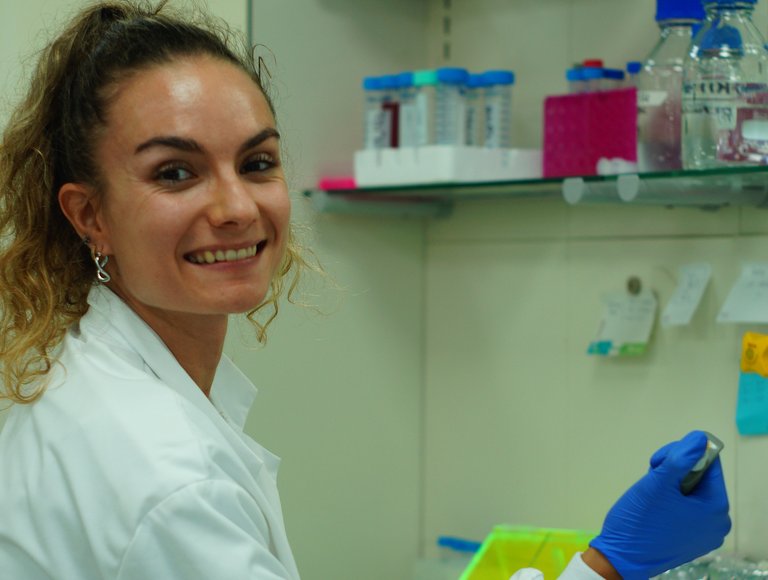
It is not easy to make an appointment with Irati Mitxelena Balerdi, who in addition to being in the last year of her thesis (in the Synthetic Biology laboratory of CIC Biogune) is an athlete. His specialty is the jump in length, which he practices at a high level. And yet, he has taken the time to tell us about his experiences.
So, remember how he got involved in the investigation: “When I was in the second year of high school, I learned about the neuroscience field and then I realized that’s what I wanted to do.” Due to the lack of opportunities to study neuroscience in the Basque Country and the good marks in athletics, he contacted several universities in the USA that had a degree in neuroscience. And he got a scholarship to study and train at the University of Cincinnati. “I’ve always said that thanks to athletics, I’ve been able to learn what I wanted,” he says.
He explains that in the United States there are better conditions than here to combine sports competition with studies, and that the possibilities are also greater, because here you can do both at the same time, train and study the degree in a few places. But that doesn’t mean that in the United States they give you everything: “They ask you to have good results. If you don’t beat them, they won’t let you compete, they’re tough on that.”
At the end of the degree, he returned to the Basque Country and completed his master’s degree in cognitive neuroscience. After that, I chose to do the doctorate, which is essential for research.
“There are a lot of mutations associated with ALE; the goal is to get a tool to correct them.”
Therefore, CIC is investigating in Biogune in Amyotrophic Lateral Sclerosis (ALS). “In our laboratory we work with synthetic proteins and I have taken it to my area and I am trying to give it an application. In my thesis, I am studying how to use genetic editing to correct mutations in ALE. In fact, AEA is a neurodegenerative disease. We don’t know very well what causes it or how it happens, but we do know that it has a very high genetic basis, that is, there are a lot of mutations associated with AEA. The goal is to get a tool to correct them.”
Like in sports and research
Believing that it is impossible to achieve excellence in two areas so different, it seems that one must be forced to choose one of the two. Mitxelena, however, remains rigorous in both, with the highest objectives. After all, Mitxelena says that both resemble each other in many ways: “In the end we have some very definite goals in my case. And to achieve these goals you have to work hard, and without knowing that you will achieve what you are looking for. In fact, they also have that in common: ignorance or uncertainty. Because many times you work hard, the goal is clear, but there is no guarantee that your effort will bear fruit.”
The way to act in the face of uncertainty is similar in both cases. “I often think they’re on par with not getting an experiment right, and not training and not achieving the goal in competition. And when these things happen, the answer is the same: to go back to work, to try again, to train again. Knowing that in some days you will get the result and in others you will not.”
“I like science, but not so much how it’s organized.”
In the short term, its objectives are clear. On the one hand, the fourth year of the thesis is being carried out and I would like to finish it this year. And on the other hand, it plans to prioritize athletics over the next two years, with a view to the Olympic Games in Los Angeles: “In fact, I know I don’t have much time left in the competition.”
However, he does not know if he will succeed, especially if he has to combine it with his work, since he also wants to continue in science. But he has also made a nuance: “I like science, but not much about how it’s organized,” he says.
Research side B
When asked why, he replies: “I think I’m very competitive. But I think that being competitive is fine when it comes to being, and in some sciences it is too competitive. In the end, it’s too strong what you publish, where you publish it, and I think other things are more important. In my case, for example, it is more important to help these people. But in the end, as the other is valued, the projects are also made different, and I’m not very much in favor of that.”
In addition, he condemns the need to go out of here to investigate. “There is no stability. We'll see what happens to the sport, but I'd like to stay here and investigate. I’m from San Sebastian, I’ve done my master’s degree here and now I’m doing my thesis, I’d like to use all that training here, but unfortunately it’s not easy. I like research, but with decent conditions.”
Irati Mitxelena Balerdi was born in San Sebastian in 1998. He studied a degree in neuroscience at the University of Cincinnati (USA) thanks to a sports scholarship. When he finished, he completed his Master’s Degree in Cognitive Neuroscience at the UPV, and now he is doing his thesis at CIC Biogune, researching genetic tools for amyotrophic lateral sclerosis. At the same time, it competes at the highest level in the jump of length.
Buletina
Bidali zure helbide elektronikoa eta jaso asteroko buletina zure sarrera-ontzian