 Bilatzailea


[Language use and mental control: beyond bilingualism]
As age progresses, mental attention and control do not age the same in all people. What determines this difference? Is it possible that the use of two languages in the day to day leaves some clue in the evolution of the abilities to face distractions and select the relevant information at each moment?
We have language. When we think, when we listen to the megaphone of the market or the train, when we read or when we look almost imperceptibly at a sign on the street, we are using the language. It is not an external tool, it is integrated into our mental activity.
In a study carried out at the University of the Basque Country (UPV/EHU) we have addressed a specific question: what is the relationship between the daily use of two languages and mental control processes, that is, does this use influence the ability to face distractions and select relevant information at all times? How does this relationship change with age? Research and Results Bilingualism: They have just been published in the journal Language and Cognition (Arantzeta, San Martín y Laka, 2026).
Research in psycholinguistics has shown that in the minds of bilingual speakers, languages are not activated alternately, as if one were switched off and the other were switched on. Words and structures in both languages are available at the same time. When we speak in Basque, Spanish is also active to some extent, and vice versa.
This means that, at every moment, in order to use a single language, the rest must be silenced. We call this ability interference control. It is not limited to language: it is a cognitive ability that we constantly use in our daily lives. When dealing with distractions by paying attention to the voice of an interlocutor or driving in a crowded room, the same mechanism is working. Dual language operation often requires the implementation of this control capability (see Bialystok et al., 2009; Bialystok, 2024).
Therefore, we asked the following question: Does the configuration of linguistic performance—how much and under what circumstances each language is used—relate to the performance of interference control?
How did we measure the use of language?
In response, about 250 people between 30 and 80 years old participated in the study: bilingual Basque and Spanish speakers and monolingual Spanish speakers. The data were collected in Vitoria-Gasteiz and Debagoiena, in two areas where different patterns of language use can be found.
In the case of bilinguals, the ability to express oneself effectively in Basque and Spanish was verified. The objective was not only to compare the label “bilingual or not”, but also to analyze to what extent and under what circumstances each language is used in bilingual people.
To this end, the Language and Social Background Questionnaire (Language and Social Background Questionnaire; Anderson et al., 2018) We used it, adapted to the context of Basque and Spanish. This questionnaire is widely used in the study of bilingualism and serves to collect linguistic use in a systematic and quantitative way. It is not limited to a single general question: “how much do you use the Basque language?”. Instead, it accurately reflects the daily use of language. It distinguishes, among others, domestic relations (with parents, couple, children), community and neighborhood relations, work or study situations, interactions in public services (health, administration) and daily activities (reading, messaging, social networks, audiovisuals).
This allows us to accurately capture the situation and the network of relationships in which each language is used. In addition, the use is not measured categorically as “yes/no”: the level of use of each language is indicated gradually, and the answers are converted into numerical values. This allows you to analyze the linguistic practice in a staggered way in a graduation.
How do we measure interference control?
To measure interference control, we used the Stroop task, a test considered a classic in cognitive sciences (Golden, 2010; see figure 1). Participants had to read or name the items presented to them in a list as quickly and accurately as possible.
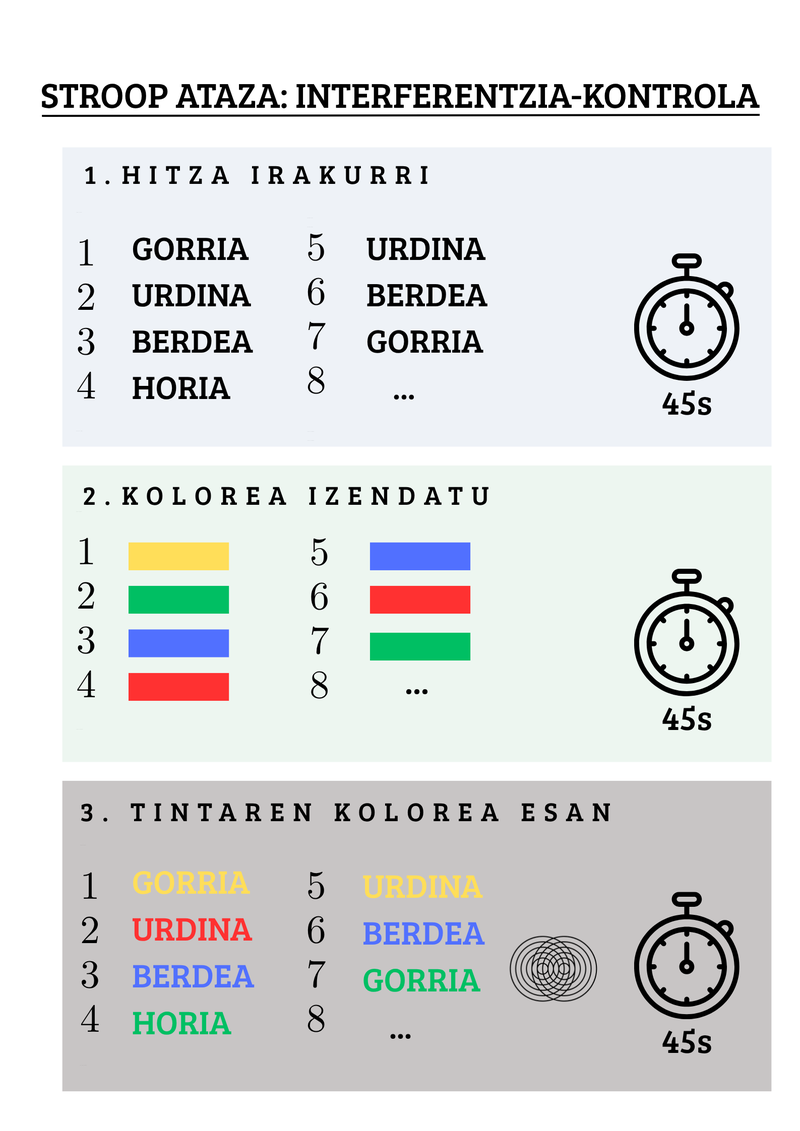
1.irudia General structure of the three conditions of the Stroop task and the logic of interference. Participants process the maximum number of items per column in 45 seconds, and the performance achieved under each condition is counted. Image: Ione Ibarretxe
In the first part, the color names were printed in black and all they had to do was read the words. In the second, simple symbols of color appeared, and they had to name their color. These two parts serve to measure the basic reading speed and the ability to name colors.
In the last part is the direct measurement of interference. The color names are printed in different ink colors, and participants should say the color of the ink instead of reading the word. Since reading is automatic, the tendency to read is activated as soon as you see the word. Stopping this trend is at the heart of the control process. Interference control was calculated using reaction times and the number of correct responses.
Results
Our results leave two main conclusions. First, as age increases, the performance of interference control decreases, and a higher level of education is associated with better performance. Both trends coincide with the models described by previous studies: with aging control processes tend to weaken and education offers a kind of protective factor (see Figure 2).
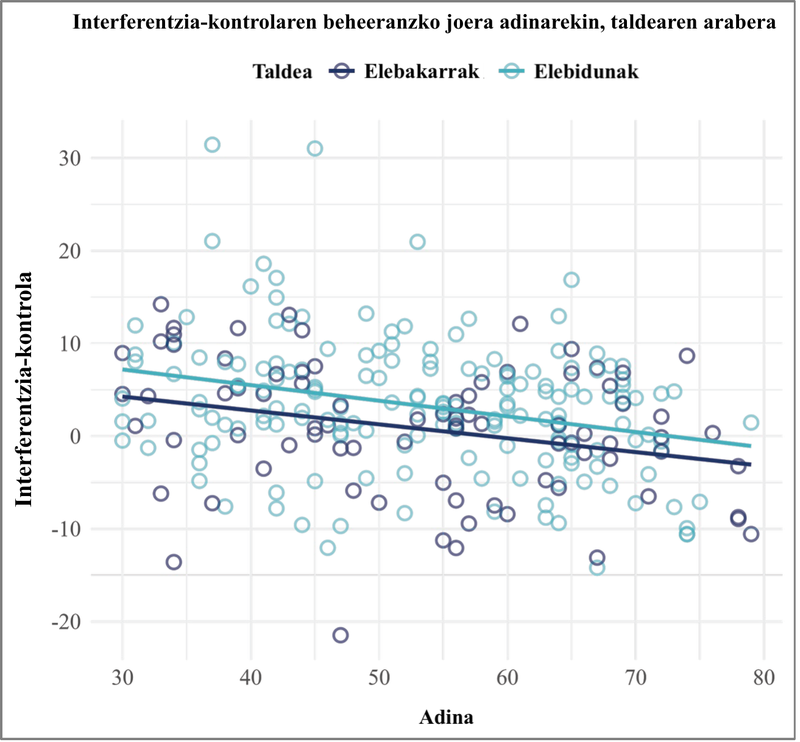
figure 2. [Evolution of interference control by age in groups]. There is a downward trend with age and no significant differences are observed between bilinguals and monolinguals at the group level. Image: Miren Arantzeta Perez
The second conclusion is our main contribution. At the group level, no significant differences were found between bilinguals and monolinguals. That is, being bilingual does not in itself guarantee better interference control.
However, there were clear differences between the bilinguals. The performance of bilinguals with a lower use of the Basque language was similar to that of monolinguals. On the other hand, among the bilinguals with a greater use of Basque, a strong relationship with interference control appeared (see figure 3).
In addition, this association does not appear at a certain threshold. There is no specific limitation that shows the beginning of the effect. The data show a progressive trend: as the social use of the Basque language increases, the performance of interference control gradually increases.
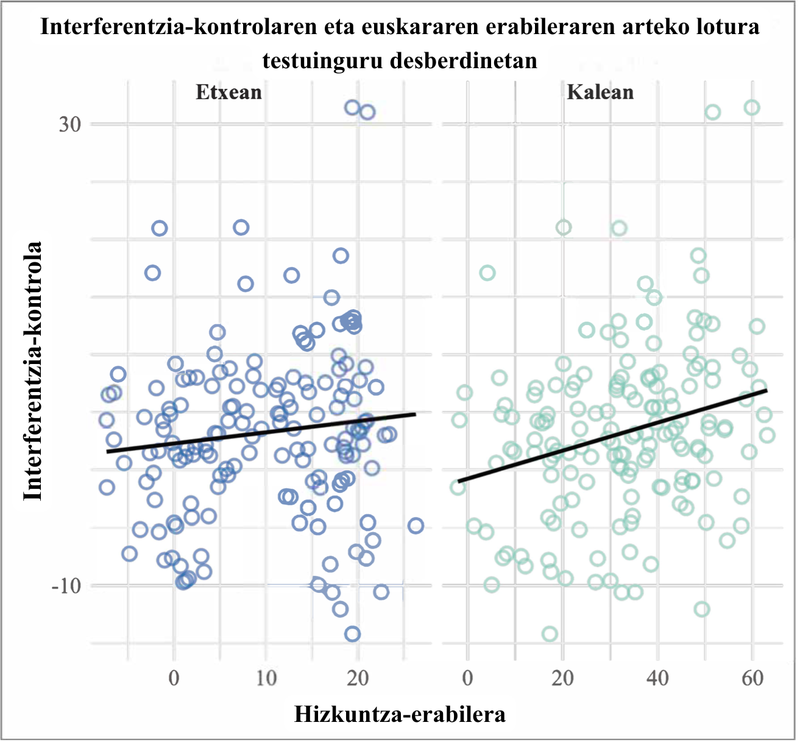
figure 3. The relationship between interference control and the use of the Basque language is clearer in urban use than in domestic use: as the social use of the Basque language increases, the performance of interference control is better. Image: Miren Arantzeta Perez
Conclusions
These results are framed in the debate on bilingualism and cognitive control. Some work has linked bilingualism to a later onset of cognitive impairment (e.g., Craik, Bialystok, & Freedman, 2010; Woumans et al., 2010; Woumans et al., 2010; Woumans et al., 2010; Woumans 2015), But the results have not always been consistent across all populations.
Our work refines this discussion. More than the number of languages that are known, what is decisive is the configuration of the activity that is carried out with them. In particular, in the case of bilingual speakers, social or street use of Basque is associated with greater interference control throughout the life cycle.
These results are consistent with experimental studies on language change. Mosca and Clahsen (2016) show that the very uncertainty of whether to change the language increases the cognitive cost. In other words, it is not only the cost of the situation that requires the passage from one language to another, but also the process of deciding whether a change is necessary activates control mechanisms.
Our research shows that a greater social use of the Basque language is associated with better interference control. In the context of the Basque Country, this greater use of the street often means that the speaker must constantly evaluate what language he uses according to his interlocutor and his situation. The frequent occurrence of these situations of uncertainty leads to a more frequent mobilization of control processes, which may explain the relationship we have found.
These control mechanisms are essential for daily autonomy. With aging, interference control weakens, and this weakening has a direct impact on daily functioning, decision-making, and the ability to cope with distractions.
These results are not the last word. They do not demonstrate that active bilingualism prevents dementia. But they show that the configuration of the daily linguistic experience is directly related to the capacities of attention and control, which are the basis of the processes that support autonomy and quality of life as we age.
Knowing a language is not just knowing the vocabulary and grammar in which they are stored, it is an activity that we carry out. The structure of this activity—how and under what circumstances languages are used—affects the functioning of our mental control.
Acknowledgements:
Our sincere thanks to all the people who have participated in the study for their time, availability and trust. We would also like to thank the City Council of Arrasate and the Euskaltegi Municipal de Arrasate for their collaboration in attracting participants and offering them space to carry out the exam.
Financing:
This work has been carried out with the support of the AGINGLEXICON project (Leonardo grant from the BBVA Foundation), the PID2022-142625OA-I00 project (MICIU/AEI), the support of Ramón y Cajal RYC2021-033222-I and the research group IT1439-22/IT1439-26 of the Basque Government.
References:
Anderson, J. A. A. D., Mak, L., Keyvani Chahi, A. and Bialystok, E. 2018. “The language and social background questionnaire: Assessing degree of bilingualism in a diverse population”. Behavior Research Methods 50, 250–263.
Arantzeta, M., St. Martin, I and Laka, I. 2026. Types of language use and interference control in aging bilinguals Insights from the Word–Color Stroop Task”. Bilingualism: Language and Cognition, 1–13
Bialystok, E. 2024. “Bilingualism modifies cognition through adaptation, not transfer”. Trends in Cognitive Sciences 28, 987-997.
Bialystok, E., Craik, F. I. M., Green, D. W. and Gollan, T. H. Oh, yeah. 2009. “Bilingual minds”. Psychological Science in the Public Interest 10, 89–129.
Craik, F. I. M., Bialystok, E. and Freedman, M. 2010. "Delaying the onset of Alzheimer's disease: Bilingualism as a form of cognitive reserve”. Neurology 75, 1726–1729.
Golden, C. J. J. 2010. Color-Word Test – Stroop (9. ED. ; B. B. Ruiz-Fernández, T. Luque and F. Sánchez-Sánchez, Spanish adaptation). TEA Ediciones, Madrid.
Mosca, M. and Clahsen, H. 2016. “Examining language switching in bilinguals: The role of preparation time. Bilingualism: Language and Cognition 19, 415–424
Woumans, E., Santens, P Sieben, A., Versijpt, J., Stevens, M. and Duyck, W. 2015. “Bilingualism delays clinical manifestation of Alzheimer’s disease.” Bilingualism: Language and Cognition 18, 568–574.
Buletina
Bidali zure helbide elektronikoa eta jaso asteroko buletina zure sarrera-ontzian