 Bilatzailea


The evolution of the human brain in a binary way makes quantum physics a philosophical puzzle
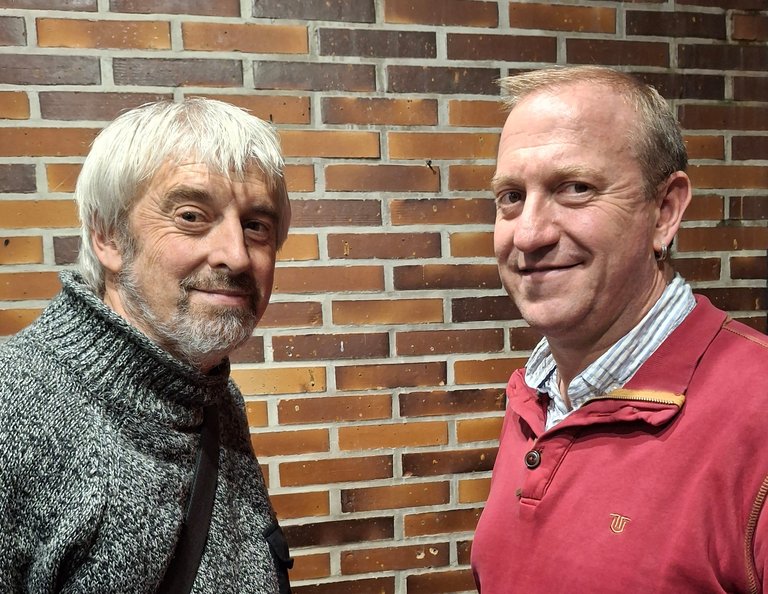
Our understanding collapses with some of the concepts that physics poses to us, including quantum physics. Matter behaves strangely and incomprehensibly when it reaches extremely small sizes. Physicists and chemists have had a hard time understanding what is happening on these small scales, and even more difficult to explain to others. Scientist Jon Mattin Matxain and disseminator Guillermo Roa reflect on the philosophical problems it generates.
Guillermo Roa We say that subatomic particles have a very rare behavior. In science we have reached very small sizes, and on these scales the matter follows other laws. As long as we don’t discover anything else, at least we call this way of functioning quantum.
Jon Mattin Matxain: That's right. The theory of quantum physics or the theory of quantum mechanics describes the small world: the world of elementary particles, atoms, electrons, protons, neutrons, light. Everything that happens on a small scale depends on the quantum, whether it is technology, electronics, or even biology and medicine. All atoms are made up of particles, governed by quantum mechanics.
We were both delighted to have declared last year the International Year of Quantum.
There are historical reasons. Quantum has revolutionized technology, it has revolutionized science, it has revolutionized knowledge. Today’s society has nothing to do with the society of 100 years ago, and that is largely thanks to quantum. So celebrating that seems very important to me.
It has been said that the greatest philosophical changes that have taken place in the twentieth century have been brought about by science and, above all, by quantum mechanics. We have created a way of life around the technology brought by quantum and, even philosophically, it has forced the way we see our world.
It was initially a great philosophical puzzle for many scientists who contributed to the development of quantum. The key was in interpretation. Accounts of probability. Scientists don't like chance. Einstein said “God doesn’t play dice” because he didn’t like probability and chance at all. And in quantum, chance intervenes.
Even if a particle has a 99% chance of doing something, it's not 100%. Perhaps the other 1%, although scarce, when it occurs, causes great changes and has a significant impact on our reality.
If I am wrong that I am corrected by neurobiologists, I think that the human brain has evolved in a binary way: YES or NO. In technology, 1 or 0. Black or white. But the reality is not so. Therefore, what scientists find in reality is for us a great philosophical puzzle.
“Humans are accustomed to certain temperatures, sizes and velocities, and quantum makes us unintuitive.”
in 2025, as the International Year of Quantum, we had to try to get rid of the big names of quantum and spread the ideas behind them. Bring out that awful beauty that's in there.
It is true that scientists should make a greater effort to explain the phenomena that appear in our daily lives. Show that there is quantum at the base and explain that there is no exoteric concept of it. Sometimes it seems exoteric, surprising, because we don’t see it with the naked eye. But it's not surprising, because it really happens.
In this mystery lies its charm, which is, to a large extent, the beauty that we must reveal. But normally, scientists get involved in our work and do not take the time to explain this beautiful phenomenology that exists in everyday life. In technical terms, I mean.
I, when our children were young, described to them that the wave/particle duality of elementary particles is both wave and particle, and, hey, they understood it very well. It was nothing unusual for them.
Beyond the technical words, intuition puts us in difficulties. In many cases, in the world of particles, what intuition makes us believe does not happen. You have to study phenomena in quantum with a very open mind, right?
That's it. We are used to living on the planet Earth, at a certain temperature, we understand a certain size of things, we only see events of a certain speed. We do not even see what is very large, or very small, or very fast, or very slow. It escapes us from our sight and therefore from our understanding. We're used to our scale of life, and when we get out of it, we're lost.
We know what a minute is, but we don't know what 4,000,000,000 years are. Or what it is to divide a second into 1,000,000,000 parts. And the molecules vibrate in these small sizes. Time on these small scales. It is unimaginable for our intuition.
There's another thing, I don't know if you'll join me. In the ikastola we learned about atoms in a rather simplistic way, and we accept it so far. But when we go into what happens in the nucleus of the atom, we have to use the word “nuclear”, and that is where the comedies begin.
No doubt about it. In fact, the word nuclear refers to anything about the atomic nucleus. The laws of quantum explain why some nuclei are stable and others break with the release of nuclear energy. And that's radioactivity.
In addition to the fission of the nuclei, we also need quantum to understand fusion. Quantum explains everything that has to do with the nucleus.
We always associate nuclear with fusion and fission, with radioactivity. In hospitals, we also work with other properties of atomic nuclei, spines. Magnetic resonance has saved many lives. It is also a nuclear property.
“Human evolution is due to radioactivity.”
In chemistry we often use a technique to identify molecules: nuclear magnetic resonance. When the same technique is used in hospitals, we must call it magnetic resonance. we must remove “nuclear” because it has words with very negative social connotations. Since World War II, nuclear has had negative connotations and, consequently, physics.
Besides, you can say that you're radioactive, Txoni. You have a lot of radicular carbon, the 14C's yourself. 14C is the unstable form of carbon atoms that emits radiation. 14C isn't just in fossils. In our body, in our liver, in our muscles, we have it anywhere.
That's it, and it doesn't end there. We humans are radioactive and we eat radioactive things. How did our 14C get into our body? In the food, of course. But not only 14C, bananas have radioactive potassium.
Moreover, human evolution has occurred thanks to radioactivity. Not only because of radioactivity, of course, but also because of radioactivity. If the Earth is this internal temperature of the planet, it is due to the disintegration of radio atoms. The energy released here raises the temperature. We evolved here because the planet has had a certain energy and temperature, and some of the energy comes from radioactivity. So watch out for the curse of radioactivity.
Quantum has the other dark side. Not dark ethically, but because dark is hard. We should take away that fame of being incomprehensible.
Yes, and although it may be contradictory, it is the very fact of being mysterious that has given it scientific value, prestige. See how alternative medicine has been used in its speeches. The prestige is undeniable, otherwise it would not be used to sell miraculous products. “It has quantum water and that cures it.”
How can we manage this? If you explain it simply, it loses its mystery and, therefore, its prestige. How to balance it?
Christianity had a similar journey. In the beginning, everything was done in Latin. They continued to speak in their own language, so that they did not really share this knowledge. The first thing Luther did to separate himself from the Catholics was to translate the Bible into all languages for all to read. This has happened many times in history. Perhaps we have fallen into the same error with the quantum.
That’s where scientists have the biggest conflict: the balance between the accuracy of concepts and the fact that they actually reach people. How can you achieve both things without lying? Scientists are still very unbalanced in terms of rigor.
Reminded me of a very good old blog: Tamiz.com I like his motto: “Better simplistic than incomprehensible. Please forgive the scientists.” Let's see if we can get that in quantum.
Buletina
Bidali zure helbide elektronikoa eta jaso asteroko buletina zure sarrera-ontzian