 Bilatzailea


Enrike Zuazua receives the Euskadi Research Award
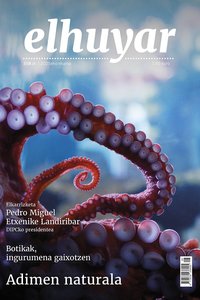
To us, the Euskadi Research Prize has given us the excuse to speak with Zuazo. The interview will be published in the magazine Elhuyar Zientzia eta Teknika of April, and if you prefer to listen to it on radio, Norteko Ferrokarrilla offers you the possibility to do it.
You work in Applied Mathematics. Indeed, although we often do not realize, Mathematics has many applications in everyday life, right?
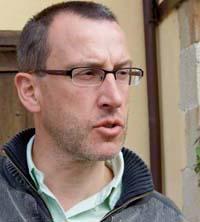
Enrike Zuazua was born in 1961 in Eibar (Gipuzkoa).
(Photo: Nagore Rementeria)
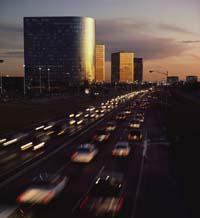
Yes, it is. For example, traffic. The car has become a must-have for our daily life, but at the same time traffic causes us many problems. What is not scientific training, perhaps he does not realize that mathematics serves to analyze traffic. But mathematicians see reality differently. Each car is a particle that is moving and is also in interaction with other particles (if the previous one slows down, the rear should also slow down). In addition, environmental conditions change and these also affect the whole, for example, time directly influences.
So, if a scientist starts to create a model for it, he will use the tools of mathematics and it will be something like the movement of the planets or the movement of fluids.
In fact, abstract mathematical models are used to analyze them, which are the most suitable to explain this reality. and, to a large extent, differential or partial derivative equations.
However, analyzing traffic is not as simple as explaining a fluid, since inside cars people go and they choose how and where to drive.
What is very difficult to explain mathematically the behaviors of people?
It is not easy. And that is, in my opinion, one of the great challenges of mathematicians of this century, to enter the social sciences. And it is that there is an implicit difficulty in human behavior, and taking into account the models we have made so far for deterministic situations, it is about how to adapt them to human behaviors. There is the question.
That is therefore one of the challenges. In your opinion, in addition to that path, where will mathematics evolve?
I think the main trend will be hybridization between math areas. Of course, new areas will be created, but we cannot know what they will be. But it is certain that classical fields (number theory, geometry...) will become more applied and applied mathematics will absorb classical theories and models. Because in the application we have to solve increasingly complex systems, and for this we need each and every instrument of mathematics.
In addition, the world of computing and computing will have more and more influence on mathematics. The operating machines that until now were in man's hands will make science and mathematics change unintentionally.
Buletina
Bidali zure helbide elektronikoa eta jaso asteroko buletina zure sarrera-ontzian