 Bilatzailea


Museum of Medical and Scientific History of the UPV/EHU: Research Center
The Basque Museum of the History of Medicine and Science, founded in 1982, is located on the Bizkaia campus of the University of the Basque Country (Leioa). Unlike many other museums, its main function is teaching, learning and research. This article summarizes some of the characteristics and advantages of the current location of the Basque Museum of the UPV/EHU halfway between the museums of objects and those of ideas.
Museums are a communication space of our time. In reality, the museum world cannot be isolated from current languages and resources[1]. In fact, instead of merely “collecting, conserving, classifying and exhibiting objects”[2], most museums in the Basque Country, whether historical, artistic, ethnographic, industrial or scientific, establish a process of communication between the object and the visitor. They do so in a variety of languages, from the traditional visual language of object museums (e.g. industrial museums and art museums) to the most modern interactive and virtual languages of idea museums (interpretation centres and science museums). The former allow the visitor to initiate a perceptive-contemplative relationship, while the latter seek a communicative and participatory relationship.
However, what is evident in public and private museums of art or science and technology is also evident in university museums, but there are some important differences. The truth is that the Basque Museum combines training and academic research in a very rich way. Unlike museums of objects and museums of ideas, which give priority to dissemination, heritage conservation or cultural entertainment, the Basque Museum focuses on the transmission of knowledge within an academic framework and the generation of new knowledge. In fact, it offers the visitor and specialists a set of resources, collections and ideas that make up a unitary space that brings together museum and research functions.
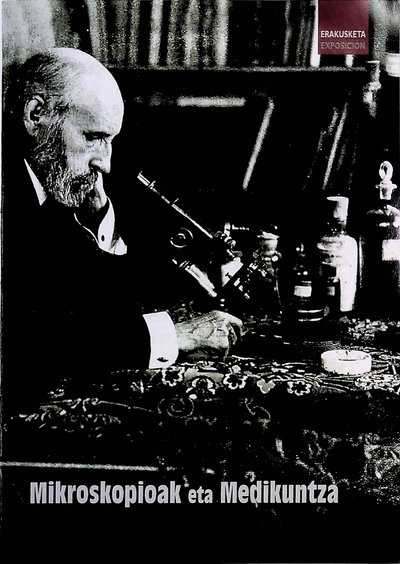
Panel to announce the temporary exhibition “Microscopes and Medicine” organized by the Basque Museum of History of Medicine and Science in 2025.
The Museum and the University have been linked since the beginning. If we are what we learn, we see our training in university museums. It is here that we see how we—as individuals, as cultures, as peoples and as societies—have prepared ourselves through teaching, learning and research. In Europe, the collections, whether physical, astronomical, natural sciences or medicine, are the embryos of the museums of the oldest medieval and Renaissance universities (Bologna, Paris and Oxford, for example) and have their integrity and foundation in the moral, progressive and rational spirit of the Enlightenment. They are reason, systematic observation and experimentation; progress and evolution are messages; and museums are the way to learn. The Physics Cabinet, the Botanical Garden and the Anatomy Amphitheater embody practical teaching.
In the 20th century, both in Europe and in the Basque Country, "second generation" university museums were created with historical collections, also for teaching and research purposes[3]. Marta C. According to Lourenço, the university is a “natural generator” of unparalleled heritage that has been creating museums in several stages, from scholarly Renaissance collections to the scientific cabinets of the Enlightenment, and from there to the history museums and laboratory museums of the 20th century[4]. Dedicated to the history of science, the Basque Museum belongs to this last group. In this museum, samples of innovation and creativity and traditional practices can be considered as interconnected narratives, all of which invite us to read between catalogs, panels and lines of labels. And in doing so, we learn not only about the history of the objects exhibited in the museum, but also about the history of our society and its institutions.
These considerations lead us to take a closer look at the Register of Museums of the Basque Country, published by Eusko Ikaskuntza in 1987. Eusko Ikaskuntza described these museums as "stable collections of separate objects", institutions that "reflected the historical evolution of the country that created and gave life". Eusko Ikaskuntza listed 39 museums, seven of which had a laboratory and research section. These included archaeological, oceanographic and ethnographic museums, as well as one on medical and scientific history (Basque Museum of the UPV/EHU). In the opinion of Eusko Ikaskuntza, these "stable collections" were "part of our heritage", although in many cases it was not well structured or sufficiently visible[5]. Perhaps because of the limitations of the time, or even despite them, their main task was to preserve the cultural heritage, that is, to preserve, protect and show the testimonies of the history of industrialization, craftsmanship and traditional customs.
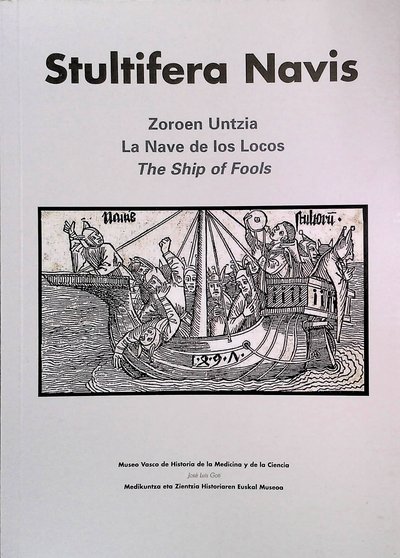
“Stultifera Navis. Catalogue of the exhibition “The ship of madmen”, Basque Museum of Medical and Scientific History, 2006.
Although the assessment made by Eusko Ikaskuntza almost forty years ago was correct, today it is necessary to review this basis, at least as far as the Basque Museum is concerned. In the first stage, under the direction of Dr. José Luis Goti (1982-1998), the studies focused on the origins of science in the Basque Country, but in the next stage, under the direction of his successor Anton Erkoreka, the Museum has expanded and gained national and international notoriety. On the one hand, the rooms of the Museum have since hosted numerous temporary exhibitions on different topics, from microscopes and medical hydrology to electrotherapy, tuberculosis and psychiatry (Stultifera Navis), stylizing new forms of exhibition and dissemination (the catalogues of all of them and the contents of the rooms are available on the website of the Museum). On the other hand, the spread of increasingly unstoppable globalizing beliefs and trends can be compared with local heritage and knowledge.
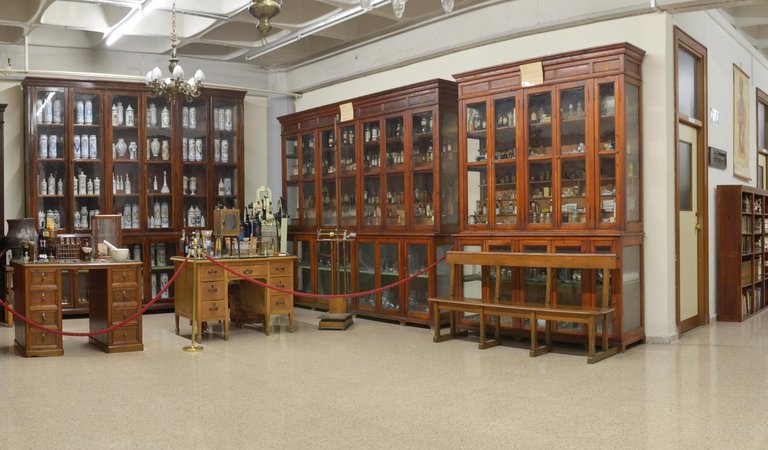
In this way, visitors prioritize the local experience, testimony and practices. This is evident in the exhibitions of popular medicine and the old pharmacy of the Basurto hospital, where more than a thousand bottles of natural and chemical products have been exhibited, as well as in the more than 6,000 objects exhibited in the 24 rooms of the Museum. Finally, the Museum’s library, which contains more than 12,000 books, allows researchers to consult works on the history of medicine, medical specialties and general and local issues. The historical archive of medical and university teaching funds[6] is also available for consultation.
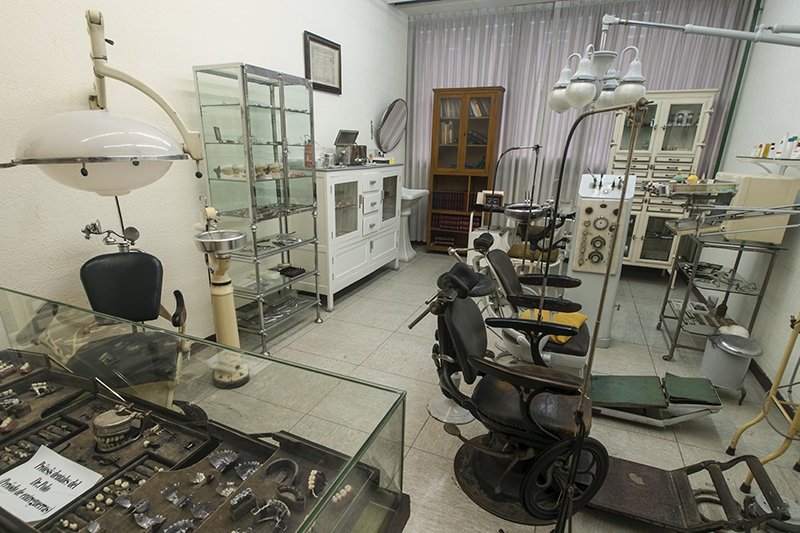
Dentistry Room of the Basque Museum of Medical and Scientific History.
As Michael Foucault said, museums are heterotopias, that is, spaces that combine different places (scientific, popular, artistic) in one and the same space[7]. They are a disruptive experience in front of the everyday space. The Basque Museum is a Foucauldian museum: it houses the sections of history, science and popular knowledge in one place. Therefore, it is a space of compensation. Today, however, the academic function of the museum is being questioned in some way due to the success of the "science centers", which are based on the museology of the idea. This is the case of the Eureka Science Museum, based in Miramón (San Sebastián). Unlike university museums, these centres offer visitors three aspects: culture, education and leisure; and they use interactive devices as a communication strategy. The visitor actively participates through explorations, experiments and technical manipulations. Interactivity is a key museum concept: the visitor experiences and discovers the scientific fact directly and in a playful way[1]. Instead, the Basque Museum opts for a different strategy and narrative. It prioritizes the promotion of research and the generation of knowledge. The visitor is not allowed to manipulate or touch objects; scientific curiosity is aroused not through interactivity and recreational experiences, but through exploration and reflection. It looks at objects, analyzes the implicit relationships between them and questions the contexts of creation and meaning. Different forms of action: the reflexive analysis of science and the generation of local and global knowledge within an academic framework.
As in many other academic institutions, aspirations are more ambitious than achievements in museums. However, the achievements of the Basque Museum of the UPV/EHU are not insignificant and are at the height of their aspirations. In fact, there are numerous articles published in high-impact national and international journals, as well as works published in prestigious publishers such as Oxford University Press and Routledge[8]. Although at first the monographs of the Museum were dedicated to medical museology and the history of diseases such as tuberculosis and plague, later, by the hand of Anton Erkoreka, they addressed the history of pandemics and especially the Spanish flu, as well as the analysis of parallels with COVID-19. Other lines of research in the museum have been the history of meteorology and geophysics and the relationships between physics and industry, with special attention to the impact of commercial interests on scientific concepts and theories. The historical relationships between Jesuits and science have also been analyzed from the point of view of knowledge networks. All this has undoubtedly contributed to the fact that, since 2009, the Basque Museum has been an accredited Scientific-Technological Agent and is integrated into the Basque Network of Science, Technology and Innovation[6].
In short, the Basque Museum has a great future ahead of it. It is no longer a mere collection of scattered objects, as it was in the 1980s, and it does not focus exclusively on the beginnings of science in the Basque Country; the current Basque Museum is a space for research and debate, of variable representation and meaning. In the Basque Museum, new knowledge is created that combines local and global knowledge. In other museums in the Basque Country, the distinction between object museums and idea museums is clear. But the Basque Museum of the UPV, located halfway between the Museum of Objects and the Museum of Ideas, is a great potential space for teaching, learning and research. Is it reckless to think that the Basque Museum can move forward from where the university comes?
Museum website: https://www.ehu.eus/eu/web/basque-museum-medicine/home
Bibliography
[1] Hernández F. 1998. The museum as a communication space. Gijón: Trea Editions.
[2] Silverstone R. 1992. ‘The Medium is the Museum: On Objects and Logics in Times and Spaces’. J. J. Durant, ed. Museums and the Public Understanding of Science. London: Science Museum, 34-44, p.34
[3] García Fernández I. M. 2018. “University museums in Europe. Challenges and initiatives”. Notebooks of Art of the University of Granada, 49: 11-32.
[4] Lourenço M. C. 2015. “University Collections, Museums and Heritage in Europe: Notes on Significance and Contemporary Role. In: García Fernández, I., Rivera Rivera, R.D. (Eds.) International Congress University Museums: Tradition and Future. Madrid: Complutense University, 59-66.
[5] C. Kortadi (Coor. ). 1987. Censo de museums of the Basque Country. San Sebastian: Eusko Ikaskuntza, p. 13.
[6] Erkoreka A. and Hernando Pérez J. (2021). “Basque Museum of History of Medicine and Science”. JONNPR, 6(12):1476-85. DOI: 10.19230/jonnpr.4180
[7] Foucault M. 1986. ‘Of Other Spaces’. Diacritics, 16(1):22-27.
[8] Anduaga A. 2016. Geophysics, Realism and Industry. How Commercial Interests Shaped Geophysical Conceptions, 1900-1960. Oxford: Oxford University Press.
Buletina
Bidali zure helbide elektronikoa eta jaso asteroko buletina zure sarrera-ontzian